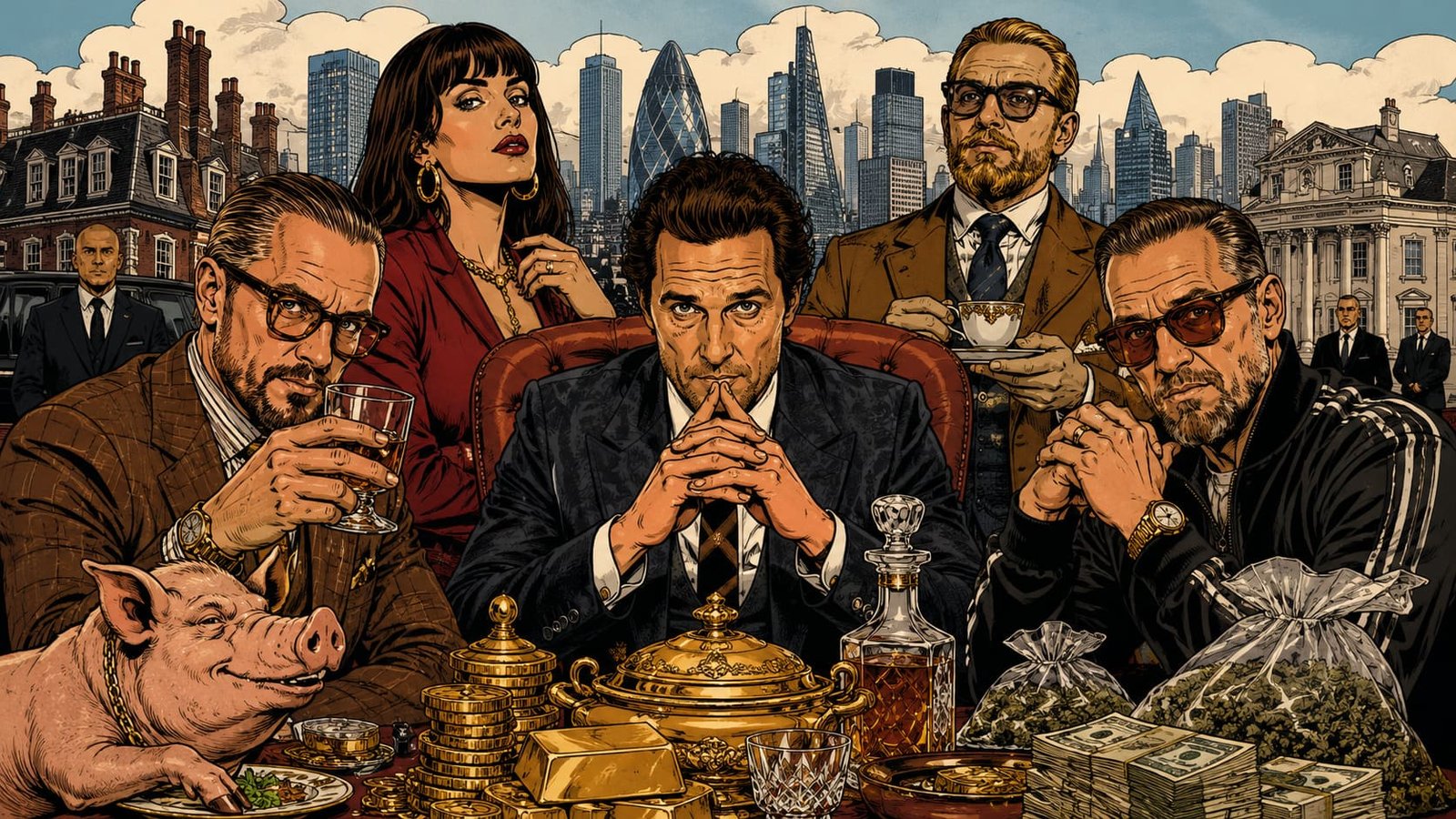
Rain crawled down London windows like nervous sweat while aristocrats, gangsters, and businessmen traded threats with the politeness of dinner guests discussing wine pairings. Tailored coats brushed against nightclub smoke. Expensive whiskey caught amber light inside private rooms where violence sounded almost elegant. The Gentlemen moves through this world with the swagger of a crime comedy and the instincts of a social autopsy. Guy Ritchie builds a universe where organized crime and elite business culture become nearly indistinguishable from one another. The film understands something modern institutions rarely admit openly: power often differs from criminality only through branding, paperwork, and public relations strategy.
Matthew McConaughey’s Mickey Pearson embodies the fantasy of the self-made empire builder refined into mythic form. He is disciplined, strategic, and emotionally controlled in ways modern business culture endlessly romanticizes. Yet beneath the polished intelligence sits predatory calculation. Pearson treats human relationships like supply-chain logistics. Loyalty becomes transactional. Morality becomes flexible. The unsettling part is how familiar that mindset feels inside legitimate industries. A luxury real-estate magnate named Vincent Hale once told junior executives during a private retreat that “ethics matter until market conditions change.” The statement reportedly landed beside crystal glasses and untouched oysters while several employees laughed nervously, unsure whether it qualified as wisdom or warning. The Gentlemen thrives inside that ambiguity. The movie keeps exposing how elite systems reward ruthlessness when wrapped inside sophistication.
Guy Ritchie’s dialogue snaps with the rhythm of men performing intelligence for survival. Every conversation feels like a negotiation disguised as entertainment. Information itself becomes currency. Reputation becomes armor. The film understands that modern influence often depends less on truth than on narrative control. A communications strategist named Helena Moretti once managed crisis messaging for a multinational corporation after leaked documents exposed exploitative labor conditions overseas. Internal executives reportedly spent more time discussing headline phrasing than employee welfare. “Perception stabilizes markets,” one senior advisor allegedly remarked while adjusting his cufflinks beneath fluorescent boardroom lighting. That emotional ecosystem pulses through The Gentlemen. Crime organizations and corporations alike survive through storytelling architecture.
Hugh Grant’s Fletcher deserves special attention because he weaponizes gossip with almost philosophical precision. He behaves less like a journalist and more like a black-market data broker monetizing human weakness. In many ways he represents the logical endpoint of modern media culture where scandal becomes entertainment infrastructure. Attention economies reward emotional manipulation relentlessly. Outrage drives engagement. Exposure becomes leverage. A tabloid editor named Marcus Doyle once described celebrity reporting as “emotional stock trading for bored populations.” The phrase sounds cynical because it is accurate. The Gentlemen understands that information itself has become criminally valuable in contemporary society, particularly when truth and performance blur together beneath digital spectacle.
The marijuana empire at the center of the story functions symbolically beyond simple criminal enterprise. Pearson builds his operation beneath aristocratic estates owned by financially desperate elites. That arrangement exposes a fascinating truth about class systems. Old money often survives by quietly partnering with forces it publicly condemns. Respectability becomes aesthetic theater. Wealth protects itself through adaptation rather than virtue. A venture capitalist named Rowan Pierce once invested heavily in controversial surveillance technologies while publicly sponsoring ethics conferences focused on responsible innovation. Nobody inside elite circles seemed disturbed by the contradiction because prestige itself insulated scrutiny. The Gentlemen repeatedly suggests that power structures maintain stability through selective hypocrisy.
The film’s humor matters because it softens the brutality just enough to make the audience complicit. Viewers laugh while watching manipulation, extortion, and violence unfold with stylish confidence. That emotional seduction mirrors real-world leadership culture more than many would comfortably admit. Entire industries glamorize aggressive personalities so long as revenue numbers remain impressive. A mergers-and-acquisitions attorney named Clara Vane once described closing negotiations where executives celebrated layoffs with champagne because “streamlining creates shareholder confidence.” The absurdity barely registered inside the room because corporate language had already anesthetized the human cost. The Gentlemen constantly blurs the line between gangster mentality and executive strategy until the distinction starts feeling cosmetic.
Visually, Guy Ritchie drenches the film in masculine ritual and class symbolism. Pub interiors glow with old-world arrogance. Tailoring becomes psychological warfare. Luxury vehicles glide through rainy streets like mobile thrones. Yet beneath the stylish surfaces sits insecurity. Every major character fears irrelevance more than death itself. That anxiety feels deeply modern. Hypercompetitive societies train people to view status as emotional survival. A hedge-fund founder named Julian Kessler once admitted after losing a major acquisition battle that the humiliation bothered him more than the financial loss. “Money recovers faster than identity,” he reportedly told a colleague while smoking alone outside a private club. That sentence could summarize the emotional engine driving The Gentlemen entirely.
Near the film’s core lies a dangerous observation about civilization itself. Systems calling themselves respectable often rely on the same instincts driving criminal empires: territorial control, reputation management, strategic intimidation, and calculated loyalty. The difference usually involves presentation rather than psychology. The Gentlemen leaves behind the smell of cigar smoke and wet London pavement, like wandering through a luxury empire built carefully atop concealed violence. Somewhere between aristocratic manners and gangster negotiations, the movie uncovers a truth modern capitalism desperately prefers to keep hidden: society frequently admires predators most when they learn how to dress like gentlemen. And once brutality acquires elegance, entire civilizations begin mistaking domination for sophistication.
Editorial Disclaimer: Whether a film is rooted in fiction or inspired by real events, the actions, decisions, and behaviors portrayed within are not intended to be encouraged, replicated, or endorsed in real-world settings. This review exists solely to analyze the storytelling, characters, themes, and business dynamics presented in the film for educational, analytical, and entertainment purposes. Any ethical or unethical conduct depicted in the film does not reflect the views, values, or endorsements of ESYRITE.
