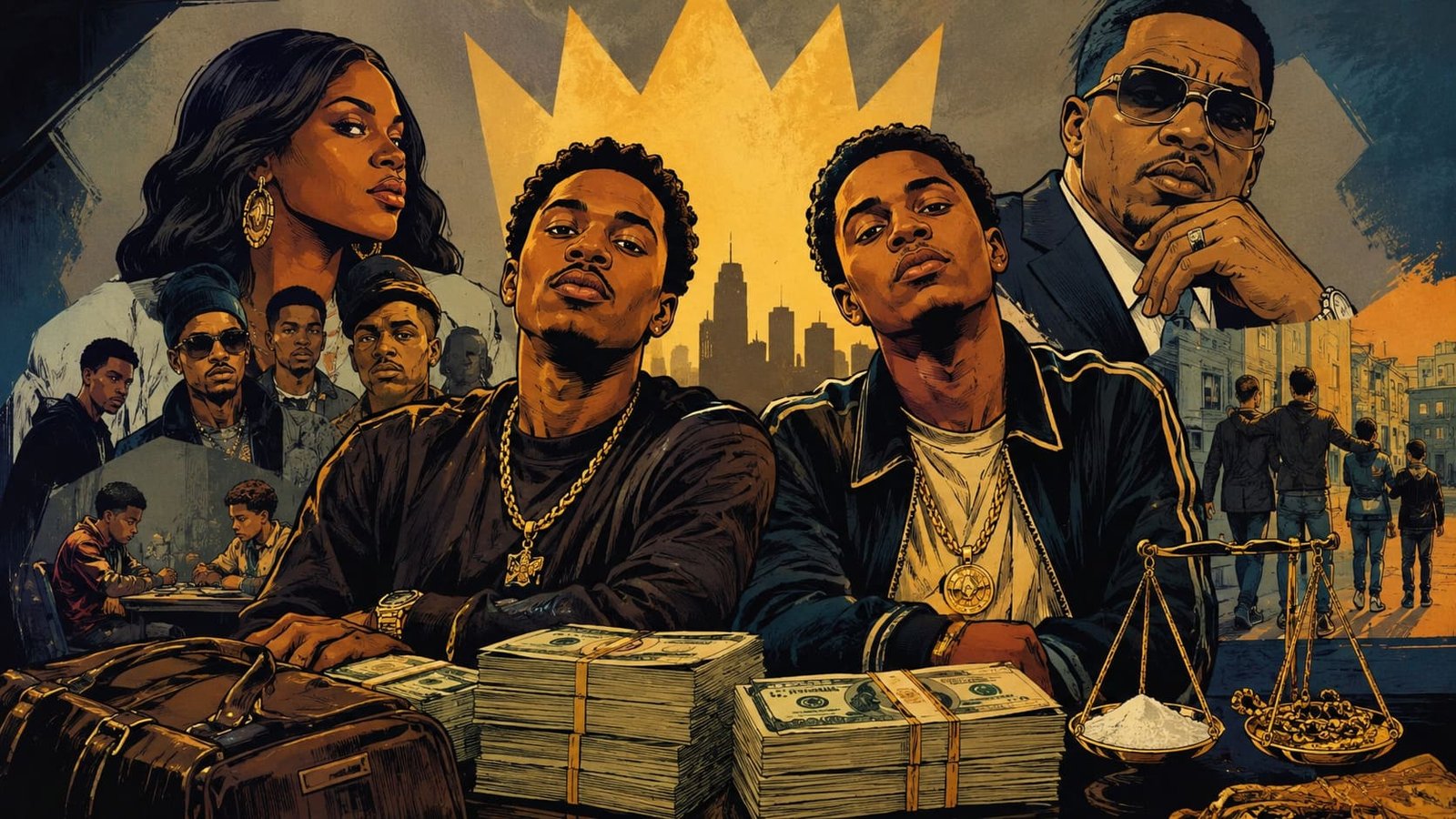
Nightclubs in BMF pulse like modern temples where ambition arrives dressed in mink coats and champagne reflections. Basslines rattle through crowded rooms while young men study power the way starving apprentices study fire. Detroit breathes heavily throughout the series. Not the polished version printed inside tourism brochures, but the bruised industrial heartbeat of a city abandoned by promises and then blamed for improvising survival afterward. In that atmosphere, the Flenory brothers rise not simply as drug kingpins, but as architects of parallel capitalism. Their empire grows because official systems leave enormous emotional and economic vacancies behind.
Demetrius “Lil Meech” Flenory Jr. portrays his father, Demetrius “Big Meech” Flenory, with fascinating tension between charisma and calculation. Meech enters rooms carrying the gravitational pull of someone who understands spectacle as strategy. He does not merely move product. He curates mythology. Expensive cars, tailored clothing, celebrity proximity, extravagant generosity. Long before influencer culture flooded social media, figures like Meech understood visibility itself could become infrastructure. BMF recognizes this with unusual sophistication. Reputation functions like currency. Attention becomes protection. Narrative becomes leverage.
The series becomes especially compelling whenever it examines the psychological difference between Meech and Terry “Southwest T” Flenory. Meech thinks expansively, emotionally, almost spiritually. Terry thinks structurally. Operationally. One brother sells vision. The other stabilizes machinery. Countless businesses collapse because they lack one of those archetypes entirely. Steve Jobs needed operational discipline around him. Music moguls need logistics teams behind glamour. Political movements require both rhetoric and administration. BMF quietly exposes how power rarely belongs to lone geniuses. It emerges through unstable collaboration between contrasting instincts.
A logistics entrepreneur in Kigali once described watching his own cousins split apart while scaling a transport company across East Africa. One wanted rapid expansion into flashy markets. The other worried about debt exposure and internal controls. Family dinners became tense strategic negotiations disguised as ordinary conversation. “Success made everyone louder,” he admitted over grilled tilapia and bitter coffee. BMF captures that exact emotional frequency. Wealth amplifies personality rather than healing it. Existing fractures become architectural faults under pressure.
Russell Hornsby’s Charles Flenory deserves recognition because he embodies the exhausted dignity of fathers watching old economic pathways disappear in real time. Factory work once promised stability. Discipline once guaranteed incremental progress. Then deindustrialization arrived like a silent apocalypse across many American cities. The younger generation inherited broken ladders and shrinking faith. BMF understands this socioeconomic backdrop deeply. Criminal empires do not emerge inside healthy ecosystems overflowing with opportunity. They grow where aspiration collides repeatedly against locked doors. The series never excuses violence, but it insists context matters. That distinction gives the storytelling moral intelligence.
There is an extraordinary atmosphere surrounding the show’s depiction of music culture. Hip-hop becomes more than soundtrack material. It operates as emotional infrastructure. Clubs transform into networking hubs, status theaters, and informal boardrooms where influence spreads faster than official institutions can monitor. Watching Meech cultivate relationships with artists feels eerily similar to modern startup founders attaching themselves to celebrity ecosystems for legitimacy. Branding, access, perception, aspiration. The mechanics remain timeless even when technology changes. BMF understands that cultural capital often becomes more valuable than money itself because culture reshapes memory.
One woman named Selene managed nightlife promotions in Johannesburg during the rise of influencer marketing. She once described watching wealthy clients throw absurd amounts of money at appearances they could barely afford privately. “Nobody wanted peace,” she laughed softly while adjusting a silver bracelet beneath dim lounge lighting. “They wanted witnesses.” That line could sit comfortably inside BMF because the show understands performance economics perfectly. Many characters do not chase luxury for enjoyment alone. They chase visibility. Recognition. Psychological escape from invisibility itself.
The visual texture of the series amplifies this beautifully. Fur coats gleam beneath nightclub strobes while old Detroit neighborhoods carry the melancholy dignity of places history stopped funding properly. Every celebration contains undertones of danger. Every triumph vibrates with instability. It resembles a civilization partying beside structural collapse. Pop culture often treats excess as uncomplicated freedom. BMF treats it like emotional anesthesia. Characters keep surrounding themselves with noise because silence might force confrontation with emptiness underneath.
Toward the final stretch, the Flenory empire begins to resemble a giant cathedral built from appetite and adrenaline. Music shakes crowded rooms while loyalty quietly fractures behind expensive smiles. Meech keeps expanding influence as though scale itself might defeat mortality, poverty, even loneliness. Yet the larger the kingdom becomes, the harder genuine intimacy survives inside it. That is the aching brilliance of BMF. It understands that ambition can rescue people from obscurity while simultaneously exiling them from ordinary humanity. Somewhere between family dinners, luxury convoys, police investigations, and nightclub champagne storms, the series whispers a truth modern culture rarely admits honestly: many empires are not built because people love power. They are built because people are terrified of ever feeling powerless again. The tragedy arrives when the cure slowly becomes another form of captivity.
Editorial Disclaimer: Whether a TV Show is rooted in fiction or inspired by real events, the actions, decisions, and behaviors portrayed within are not intended to be encouraged, replicated, or endorsed in real-world settings. This review exists solely to analyze the storytelling, characters, themes, and business dynamics presented in the TV Show for educational, analytical, and entertainment purposes. Any ethical or unethical conduct depicted in the TV Show does not reflect the views, values, or endorsements of ESYRITE.
