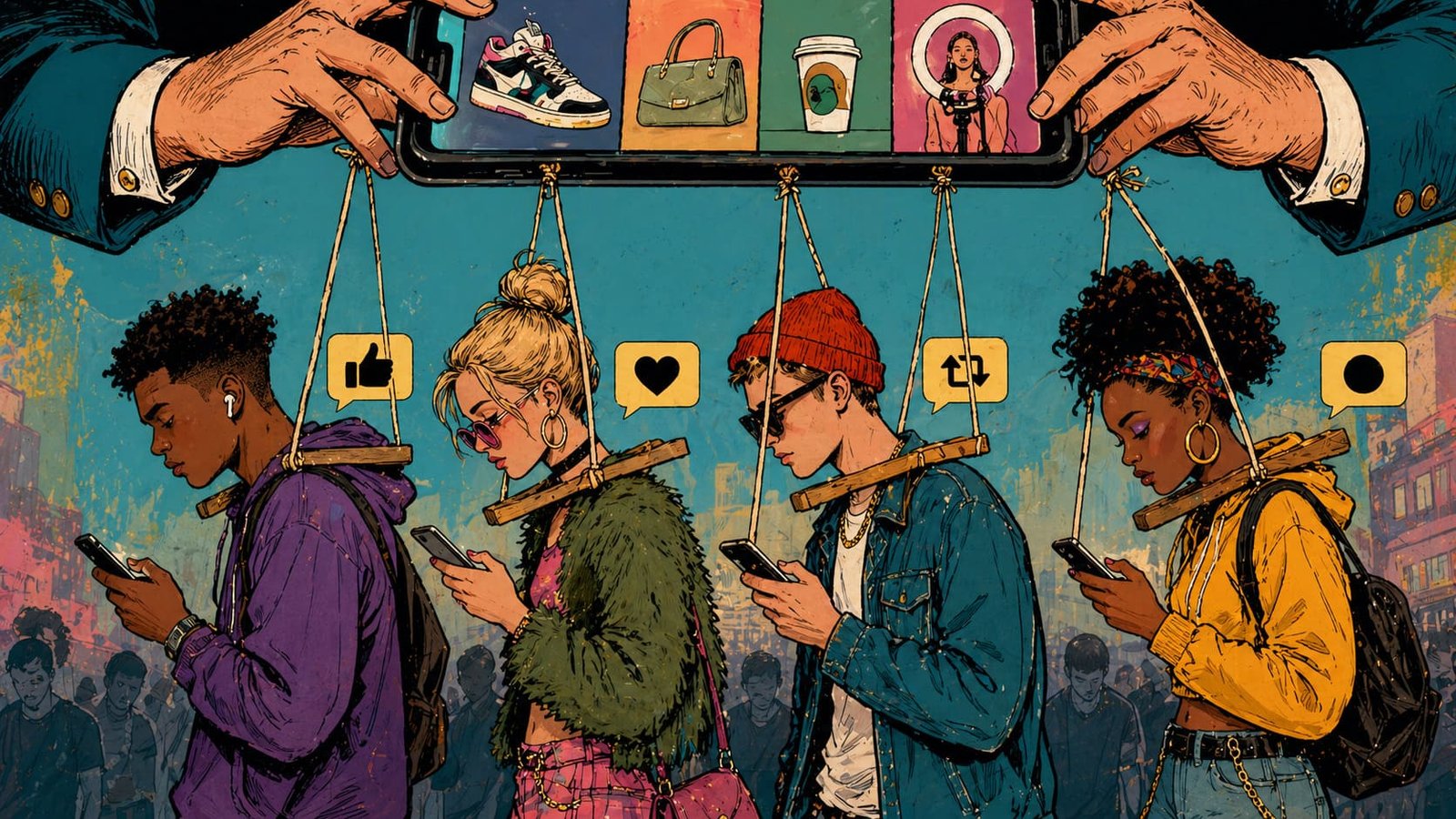
A quiet panic hums beneath the glow of a scrolling feed. Not loud enough to alarm, not sharp enough to interrupt, but steady, like a low-frequency signal running through the bones of modern life. Every swipe delivers a verdict dressed as inspiration. This is what matters now. This is what belongs. This is what fades next. The crowd does not argue. It adjusts. Outfits change, language shifts, opinions tilt ever so slightly toward the center of gravity. No one announces surrender, yet something inside culture begins to kneel.
The mechanism feels harmless because it arrives disguised as discovery. Trends appear as if they were found, not engineered. A dance spreads, a phrase catches, a color palette dominates entire seasons without explanation. It feels organic, almost poetic. Yet behind the surface sits a system that rewards repetition and punishes hesitation. The faster one aligns, the more visible one becomes. Visibility becomes validation. Validation becomes habit. Habit becomes obedience.
There is a designer named Renata who once built her studio around slow fashion principles. She sourced materials carefully, produced in small batches, and spoke often about restraint. Her audience was modest but loyal. Then a sudden wave hit. A specific aesthetic, loud, exaggerated, algorithm-friendly, flooded her space. Customers began asking why her work did not “feel current.” Renata experimented, reluctantly at first, then with growing urgency. Sales doubled. Her name traveled farther than it ever had. Yet in private moments, she admitted something unsettling. The work no longer felt like hers. It felt like compliance dressed as creativity.
Trends do not ask for belief. They ask for participation. That is their genius. One does not need to agree with a trend to follow it. One only needs to fear being left behind. This is where obedience hides, not in force, but in quiet anxiety. A marketing analyst named Idris once described it during a late-night campaign sprint. “We don’t create desire anymore,” he said, staring at a dashboard glowing like a control panel. “We monitor it and adjust.” His team shifted messaging hourly, chasing micro-movements in attention. By morning, the campaign succeeded. By evening, it was irrelevant. The cycle continued without pause.
The cost of this rhythm is subtle but cumulative. Taste, which once required time to develop, becomes outsourced to momentum. Decisions that used to carry weight now feel temporary. A playlist changes before it settles. A brand identity morphs before it matures. Even language begins to feel disposable. Words are adopted, repeated, exhausted, and discarded within weeks. The mind adapts by lowering its attachment. Nothing needs to last if everything can be replaced.
There is also a strange flattening that occurs. When trends dominate, difference becomes risky. Original ideas must either conform quickly or risk invisibility. A filmmaker named Soren spent years crafting a script that refused conventional pacing. Studios passed, citing uncertainty. Then a trend emerged favoring experimental narratives. Suddenly, his work was labeled visionary. It was the same script. The only change was timing. The market did not discover his originality. It permitted it.
This reveals a deeper tension between expression and acceptance. Culture promises freedom while quietly enforcing alignment. It invites individuality but rewards imitation. The result is a kind of performative uniqueness, where everyone strives to stand out using the same signals. The irony is almost theatrical. People become more alike in their attempt to be different.
Pop culture amplifies this pattern with remarkable efficiency. A single viral moment can redefine entire categories overnight. Consider how certain aesthetics dominate music videos, fashion campaigns, even interior design within weeks of emergence. The influence radiates outward, touching industries that seem unrelated. A café owner named Mateo redesigned his space after noticing a surge in a specific visual style across social platforms. Foot traffic increased. Photos circulated. Yet regular customers quietly drifted away, sensing a loss they could not quite name. The space looked better. It felt thinner.
Obedience in this context is not about control from above. It is about synchronization across millions of small decisions. Each individual choice seems harmless, even logical. Together, they create a powerful current that is difficult to resist. The system does not need to force anyone. It only needs to reward alignment consistently enough that deviation feels expensive.
There are moments, however, when the pattern breaks. They are often quiet, almost invisible at first. A writer refuses to chase trending topics and instead explores an unfashionable idea with patience. A brand declines a viral collaboration to protect its identity. A musician releases work that does not fit current playlists. These choices rarely explode into immediate success. They move slower, often unnoticed. Yet they carry a different kind of weight. They build something that does not depend on constant adjustment.
A small publishing house run by Eleni offers a clear example. While competitors pivoted toward trending genres, she continued to invest in overlooked voices that did not fit current molds. Sales were modest. Growth was steady. Years later, several of those authors shaped conversations that outlived multiple trend cycles. Eleni’s approach looked stubborn at the time. In retrospect, it appears almost prophetic.
The question is not whether trends are inherently harmful. They can inspire, connect, and accelerate discovery. The issue lies in how deeply they are allowed to define taste. When trends become the primary filter, culture begins to lose its capacity for independent judgment. It reacts instead of reflecting. It moves instead of thinking.
There is a peculiar exhaustion that follows prolonged exposure to this cycle. It is not physical fatigue, but something closer to cognitive erosion. The constant need to stay updated creates a background tension that never fully resolves. Even moments of rest feel temporary, as if something important might be missed. This is the hidden cost of obedience. It demands attention without offering stability.
In quieter corners, a different approach continues to exist. It values slowness, repetition, and depth. It allows ideas to mature without immediate validation. It treats taste as something cultivated rather than adopted. These spaces rarely dominate headlines. They do not trend. Yet they persist, offering an alternative rhythm that feels almost unfamiliar in its steadiness.
The glow of the feed does not disappear. It continues to pulse, offering new directions, new signals, new urgencies. The crowd keeps moving, adjusting, aligning. Yet somewhere within that movement, there is a small pause, barely noticeable, where a choice can be made without reference to what is currently rising.
Hold that pause for a moment, and consider quietly: is your taste guiding your attention, or is your attention training your taste to obey?
