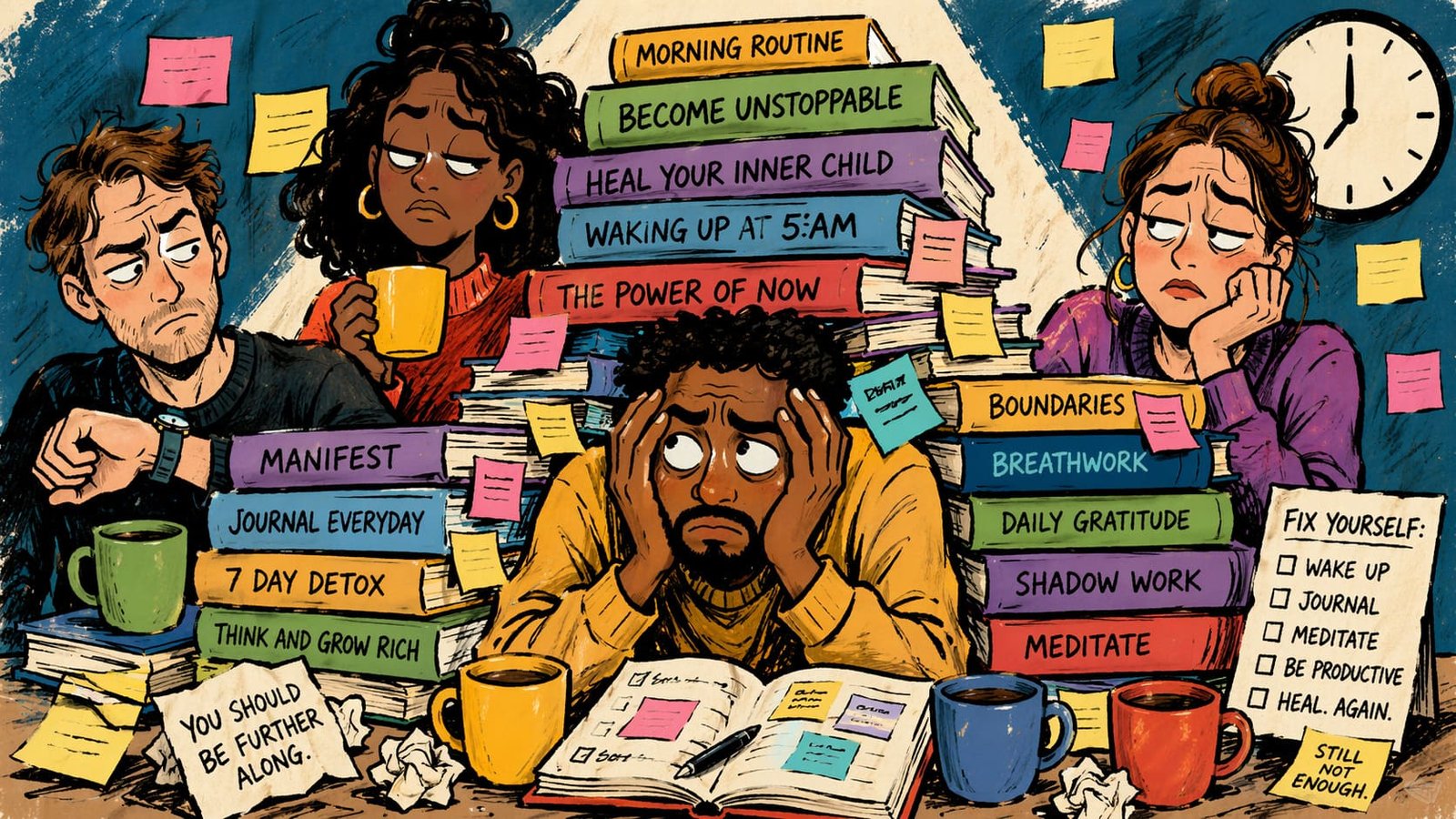
The notebook is open, but nothing feels lighter. A page filled with prompts stares back, asking questions that sound wise and measured, yet strangely demanding. Gratitude lists, habit trackers, shadow work exercises, morning routines that promise clarity if followed with enough discipline. A person sits with a pen, aware of the quiet pressure beneath it all. Healing has been scheduled. Growth has been assigned. Somewhere between intention and obligation, something has shifted. The work meant to free the mind now feels like a system it must obey.
It did not begin this way. The modern self-help movement grew from a genuine need. People searched for language to understand their struggles, tools to navigate anxiety, frameworks to rebuild after loss or burnout. Books offered guidance. Podcasts created community. Therapy became more visible, less stigmatized. For many, these resources opened doors that had long been closed. They made inner life feel accessible, something that could be explored rather than endured in silence. The early promise was simple. Understanding yourself could lead to a better life.
Then the tools multiplied. What started as guidance became a catalog. Morning routines, productivity systems, journaling methods, mindset shifts, breathwork practices, each one presented as a pathway to improvement. The variety felt empowering at first. Options meant freedom. Over time, the abundance created a different effect. It introduced comparison. If one method did not work, another was waiting. If progress felt slow, it could be optimized. The journey inward began to resemble a checklist outward.
A marketing manager named Ruth found herself deep in this ecosystem. She started with a single habit, writing three things she appreciated each morning. It felt grounding. Encouraging. Gradually, she added more practices. Meditation before work, reflective journaling at night, weekly goal setting, monthly life audits. Each addition promised incremental improvement. Her days became structured around self-improvement tasks. From the outside, it looked disciplined. From the inside, it felt relentless. When she skipped a routine, she did not feel rested. She felt behind.
This is the quiet inversion at the heart of modern self-help. Healing becomes something to perform. Progress becomes something to measure. The language shifts from compassion to optimization. Instead of asking what is needed in a given moment, the system asks whether the process has been followed correctly. The individual becomes both the subject and the evaluator, constantly assessing whether enough has been done to deserve a sense of peace.
There is also a deeper cultural layer shaping this dynamic. In a world that rewards productivity, even rest begins to carry expectations. Time must be used well. Emotions must be processed efficiently. Growth must be visible. Self-help adapts to that environment by framing inner work as something that can be improved through effort and consistency. The message is subtle but powerful. If you are not feeling better, perhaps you are not trying hard enough. The responsibility shifts entirely onto the individual.
A therapist named Daniel noticed a pattern among his clients. Many arrived with extensive knowledge of psychological concepts. They could articulate their patterns, name their triggers, even outline strategies for change. Yet they felt stuck. “They know what to do,” he said, “but they treat themselves like projects.” The insight was not lacking. The relationship with themselves was. They approached healing with the same mindset they used for work, structured, goal-oriented, outcome-driven. The result was a kind of emotional fatigue that no checklist could resolve.
This fatigue often hides behind the appearance of progress. Someone might adopt healthier habits, improve their routines, even achieve external markers of success. Yet a quiet tension remains. The sense that peace is conditional, dependent on maintaining the system. Relaxation becomes temporary, something earned after completing the required steps. The freedom that self-help promises starts to feel contingent, always one missed practice away from slipping.
At the same time, the industry continues to expand. New frameworks emerge, each one offering a refined approach, a more effective method, a clearer path. The cycle reinforces itself. More content leads to more awareness, which leads to more expectations. The individual stands at the center of this expanding system, trying to navigate it while also living a life that feels authentic and unforced.
In a quiet room, a person closes a notebook that has become heavier than expected. The pages are filled with intentions, reflections, plans for improvement. For a moment, there is stillness. No prompt, no instruction, just the absence of guidance. It feels unfamiliar, almost uncomfortable. Then something softer appears. Not a solution, not a breakthrough, just a sense of being without evaluation. It does not last long, but it is enough to suggest a different possibility.
Somewhere between effort and ease, the idea of healing begins to shift again, and the question lingers gently, waiting to be considered without urgency: when the pursuit of becoming better starts to feel like a burden, will you continue refining the system, or will you allow yourself the space to exist without needing to improve at all?
