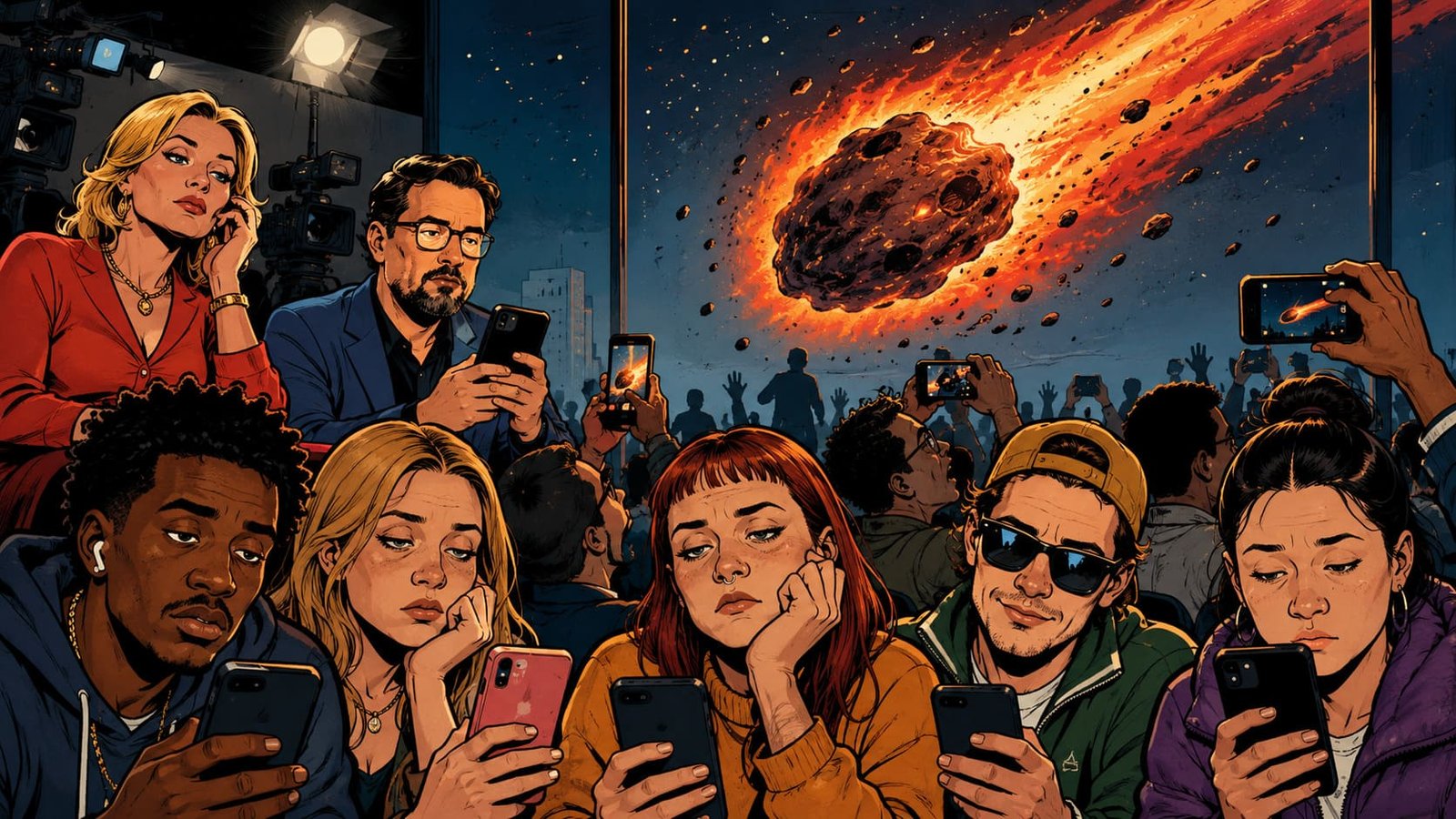
A woman in a glittering television studio adjusted her smile while the world quietly moved toward extinction. Cameras floated across polished floors like obedient drones. Coffee steamed beneath artificial lights. Producers whispered countdowns into headsets with the urgency of battlefield commanders preparing for war, except the war had already arrived and nobody wanted to ruin audience retention by admitting it. That suffocating contradiction powers Don’t Look Up. The film begins like political satire and slowly mutates into something more unsettling: a psychological autopsy of a civilization so addicted to spectacle that catastrophe itself becomes content. Adam McKay does not simply mock governments or media corporations. He exposes a culture that confuses attention with wisdom and visibility with truth. Somewhere beneath the celebrity gossip, campaign slogans, and meme-ready chaos sits a terrifying possibility that the apocalypse may not arrive through ignorance alone. It may arrive through distraction.
The comet in the film works less like a scientific threat and more like a mirror held against modern institutions. Every character seems trapped inside systems optimized for short-term emotional rewards. Politicians chase polling numbers. Billionaires chase market dominance. News anchors chase likability. Audiences chase comfort. Nobody wants interruption. Reality itself becomes an inconvenience. A biotech executive named Marcus Vale once spent an investor conference promising that his company’s wellness patches could “re-engineer emotional resilience.” Journalists applauded the presentation because the branding looked futuristic. Months later, internal reports revealed the product barely functioned. Yet the company’s valuation exploded anyway because belief had become more profitable than evidence. Don’t Look Up understands this emotional economy perfectly. Modern power often depends less on solving problems than on controlling the emotional atmosphere surrounding them.
Leonardo DiCaprio’s performance captures the exhaustion of intelligent people trapped inside systems designed to flatten complexity into entertainment. His character begins with rational urgency and slowly transforms into another television personality orbiting the machine he once tried to resist. That transformation feels painfully familiar. Institutions often absorb critics faster than they absorb solutions. A climate researcher named Farah Linden spent years warning corporate leaders about infrastructure risks linked to extreme weather. Nobody listened until her conference clips started trending online because viewers found her frustration “relatable.” Suddenly executives invited her onto panels beside smiling moderators holding branded water bottles under soft blue stage lights. The warnings stayed the same. The packaging changed. That emotional shift sits at the center of the film’s cruelty. Society often rewards people only after turning them into consumable characters.
The humor works because the absurdity feels dangerously close to ordinary life. Social media has trained entire populations to process tragedy through irony and performance. Disasters become hashtags before they become policy discussions. During one scene in the film, celebrity culture and political dysfunction collapse into each other with the elegance of a circus tent catching fire during a sponsorship deal. It feels outrageous until reality quietly taps the audience on the shoulder. Public discourse increasingly resembles a streaming platform algorithm where outrage, fear, beauty, and misinformation compete for the same shrinking attention span. Marshall McLuhan once warned that “the medium is the message.” Don’t Look Up extends that warning into something colder: eventually the medium consumes the message entirely.
The film’s sharpest observations emerge through its portrayal of elite confidence. The billionaire tech figure, played with eerie calm by Mark Rylance, embodies a modern archetype that has become culturally sacred. Society increasingly treats wealthy founders as philosopher-kings capable of solving moral crises through innovation alone. The language sounds visionary. The outcomes often resemble casino economics wrapped in minimalist branding. A startup founder named Elena Voss once convinced municipal leaders to install experimental surveillance kiosks marketed as “urban empathy systems.” Promotional videos showed smiling pedestrians beneath warm ambient music. Privacy experts raised concerns immediately. Nobody cared because the product felt futuristic and optimism photographs well on magazine covers. Don’t Look Up attacks this worship of technological salvation with surgical precision. The movie argues that intelligence without humility becomes another form of danger.
Beneath the satire lies profound loneliness. Every character appears emotionally stranded despite constant connectivity. Phones vibrate. Screens glow. People speak endlessly. Genuine listening disappears. One of the film’s quiet tragedies involves how easily human beings retreat into tribes during fear. Facts stop mattering once identity enters the room. Entire populations begin treating reality like a sports rivalry where loyalty outranks evidence. The emotional texture feels strangely intimate because many viewers recognize fragments of their own lives inside it. Families divided by politics. Friends trapped inside algorithmic outrage loops. Executives privately terrified while publicly performing certainty. A late-night producer named Simon Reed once admitted after a broadcast meeting that fear-based headlines boosted engagement metrics better than hopeful stories ever could. The room reportedly fell silent for several seconds before someone changed the topic to advertising revenue.
Adam McKay floods the movie with noise because modern life itself feels overcrowded with stimulation. Every scene vibrates with interruption. The editing style resembles scrolling through catastrophe while eating takeout beneath fluorescent kitchen lights after midnight. That sensory overload becomes part of the argument. Human beings are drowning in information while starving for wisdom. Ancient societies feared censorship. Modern societies often fear silence more. A quiet room leaves space for reflection. Reflection can lead to uncomfortable truths. The film repeatedly suggests that distraction has become a political technology all its own. Not because someone secretly controls every narrative, but because exhausted populations willingly choose emotional convenience over difficult reckoning.
Near the end, something haunting settles over the story. The comedy starts dissolving into grief. Not grief for planetary destruction alone, but grief for missed chances at sincerity, courage, and collective clarity. A candle flickers beside untouched food while distant panic hums through invisible networks. In that fragile atmosphere, Don’t Look Up stops feeling like satire and starts feeling like confession. Civilizations rarely collapse because people lacked information. They collapse because too many people believed somebody else would act first. The film leaves behind a strange emotional residue, part dread, part recognition, part exhausted tenderness for flawed human beings trapped inside systems larger than themselves. Somewhere beyond the screaming headlines and glowing screens sits an unbearable thought that lingers long after the credits disappear: the most dangerous societies are not always the cruelest ones, but the ones too entertained to notice what they are becoming. And when the next warning finally arrives, the hardest thing may not be surviving it, but deciding whether truth still matters more than comfort.
Editorial Disclaimer: Whether a film is rooted in fiction or inspired by real events, the actions, decisions, and behaviors portrayed within are not intended to be encouraged, replicated, or endorsed in real-world settings. This review exists solely to analyze the storytelling, characters, themes, and business dynamics presented in the film for educational, analytical, and entertainment purposes. Any ethical or unethical conduct depicted in the film does not reflect the views, values, or endorsements of ESYRITE.
