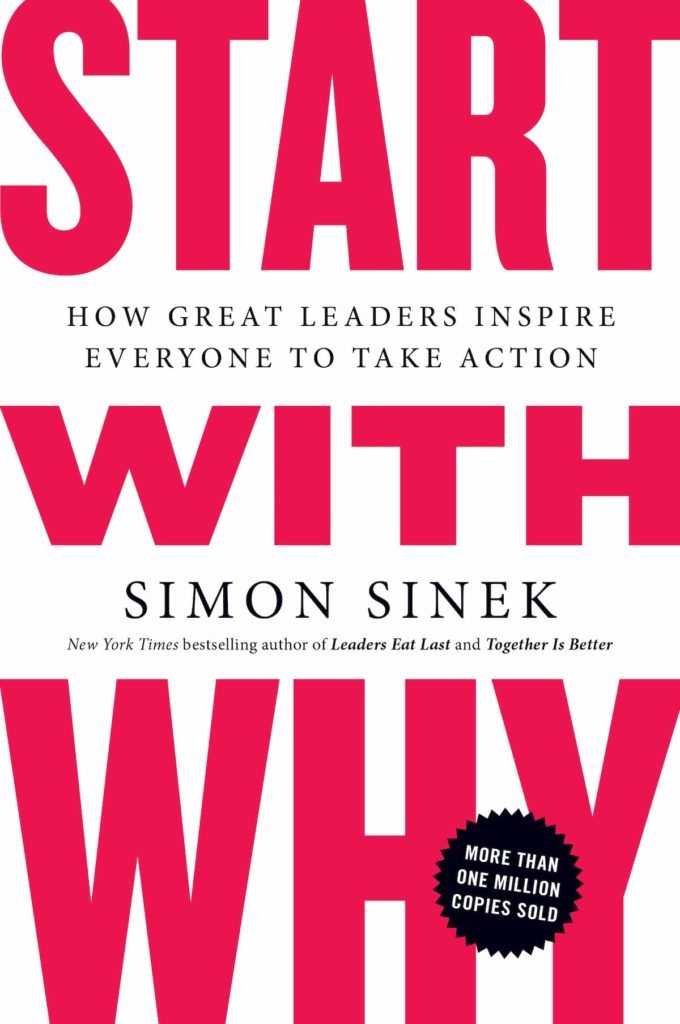
The boardroom smelled faintly of polished leather, burnt espresso, and invisible panic. Outside the skyscraper windows, traffic crawled through the city like circuitry overheating beneath the weight of modern ambition. Inside, executives rehearsed quarterly talking points with the emotional texture of exhausted actors trapped inside a franchise nobody believed in anymore. Then somewhere else, in a smaller office with peeling paint and terrible fluorescent lighting, a founder explained a mission with trembling conviction and suddenly people leaned forward. That tension sits at the center of Start with Why by Simon Sinek. The book does not merely ask how organizations succeed. It asks why certain leaders make human beings believe.
Sinek’s “Golden Circle” framework became famous because it translates a deeply emotional truth into deceptively simple language. Most organizations communicate from the outside in. What they do. How they do it. Occasionally why they exist. Great leaders reverse the direction. They begin with belief. That reversal changes everything because human beings rarely commit themselves fully to products, services, or strategies alone. They commit to identity, meaning, orientation, and emotional resonance. People buy narratives about themselves hidden inside decisions. A technology company selling rebellion becomes culturally magnetic. A shoe becomes aspiration. A coffee shop becomes ritual. A founder becomes mythology.
The book’s power comes from recognizing how emotionally starved many modern institutions have become. Corporate language often sounds engineered by exhausted committees terrified of sincerity. Mission statements drift into sterile abstraction. Teams hit targets while forgetting what the targets were supposed to serve in the first place. Start with Why slices directly through that fog. Sinek argues that purpose is not decorative branding layered on top of operations. It is operational gravity itself. Without emotional coherence, organizations drift toward cynicism, bureaucracy, and eventually irrelevance. That idea sounds inspirational at first glance. Underneath, it is brutally strategic.
A founder named Matteo Vescari once launched a boutique travel company specializing in slow cultural immersion across Southern Europe. Investors pressured him repeatedly to pivot toward scalable tourism packages with larger margins. Matteo refused. He insisted the company existed to help emotionally exhausted professionals rediscover attention, intimacy, and curiosity through travel rather than consumption. Friends quietly mocked the philosophy as commercially naive. Yet travelers returned obsessively because the experience felt emotionally rare in an age of algorithmic tourism and staged authenticity. Years later, competitors offering cheaper packages struggled while Matteo’s company developed near cult-like loyalty. Guests tattooed symbols from the journeys onto their arms. One client described the trips as “therapy disguised as geography.” That emotional attachment did not emerge from logistics alone. It emerged from why.
Sinek repeatedly references leaders like Martin Luther King Jr. and companies like Apple Inc. because the book understands something uncomfortable about influence. Human beings do not follow information consistently. They follow conviction. That distinction explains why charismatic visionaries can mobilize movements while technically superior competitors disappear quietly despite stronger resources. A mediocre product wrapped inside emotional clarity often outperforms a better product wrapped inside emotional confusion. The idea feels almost unfair. Yet history keeps confirming it. Politics. Entertainment. Religion. Technology. The organizations shaping culture usually communicate belief before mechanics.
There is also a subtle warning hidden beneath the optimism. “Why” can inspire or manipulate depending on the ethics underneath it. History is crowded with movements powered by emotional clarity and catastrophic intentions. Sinek hints at this tension without fully diving into its darker psychological dimensions. The same emotional architecture that builds transformative companies can also build ideological fanaticism. That complexity makes the book more interesting than critics sometimes admit. Purpose is powerful precisely because it bypasses purely rational processing. People yearn for orientation in chaotic societies. Leaders who provide it gain extraordinary influence over behavior.
A media strategist named Safiya El Khatib once consulted for a rapidly growing wellness startup whose products performed reasonably well but whose community engagement remained strangely cold. During workshops, Safiya noticed employees could describe pricing models and product features perfectly yet stumbled awkwardly when asked why the company existed beyond revenue growth. After weeks of uncomfortable internal conversations, leadership admitted the original mission around emotional healing and community support had quietly disappeared beneath investor pressure and expansion anxiety. The company rebuilt its messaging and culture around that forgotten emotional core. Staff morale changed almost immediately. Customers responded differently too. Safiya later reflected that organizations become psychologically brittle the moment they stop believing their own story.
The book resonates so deeply because it addresses a quiet crisis haunting ambitious people everywhere. Many professionals achieve external success while privately feeling emotionally disconnected from their labor. Promotions arrive without emotional meaning attached. Productivity expands while identity contracts. Sinek offers an antidote rooted not in hustle culture or motivational theatrics but in alignment. The idea that work connected to belief creates deeper endurance than work connected solely to pressure feels increasingly urgent in a digital economy optimized for exhaustion. Purpose does not eliminate suffering. It changes the emotional texture of sacrifice.
A cinematographer named Lena Armitage once described filming luxury advertising campaigns for brands she secretly disliked because the work paid exceptionally well. One winter evening she accepted a smaller project documenting independent teachers building community art programs inside neglected neighborhoods. The budget was miserable. The equipment kept malfunctioning. Yet Lena admitted she had not felt that emotionally awake in years. She later turned down multiple high-paying contracts to focus on mission-driven storytelling instead. Friends called the decision irrational. Lena described it differently. “The body knows when the soul has stopped participating.” That sentence lingers in the atmosphere surrounding Start with Why because Sinek’s deeper argument is not about marketing at all. It is about emotional coherence between belief and behavior.
Long after keynote speeches end and polished branding campaigns fade into digital static, another exhausted executive still sits alone beneath office light wondering why achievement keeps feeling strangely temporary. Somewhere else, a small team gathers around terrible coffee and impossible odds yet carries enough conviction to outlast organizations ten times larger. Rain slides down skyscraper windows. Subway brakes scream softly beneath crowded streets. The future keeps rewarding people capable of making others feel part of something meaningful rather than merely profitable. That is the haunting pulse beneath Start with Why. Human beings will tolerate astonishing hardship for money briefly, but they will cross oceans, rebuild civilizations, and sacrifice comfort for belief. The dangerous question is not whether a leader has vision. It is whether the vision still remembers the humanity of the people carrying it forward.
Editorial Disclaimer: Whether a book is a work of fiction, a memoir, or inspired by real events, the ideas, actions, decisions, and behaviors discussed within are not intended to be encouraged, replicated, or endorsed in real-world situations. This review is published solely for educational, analytical, literary, and entertainment purposes, with the aim of examining the book’s themes, storytelling, characters, philosophies, and broader cultural or business insights. Any ethical or unethical viewpoints, practices, or conduct presented in the book do not necessarily reflect the views, values, or endorsements of ESYRITE.
