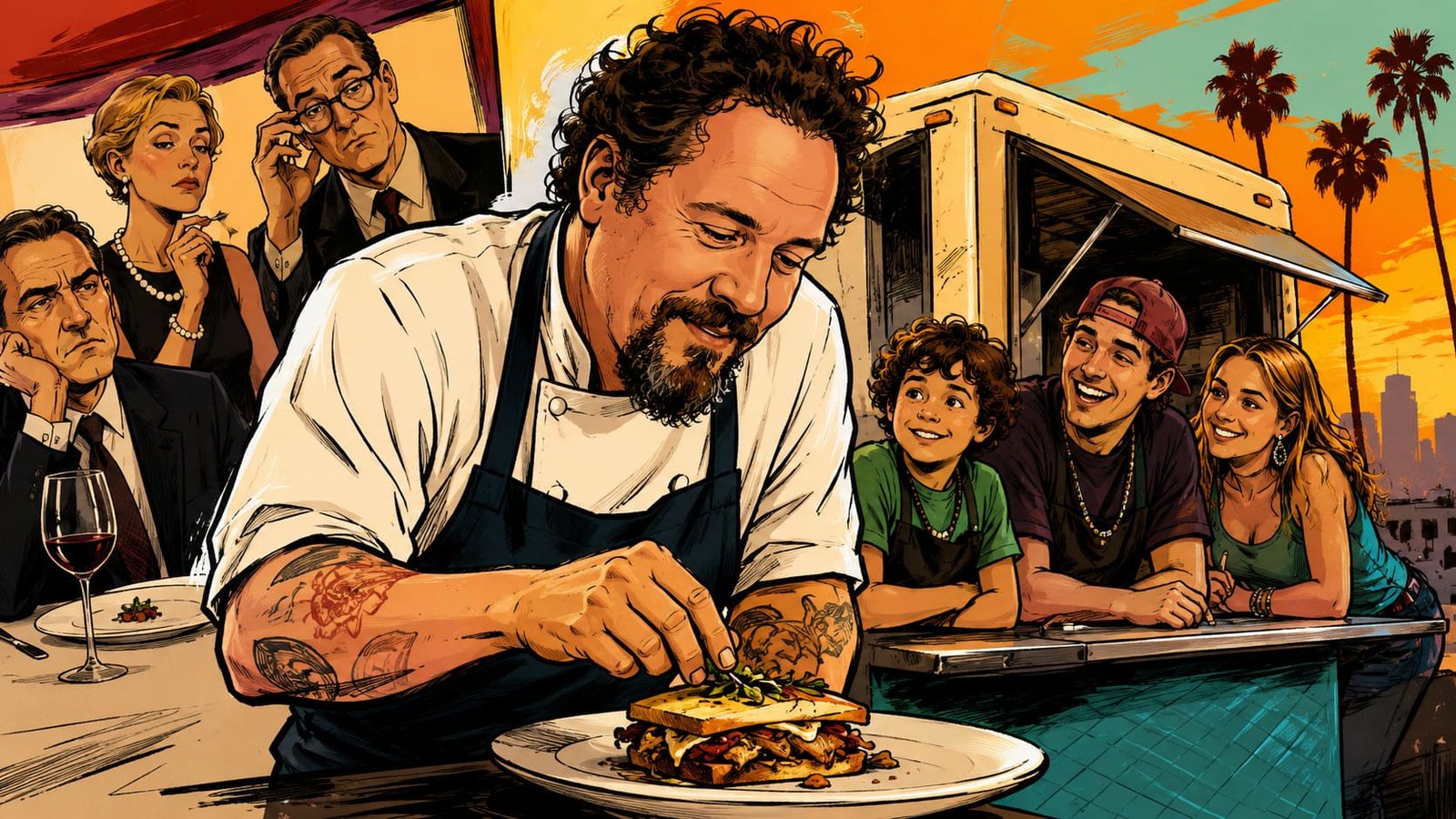
Rain pressed itself against the windows of a Los Angeles restaurant like a crowd trying to force entry into a collapsing cathedral. Inside, expensive plates floated through dim light while exhausted cooks moved with the silence of people hiding bruises beneath tailored clothing. One critic held more power than the owner, more influence than the chef, maybe more than the entire kitchen itself. That is the first strange truth pulsing through Chef. Not food. Not fame. Power. The film understands something modern culture hates admitting: talented people are often trapped inside systems designed by frightened gatekeepers pretending to protect quality while secretly protecting predictability. Jon Favreau’s Carl Casper does not merely lose control of a menu. He loses language. Every reheated dish becomes a tiny funeral for identity. Somewhere between burnt garlic and passive-aggressive customer smiles, the movie transforms into something larger than culinary cinema. It becomes a story about creative suffocation in an economy addicted to safe mediocrity.
Most films about ambition worship scale. Chef distrusts it. That tension gives the movie its pulse. Carl works in a respected restaurant, yet every scene feels spiritually claustrophobic, like a billionaire living inside a beautifully decorated prison cell. Dustin Hoffman’s restaurant owner behaves less like a villain and more like an executive committee disguised as one exhausted man. Every organization has one. The person who fears experimentation because experimentation threatens stability. Somewhere in Manhattan, London, Nairobi, or Seoul, a talented employee is currently being told to “stay consistent” when what they really hear is “stay smaller.” The movie slices into that emotional wound with unsettling precision. One startup founder once described corporate meetings as “watching innovation drown politely.” That sentence could have been stitched directly into Carl’s apron. The kitchen becomes a metaphor for modern professional life, where people with vision are slowly trained to confuse obedience with maturity.
The film grows sharper once humiliation enters the bloodstream. Carl’s public meltdown against food critic Ramsey Michel feels funny on the surface, yet underneath the comedy sits something raw and recognizable. Social media transformed private frustration into gladiator theater. A bad day can become permanent architecture online. Watching Carl discover Twitter feels almost archaeological now, like observing someone accidentally touch an electric fence during the early internet gold rush. Yet the humiliation matters because it strips away illusion. Comfort had disguised stagnation. A man who once cooked with imagination had quietly become a curator of repetitive luxury. There is a devastating line hidden beneath the film’s warmth: success can become camouflage for creative death. Silicon Valley romanticizes disruption until disruption enters the quarterly report. Hollywood celebrates originality while recycling sequels like factory machinery. Carl’s collapse exposes a larger cultural sickness. Systems praise innovation verbally while punishing it operationally.
Then comes Miami, sunlight, smoke, roasted pork, and the sound of oil cracking against steel like applause from another universe. The food truck changes the emotional temperature of the movie entirely. Suddenly movement replaces stagnation. Texture replaces polish. The film understands that freedom rarely arrives looking sophisticated. Sometimes liberation smells like grease trapped inside denim jackets. Sometimes reinvention begins in parking lots instead of conference rooms. Carl cooking Cuban sandwiches alongside his son Percy becomes one of the most emotionally intelligent depictions of leadership in modern cinema. Leadership here is not domination. It is participation. Shared labor. Attention. Presence. Percy does not learn entrepreneurship from motivational speeches. He learns it from burnt fingers, exhausted mornings, and watching adults recover dignity through craftsmanship. A consultant named Mireille once left a prestigious branding agency after panic attacks began arriving every Sunday evening. She opened a tiny bakery near Marseille. Friends called it career suicide. Two years later, she admitted something almost embarrassing: “I finally sleep without dreaming about emails.” Chef understands that confession deeply.
Food in this movie behaves like emotional memory rather than commerce. That distinction matters. Carl’s meals reconnect fractured relationships because they carry intention instead of performance. The famous grilled cheese scene lands harder than most blockbuster monologues because the film treats care as sacred labor. Not branding. Not optimization. Care. There is a reason audiences remember the sandwich. People are starving for evidence that attention still exists in a distracted civilization. Restaurants, startups, marriages, even friendships often decay the same way: people stop noticing details. Carl regains himself not through spectacle but through presence. The knife cuts cleaner. The conversations slow down. The laughter becomes less defensive. A teenager named Omar once described his father’s tiny auto garage in Casablanca with strange tenderness. “He fixed engines like he was apologizing to them.” That line floats through Chef invisibly. The movie argues that real mastery contains affection, not just skill.
What makes the film unexpectedly philosophical is its rejection of performative ambition. Carl does not conquer Wall Street. He does not build a tech empire. He rebuilds coherence between identity and labor. That sounds smaller until one realizes how rare it has become. Modern culture treats exhaustion like moral achievement. Hustle became a religion precisely because burnout looks impressive from a distance. Chef quietly rebels against that mythology. The food truck succeeds because it restores rhythm. Work stops feeling like extraction and starts feeling alive again. Even the soundtrack carries this emotional recalibration. Jazz, salsa, and blues drift through scenes like reminders that life should contain texture beyond productivity metrics. The movie asks a dangerous question beneath its charm: what if success without emotional coherence is merely elegant self-abandonment? Few business dramas dare touch that nerve because the answer threatens entire industries built on prestige addiction.
There is also something politically sharp hiding beneath the warmth. Carl’s journey exposes how institutions often exploit creators while pretending to elevate them. The restaurant profits from his reputation while suppressing his instincts. That contradiction exists everywhere now. Streaming platforms demand originality while feeding algorithms. Corporations recruit “visionaries” before burying them beneath approval chains and presentation decks dense enough to stop human feeling altogether. Carl escaping into a food truck resembles a musician leaving a record label or a writer abandoning click-farm journalism for independent publishing. The film never romanticizes struggle completely. Money still matters. Logistics still matter. Exhaustion still matters. Yet it insists that ownership changes the emotional chemistry of labor. A grilled sandwich cooked freely tastes different from one assembled under silent resentment. Anyone who has worked inside bureaucratic machinery recognizes that truth instantly, even if they cannot articulate it aloud.
Near the emotional center of the movie sits an uncomfortable realization that lingers long after the credits disappear: many adults secretly become strangers to themselves while trying to appear successful to other strangers. Carl nearly loses his son because distraction disguised itself as responsibility. He nearly loses his creativity because reputation disguised itself as achievement. He nearly loses joy because routine disguised itself as professionalism. The film refuses cynicism without becoming naive, which is harder than most critics admit. Warmth here feels earned. Every laugh carries bruises underneath it. Every victory smells faintly of earlier disappointment. Somewhere beneath the Cuban sandwiches and road-trip humor sits a haunting recognition that modern life trains people to abandon the parts of themselves that once felt most alive. Then one day, a random song, a smell from childhood, or a tiny roadside meal reminds them they were never meant to live emotionally anesthetized.
Far from the polished dining rooms and carefully curated applause, a lonely truck rolled beneath neon skies while smoke climbed quietly into the dark like a signal fire from another century. Inside, a tired chef chopped onions beside his son with the concentration of a man rebuilding a lost language one movement at a time. No empire had been conquered. No grand speech had been delivered. Yet something larger had shifted. A human being had stopped performing a life and started inhabiting one again. That is why Chef lingers. Not because of food, but because it understands how many people are starving while surrounded by abundance. The film whispers a dangerous possibility into the noise of modern ambition: maybe fulfillment is not hiding at the top of the mountain, maybe it is waiting inside the work that still makes the soul feel awake. And somewhere deep down, you already know whether your own life tastes freshly made or merely reheated.
Editorial Disclaimer: Whether a film is rooted in fiction or inspired by real events, the actions, decisions, and behaviors portrayed within are not intended to be encouraged, replicated, or endorsed in real-world settings. This review exists solely to analyze the storytelling, characters, themes, and business dynamics presented in the film for educational, analytical, and entertainment purposes. Any ethical or unethical conduct depicted in the film does not reflect the views, values, or endorsements of ESYRITE.
