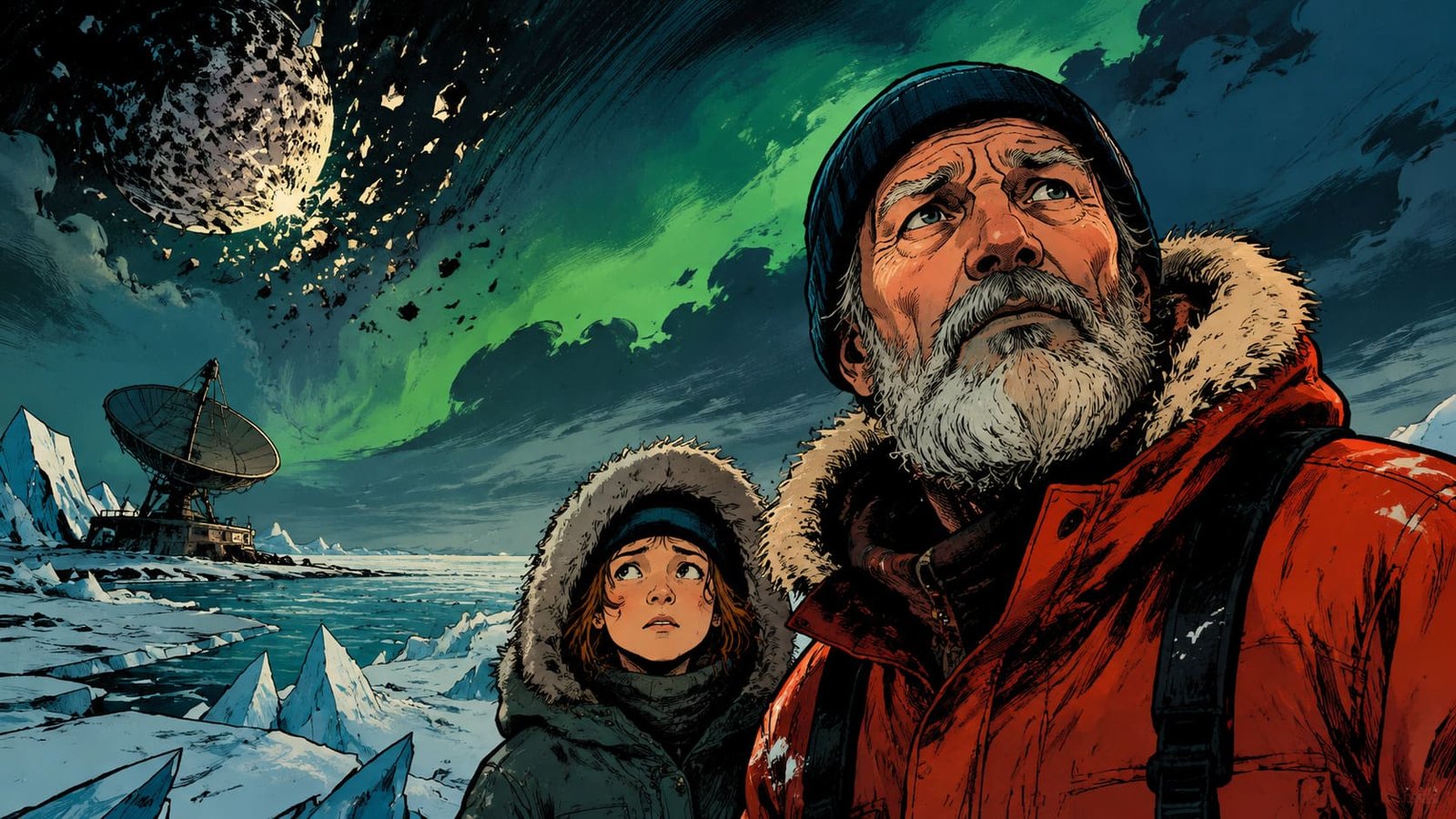
Snow drifted across the Arctic like ash from a civilization that had finally exhausted itself. The research station sat in the frozen silence with the eerie stillness of a church abandoned after prophecy came true. Metal corridors hummed softly beneath dim fluorescent light. Machines blinked into emptiness. Somewhere beyond the ice, the world had already collapsed into invisible poison, yet the computers kept running as if bureaucracy itself could outlive humanity. There was something darkly funny about it. Even at the edge of extinction, systems refused to clock out.
The Midnight Sky arrives disguised as a science-fiction survival story, but the film behaves more like a philosophical fever dream about regret, leadership, and the emotional cost of intellectual ambition. Directed by and starring George Clooney, the story follows Augustine Lofthouse, a terminally ill scientist stranded in the Arctic after a planetary catastrophe, attempting to warn astronauts returning home that Earth is no longer safe. Most apocalypse films worship destruction with fireworks and noise. This one whispers. That whisper becomes unbearable after a while because it sounds too much like modern life.
Augustine belongs to a familiar species of modern genius: brilliant enough to understand systems, emotionally unequipped to survive intimacy. The film understands that contradiction with painful clarity. Entire industries reward obsession while quietly humiliating tenderness. High performers become addicted to productivity because productivity offers measurable proof of existence. Love does not. Families do not. Human connection remains stubbornly inefficient. Augustine spent years pursuing discovery while letting ordinary relationships starve in the background like forgotten houseplants beside laboratory windows. The result feels haunting because countless executives, founders, academics, and ambitious professionals recognize themselves inside that emotional architecture.
A biotech entrepreneur from Singapore named Elias built his reputation on futuristic longevity research. Investors adored him. Podcasts treated him like a prophet wearing minimalist sneakers. During one conference in Berlin, he bragged privately that sleep was merely “a biological negotiation.” Months later, his teenage son stopped answering his calls entirely. Elias admitted over whiskey in a quiet hotel lounge that he could map cellular aging pathways but had no idea how to speak honestly to his own family anymore. The strange tragedy of modern ambition is that intelligent people often become fluent in complexity while remaining emotionally illiterate in ordinary life. Augustine carries that exact wound through every frozen hallway.
The Arctic setting sharpens the film’s emotional brutality. Isolation here does not feel cinematic. It feels administrative. Like the universe processing paperwork after human failure. Clooney plays Augustine with exhaustion etched into every movement. Heavy breathing echoes through narrow corridors. Frost gathers against windows like veins spreading beneath pale skin. The station itself resembles a dying corporation continuing quarterly meetings after the market has already collapsed. That metaphor lands harder than expected because many institutions operate exactly that way. Companies continue optimizing metrics while morale rots quietly beneath polished mission statements. Governments issue statements. Platforms chase engagement. Everyone keeps moving. Nobody pauses long enough to ask whether the machine still deserves survival.
Then comes the spacecraft crew, drifting through space with fragile optimism intact. Their storyline becomes a mirror held against Augustine’s loneliness. Commander Adewole, played by David Oyelowo, leads with measured calm rather than theatrical heroism. The crew members joke softly, share meals, repair systems together. Those moments matter because the film treats cooperation as sacred rather than transactional. Science fiction usually celebrates technological progress. This story quietly argues that emotional resilience matters more. A civilization can build spacecraft capable of crossing galaxies and still collapse because its people forgot how to care for one another without conditions attached.
There is also a devastating critique of masculine identity buried beneath the ice. Augustine spent decades performing intellectual importance because society trained him to believe usefulness was the price of dignity. The film peels apart that lie carefully. Men raised inside achievement culture often treat vulnerability like a software bug needing correction. Silence becomes armor. Work becomes anesthesia. Augustine realizes too late that accomplishments do not hold hands beside hospital beds. Awards do not forgive absence. Research papers do not remember birthdays. The emotional force of the film comes from watching a man confront the terrifying possibility that his greatest discoveries may have distracted him from the only things that truly mattered.
One scene involving a child cuts through the film like sudden warm light inside a collapsing bunker. The interactions feel tender without becoming sentimental. That restraint gives the story credibility. Hollywood frequently mistakes emotional depth for dramatic speeches. The Midnight Sky trusts silence more than dialogue. It understands that grief often enters quietly. So does wisdom. A faint cough inside an empty corridor can feel more devastating than explosions ripping across planets. The movie moves with the rhythm of memory itself, fragmented, cold, strangely beautiful, difficult to escape.
By the final stretch, the Arctic no longer feels like a location. It feels like the inside of a human conscience after years of avoidance. Snow presses against steel walls. The station groans softly in the darkness. Somewhere above the poisoned Earth, fragile people continue searching for a future while carrying the emotional debris of the old world with them. The film leaves behind an uncomfortable realization that feels almost prophetic: humanity may not destroy itself through ignorance alone. It may collapse from emotional malnutrition disguised as progress. And when the noise finally fades, when the servers stop humming and the satellites drift silently across dead skies, one question remains floating in the cold like breath in winter air: what survives after achievement loses its audience?
Editorial Disclaimer: Whether a film is rooted in fiction or inspired by real events, the actions, decisions, and behaviors portrayed within are not intended to be encouraged, replicated, or endorsed in real-world settings. This review exists solely to analyze the storytelling, characters, themes, and business dynamics presented in the film for educational, analytical, and entertainment purposes. Any ethical or unethical conduct depicted in the film does not reflect the views, values, or endorsements of ESYRITE.
