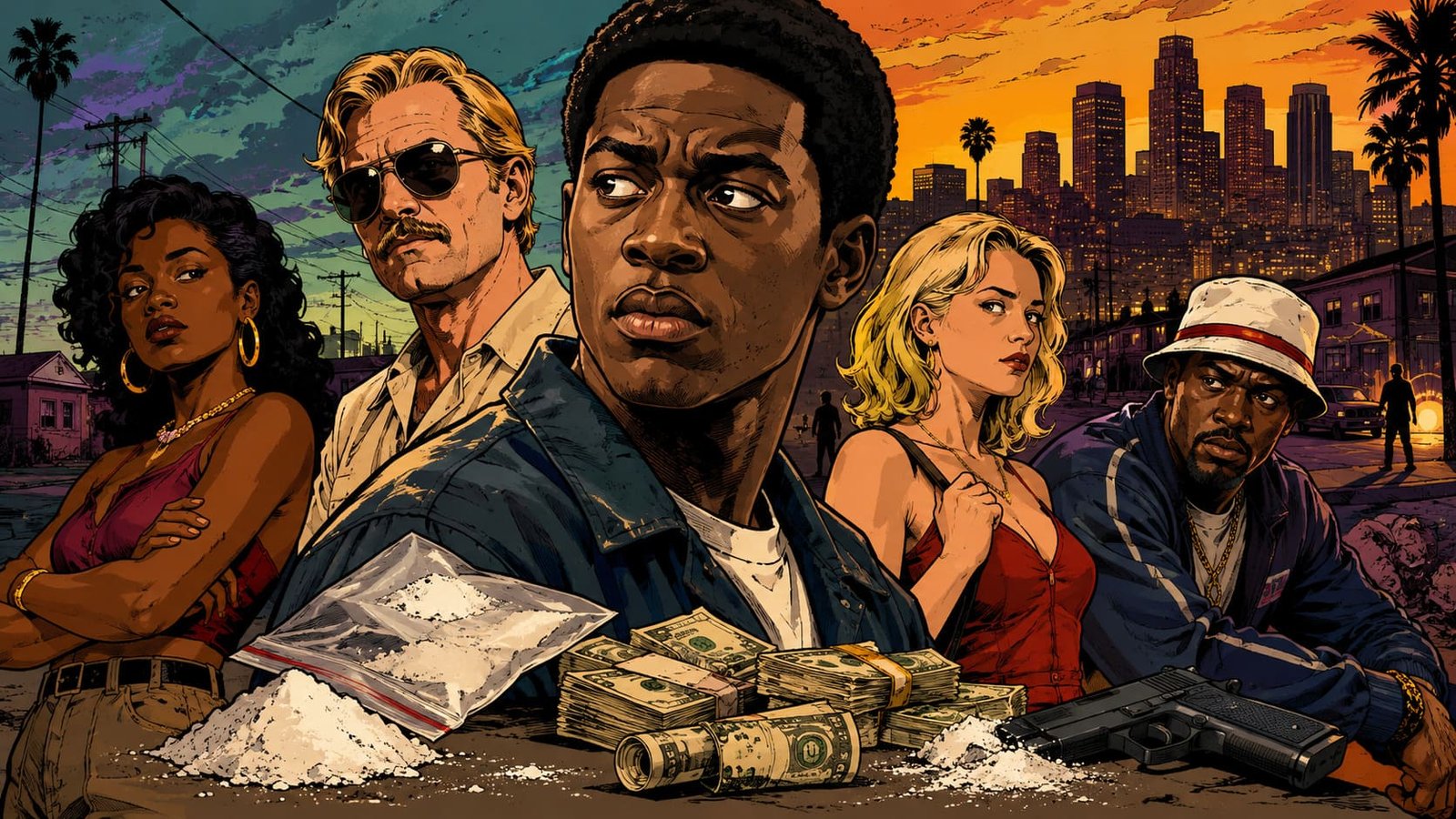
Summer heat wrapped around Los Angeles in Snowfall like a fever no one could sweat out. Palm trees swayed above neighborhoods already carrying the exhaustion of neglect while sirens echoed through streets where children learned survival before innocence fully arrived. The series begins quietly, almost deceptively. Young people chase money. Families chase stability. Politicians chase appearances. Then crack cocaine enters the bloodstream of the city and everything changes shape. Ambition mutates into predation. Community becomes transaction. The American Dream starts looking less like opportunity and more like a market experiment conducted on desperate people.
Damson Idris delivers a mesmerizing performance as Franklin Saint, a character who evolves from ambitious teenager into corporate-minded empire builder with terrifying precision. Franklin never behaves like a reckless stereotype. He studies systems. He calculates. He adapts. That intelligence makes his transformation emotionally devastating because viewers recognize qualities society normally celebrates in entrepreneurs. Vision. Discipline. Strategic patience. Negotiation skills. Snowfall forces an uncomfortable realization into the open: capitalism itself does not guarantee moral direction. The same instincts that create billion-dollar companies can also construct devastating underground economies when legitimate pathways remain inaccessible.
The series becomes especially powerful whenever it examines structural abandonment. South Central Los Angeles is not portrayed merely as a dangerous environment. It is shown as a neglected ecosystem where economic desperation collides with institutional indifference. Factories disappear. Public trust erodes. Political promises evaporate. Into that vacuum steps Franklin with a product capable of generating immediate wealth and catastrophic destruction simultaneously. That contradiction gives Snowfall unusual depth. The show refuses simplistic narratives about personal responsibility without collapsing into excuse-making. Human beings still make choices. Yet choices emerge from environments shaped by history, policy, and unequal opportunity.
A former youth counselor in Nairobi once described watching brilliant teenagers drift toward cybercrime after repeated rejection from traditional employment systems. “They weren’t lazy,” she explained during a community workshop. “They were tired of waiting for permission to survive.” Snowfall captures that emotional atmosphere perfectly. Franklin’s rise feels believable because it emerges from recognizable frustration. Modern societies often romanticize hustle while quietly restricting legitimate access to advancement. Eventually some people stop asking institutions for entry and begin building parallel economies instead.
The relationship between Franklin and his mother, Cissy Saint, gives the series much of its emotional gravity. Michael Hyatt portrays Cissy with the moral exhaustion of someone watching intelligence slowly detach from conscience. Her son becomes successful by the metrics society worships: money, influence, expansion, control. Yet every achievement carries visible spiritual erosion beneath it. Countless parents recognize that fear. Children chase status so aggressively they forget the emotional reasons they wanted success in the first place. Snowfall understands that tragedy deeply. Wealth can stabilize material conditions while destabilizing the soul simultaneously.
The show’s depiction of the CIA connection adds another layer of institutional critique without descending into cartoon conspiracy theatrics. Corrupt systems rarely operate through dramatic secret meetings alone. More often, they emerge through strategic compromise, plausible deniability, and geopolitical priorities overriding local devastation. Snowfall quietly asks a dangerous question: how many communities throughout history have been sacrificed in service of larger political games played far above ordinary citizens’ visibility? That question lingers because the answer feels uncomfortably broad.
One restaurant owner named Elias in Kingston spent years building a small but respected food business before local gang extortion began strangling operations. Police protection felt inconsistent. Economic opportunities shrank. Younger employees started disappearing into criminal networks promising faster rewards. “The neighborhood changed one transaction at a time,” he admitted while cleaning glasses beneath dim fluorescent lights after closing. “Nobody noticed the collapse until it became normal.” That gradual moral deterioration sits at the center of Snowfall. Entire communities do not implode overnight. They erode through repetition.
Visually, the series captures Los Angeles with haunting duality. Sunlight floods swimming pools and luxury mansions while nearby neighborhoods absorb violence, addiction, and paranoia. The contrast feels deliberate. American prosperity has always depended partly on selective visibility. Some suffering remains hidden behind economic mythology until crisis makes concealment impossible. Snowfall drags that hidden reality directly into the frame. Even the soundtrack contributes beautifully, blending nostalgia with dread until every party scene carries undertones of collapse waiting patiently nearby.
Franklin’s evolution eventually becomes Shakespearean in scale. He starts as a young man seeking freedom from poverty. Slowly, he transforms into someone trapped by the very empire meant to liberate him. Relationships deteriorate. Trust evaporates. Fear becomes operational logic. This pattern repeats across history constantly. Leaders build systems to escape vulnerability, then discover those systems demand increasing emotional sacrifice to maintain. The empire expands while humanity contracts. Snowfall captures that psychological imprisonment with painful elegance.
Toward the end, Los Angeles begins to resemble a giant mirage shimmering beneath heat and ambition. Drug money flows through neighborhoods like contaminated electricity while ordinary families struggle to recognize the world around them anymore. Franklin stands near the center of that transformation, dressed sharply, speaking calmly, carrying the invisible loneliness of someone who achieved power without peace. That is the devastating brilliance of Snowfall. It understands that civilizations often disguise exploitation as opportunity until the damage becomes impossible to ignore. Somewhere between economic neglect, political gamesmanship, and personal ambition, an entire generation gets taught a brutal lesson: when society repeatedly treats human beings like disposable assets, eventually some people start treating each other the same way. The silence after that realization feels heavier than any gunshot.
Editorial Disclaimer: Whether a TV Show is rooted in fiction or inspired by real events, the actions, decisions, and behaviors portrayed within are not intended to be encouraged, replicated, or endorsed in real-world settings. This review exists solely to analyze the storytelling, characters, themes, and business dynamics presented in the TV Show for educational, analytical, and entertainment purposes. Any ethical or unethical conduct depicted in the TV Show does not reflect the views, values, or endorsements of ESYRITE.
