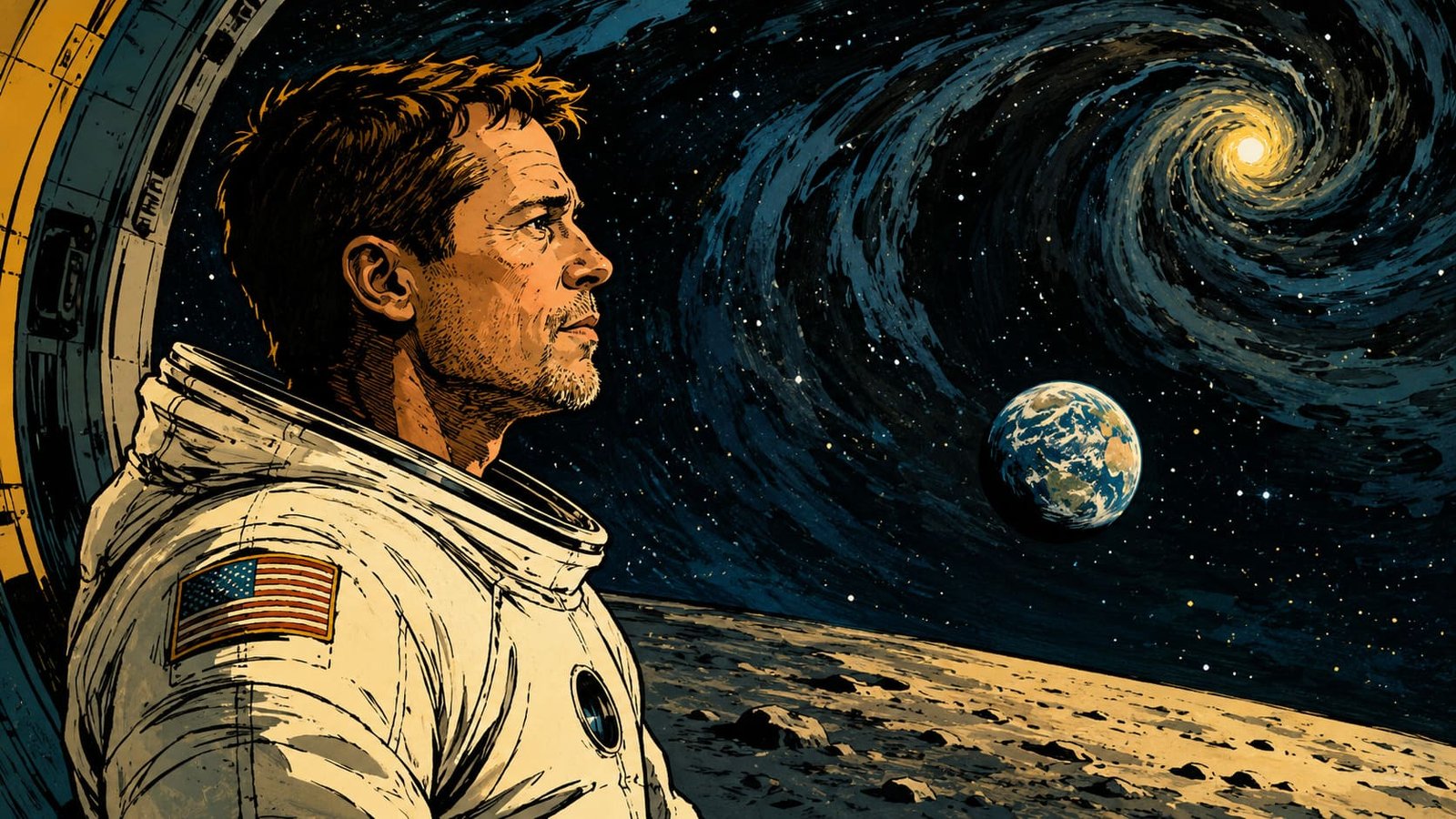
The corridor hummed with sterile silence. Somewhere above the curve of Earth, a man floated through metallic shadows while alarms pulsed like distant heartbeats trapped inside a dying cathedral. Outside the spacecraft window sat the cold majesty of space, endless and magnificent, yet emotionally vacant in a way that felt almost accusatory. Ad Astra moves through that emptiness with hypnotic patience. James Gray does not build a traditional science-fiction adventure. He constructs a meditation on emotional inheritance, masculine ambition, and the strange loneliness hidden beneath humanity’s obsession with conquest. The film looks toward the stars while quietly asking why so many accomplished people still struggle to remain present with the human beings standing directly beside them. Beneath the rockets and lunar landscapes lives a deeply earthly tragedy: success often becomes a sophisticated escape route from intimacy.
Brad Pitt’s Roy McBride drifts through the story like a corporate executive who mastered operational efficiency but misplaced his emotional vocabulary somewhere during the climb. His pulse barely rises. His speech stays measured. His discipline feels almost supernatural. Modern institutions reward this kind of composure constantly. Entire industries confuse emotional suppression with leadership. A logistics founder named Adrian Keller once bragged during a leadership retreat that he had not cried in twenty years. The room applauded as if he had announced a marathon victory. Hours later he sat alone near the hotel ice machine eating cold fries from a paper container while ignoring calls from his estranged daughter. Ad Astra understands that contradiction with painful clarity. Society often celebrates people for becoming emotionally unreachable, then wonders why they collapse internally once the applause fades.
Space in the film operates less like a frontier and more like psychological architecture. Every station feels commercialized, exhausted, and spiritually hollow. The moon resembles an airport lounge designed by venture capitalists after too much caffeine and not enough sleep. Tourists shuffle through branded corridors while violence lurks just outside the polished surface. That detail matters because the movie quietly argues that human beings export their emotional dysfunction into every system they build. Technology changes. Human hunger does not. A former advertising strategist named Mirelle Dane once left a high-paying agency role after realizing her team spent more energy engineering consumer anxiety than solving meaningful problems. She described the office as “a luxury submarine filled with people terrified of silence.” That sentence could fit comfortably inside the emotional landscape of Ad Astra.
The relationship between Roy and his father transforms the movie into something far richer than speculative fiction. Tommy Lee Jones plays Clifford McBride with the haunted conviction of a man who sacrificed ordinary human connection at the altar of cosmic importance. There is something disturbingly familiar about him. Modern culture often treats obsession as virtue when it produces measurable achievement. Founders who ignore families become legends. Executives who destroy their health for expansion become case studies. The mythology of relentless ambition remains deeply seductive because it disguises emotional absence as heroic discipline. Steve Jobs once admitted that his intensity damaged relationships around him even while reshaping entire industries. Ad Astra circles that tension relentlessly. The film asks whether greatness achieved through emotional abandonment still deserves admiration once the lights fade and the rooms become quiet again.
The pacing frustrates some viewers because the story refuses conventional spectacle. That restraint becomes part of its power. Space travel here feels procedural, lonely, almost bureaucratic. Danger arrives suddenly and disappears without dramatic celebration. One lunar ambush unfolds with the detached terror of surveillance footage accidentally capturing human panic. The silence afterward feels heavier than explosions. James Gray seems deeply uninterested in turning existential emptiness into popcorn entertainment. Instead he creates moments that linger like half-remembered dreams. A management consultant named Darius Cole once spent six months traveling nonstop between global offices. Airport lounges blurred together. Hotel carpets smelled faintly of detergent and fatigue. During one delayed flight he reportedly stared at the blinking wing lights outside the cabin window and realized he could no longer remember the sound of genuine laughter inside his own apartment. The emotional gravity of Ad Astra lives inside moments exactly like that.
There is also an undercurrent of criticism aimed directly at modern masculinity. Roy survives by remaining emotionally sealed. Vulnerability threatens operational stability. Yet the film slowly reveals the cost of that survival strategy. Isolation becomes addictive because it protects ambition from interruption. Emotional intimacy requires unpredictability, compromise, and exposure. Entire corporate cultures quietly train people to avoid those conditions. A private equity analyst named Victor Han developed a reputation for ruthless efficiency during acquisition negotiations. Colleagues admired his composure. Years later his marriage dissolved after his wife described him as “physically present but psychologically outsourced.” That phrase hangs over the movie like static electricity. Ad Astra recognizes that emotional distance often masquerades as competence until the loneliness becomes impossible to ignore.
Visually, the film feels extraordinary without becoming self-congratulatory. Neptune glows with ghostly beauty. Metallic hallways echo with mechanical loneliness. Emergency lights flicker across exhausted faces like memories refusing to disappear. Yet the greatest achievement involves emotional atmosphere rather than visual scale. James Gray turns silence into narrative pressure. The emptiness surrounding the characters starts feeling spiritual, almost theological. Humanity reaches farther into the cosmos while remaining profoundly confused about itself. The irony lands hard. Civilization can engineer artificial gravity yet still fail basic emotional honesty during dinner conversations. Technology evolves faster than self-awareness. The movie keeps returning to that imbalance with devastating precision.
Near the emotional center of the story sits a realization too uncomfortable for most productivity cultures to admit openly. Ambition without emotional grounding eventually mutates into exile. Clifford McBride searched the universe for intelligent life while neglecting the fragile human bond already waiting beside him. Roy nearly inherited the same fate. Somewhere inside the silent machinery of distant spacecraft and fading transmissions, Ad Astra reveals a truth that feels larger than science fiction. The greatest distance separating human beings is rarely physical. It is emotional. The film leaves behind the strange sensation of floating alone through beautiful darkness while hearing faint echoes of every relationship sacrificed in pursuit of becoming extraordinary. And somewhere beyond the stars, beyond the machinery and ambition and masculine mythology, waits a question that feels impossible to escape: what if the real frontier was never space at all, but the terrifying act of allowing another person to truly know you?
Editorial Disclaimer: Whether a film is rooted in fiction or inspired by real events, the actions, decisions, and behaviors portrayed within are not intended to be encouraged, replicated, or endorsed in real-world settings. This review exists solely to analyze the storytelling, characters, themes, and business dynamics presented in the film for educational, analytical, and entertainment purposes. Any ethical or unethical conduct depicted in the film does not reflect the views, values, or endorsements of ESYRITE.
