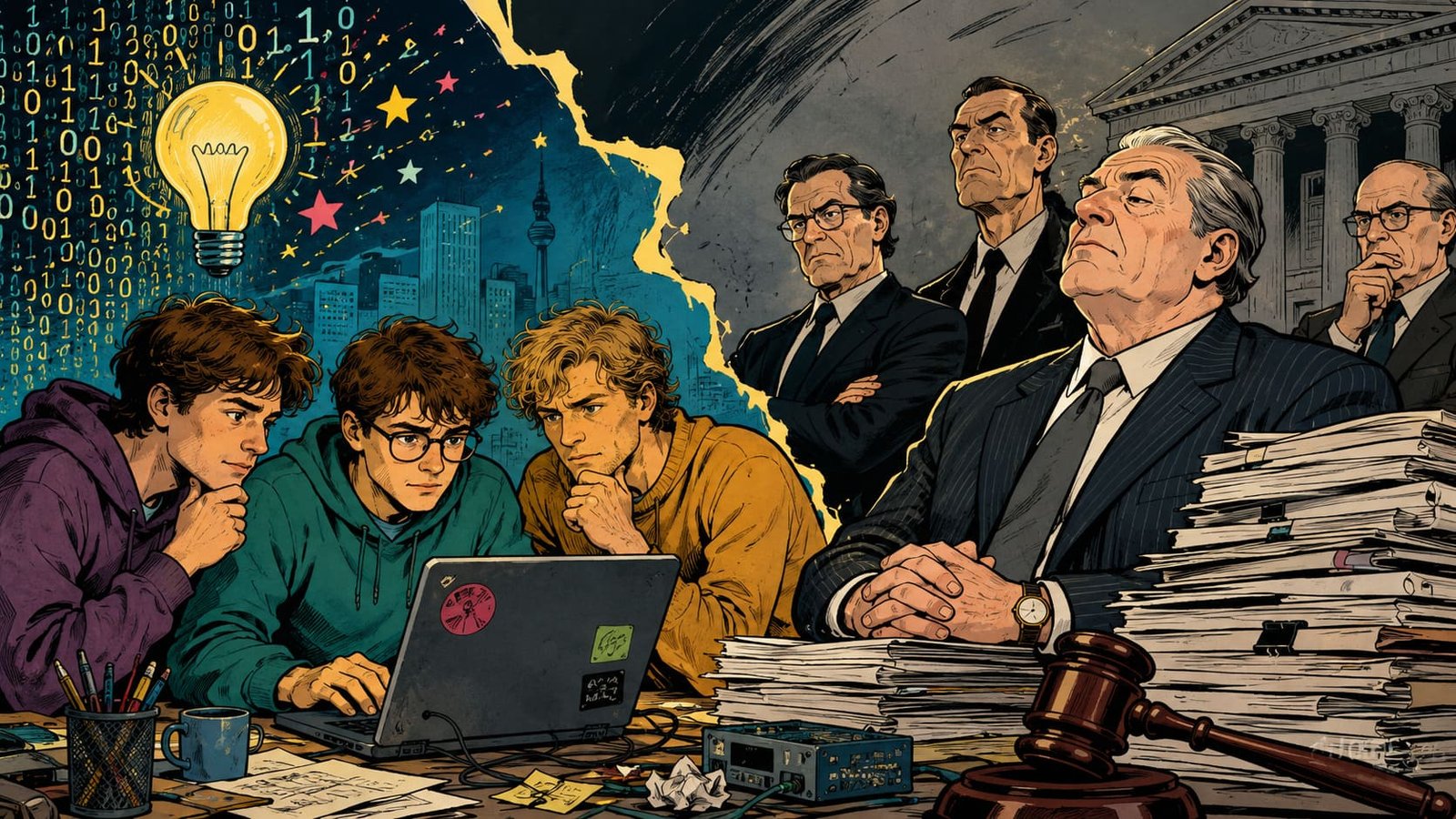
Berlin in The Billion Dollar Code feels cold enough to preserve old resentments like artifacts trapped beneath ice. Graffiti stains concrete walls beside underground clubs where exhausted programmers argue about creativity, freedom, and capitalism while cigarette smoke coils toward cracked ceilings. Long before digital platforms became modern empires, a handful of idealistic engineers were already trying to map the planet through code and imagination. They believed technology could become a form of artistic liberation. Then Silicon Valley arrived with lawyers, scale, and billion-dollar ambition. The series unfolds like a courtroom thriller wrapped around a deeper emotional wound: what happens when innovation born from curiosity gets swallowed by systems optimized for ownership?
Mark Waschke and Marius Ahrendt deliver deeply human performances as Carsten Schlüter and Juri Müller, two creators inspired by the real-life developers behind Terra Vision, an early precursor to technologies later associated with Google Earth. Their partnership carries the beautiful messiness of people driven more by obsession than business discipline. They code through exhaustion. They argue passionately. They improvise wildly. Watching them work feels less like observing entrepreneurs and more like witnessing musicians trying to invent a new language before realizing the industry surrounding them already speaks in patents, leverage, and acquisition strategy.
The brilliance of The Billion Dollar Code lies in how it reframes technological innovation as cultural conflict rather than pure genius mythology. European hacker idealism collides violently with American platform capitalism. One side values openness, experimentation, and artistic possibility. The other values speed, ownership, and aggressive scaling. Neither worldview appears entirely innocent. Yet the emotional imbalance becomes obvious quickly. The dreamers build. The empire monetizes. That pattern repeats across modern technology history with brutal consistency.
A software architect in Nairobi once described presenting a groundbreaking mapping solution at an international conference only to watch a larger corporation release a suspiciously similar product months later with vastly superior marketing reach. “They didn’t steal the idea,” he sighed bitterly over rooftop drinks afterward. “They stole the future attached to it.” The Billion Dollar Code captures that exact emotional devastation. Intellectual theft in the digital age rarely feels cinematic. Often it feels administrative. Quiet. Sanitized through legal language and market dominance.
The courtroom sequences carry unusual philosophical weight because they force viewers to confront uncomfortable questions about ownership itself. Can anyone truly own ideas built from collective technological evolution? At what point does inspiration become exploitation? Silicon Valley often celebrates disruption while quietly consolidating enormous informational power beneath friendly branding. The series exposes that contradiction elegantly. Innovation culture markets itself as rebellious, yet many tech giants eventually behave like traditional monopolies wearing hoodies instead of suits.
One of the show’s smartest choices involves its visual texture. Berlin appears restless and imperfect, full of artistic grime and analog warmth. Early tech experimentation feels tactile. Messy desks. Glowing monitors. Coffee-stained notebooks. Human improvisation everywhere. By contrast, large corporate environments radiate polished detachment. Conference rooms feel emotionally refrigerated. Executives speak about creativity with the sterile precision of people calculating acquisition probabilities. The visual contrast subtly reinforces the series’ deeper argument. Scale often strips invention of emotional texture.
There is a heartbreaking intimacy between Juri and the idea of Terra Vision itself. The technology becomes more than software. It becomes proof of existence. Proof that curiosity mattered before commercial recognition arrived. Countless creators recognize that emotional attachment immediately. Artists. Founders. Writers. Musicians. Researchers. Many projects begin as acts of wonder before market systems demand optimization and monetization. The Billion Dollar Code mourns that transition quietly throughout its runtime.
One product designer named Leila once worked inside a fast-growing augmented reality company in Toronto where executives constantly preached innovation while aggressively suppressing dissenting voices internally. During brainstorming sessions, junior employees hesitated to share original ideas openly because leadership routinely repackaged concepts without acknowledgment afterward. “People stopped creating,” she recalled during a panel discussion years later. “They started protecting.” That sentence hovers over The Billion Dollar Code like static electricity. Systems built around ownership often unintentionally suffocate experimentation itself.
The series also explores timing beautifully. Carsten and Juri create revolutionary concepts before global infrastructure, markets, and institutions fully understand their value. History repeatedly punishes visionaries who arrive too early. Nikola Tesla understood this. So did countless artists, inventors, and founders whose ideas required cultural readiness before profitability became possible. The tragedy is not merely that powerful corporations capitalize on innovation. Sometimes they inherit timing advantages impossible for early creators to survive against.
At its core, the show functions as a meditation on recognition. Human beings want more than money. They want acknowledgment that their imagination altered reality meaningfully. The lawsuit becomes emotionally larger than compensation because it concerns historical authorship itself. Who gets remembered? Who gets erased? Modern digital culture increasingly rewards whoever scales fastest rather than whoever invents first. The Billion Dollar Code forces viewers to sit inside that discomfort rather than escape through simplistic hero narratives.
Near the end, Berlin streets glisten beneath rain while old programmers revisit memories buried beneath decades of frustration and legal warfare. Screens flicker softly in dark rooms where youthful idealism once believed technology could remain innocent. Somewhere between artistic obsession and corporate conquest, an entire generation of creators learned a brutal lesson about modern innovation: the world often celebrates imagination only after power figures out how to package it profitably. The haunting realization lingers long after the credits fade. In digital history, genius alone rarely determines legacy. Visibility does. Ownership does. Scale does. And sometimes the people who change the future most profoundly are forced to watch someone else place their logo on it.
Editorial Disclaimer: Whether a TV Show is rooted in fiction or inspired by real events, the actions, decisions, and behaviors portrayed within are not intended to be encouraged, replicated, or endorsed in real-world settings. This review exists solely to analyze the storytelling, characters, themes, and business dynamics presented in the TV Show for educational, analytical, and entertainment purposes. Any ethical or unethical conduct depicted in the TV Show does not reflect the views, values, or endorsements of ESYRITE.
