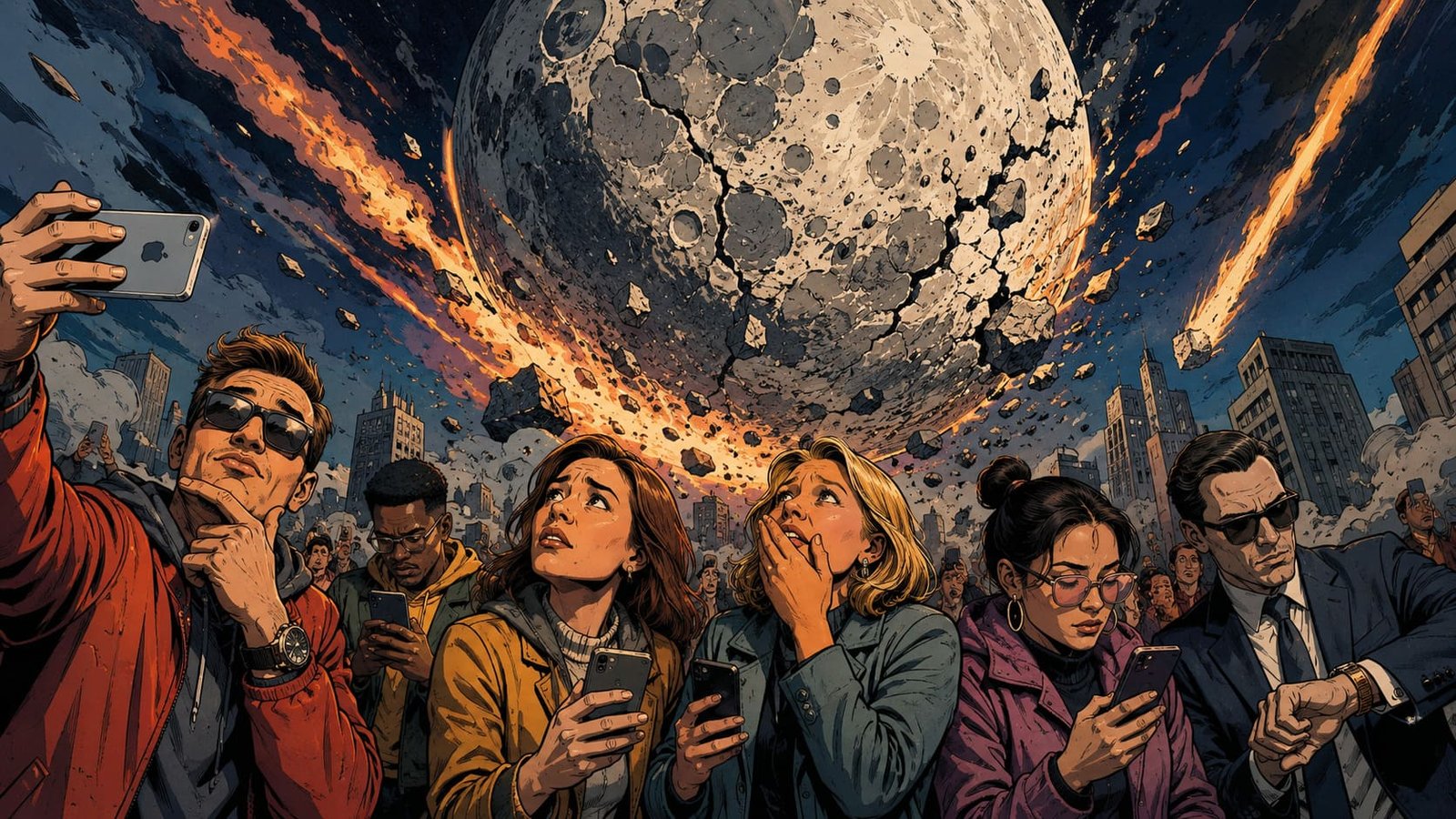
The moon hung over the planet like a cracked surveillance camera watching civilization unravel in slow motion. Tides swallowed cities. Gravity twisted like a corrupted operating system. Somewhere beneath the screaming headlines and collapsing skylines, human beings continued arguing about authority, ego, and control while the laws of existence themselves started malfunctioning. Moonfall arrives with all the absurd spectacle of classic disaster cinema, yet Roland Emmerich quietly slips something stranger beneath the destruction. The film becomes a delirious meditation on institutional arrogance and humanity’s desperate need to believe it understands systems far larger than itself. Critics mocked its excess, though the excess feels strangely appropriate. Modern civilization increasingly resembles a species building glass towers while pretending the universe signed a long-term stability contract.
The story moves with the logic of a conspiracy theory written during an energy drink binge at three in the morning, and somehow that chaos strengthens its emotional texture. Governments suppress information. Scientists fight for credibility. Billionaires prepare escape strategies while ordinary people absorb confusion through glowing screens. That emotional atmosphere no longer feels fictional. Public trust has eroded so dramatically that almost every major crisis now arrives wrapped in competing narratives and algorithmic panic. A transportation executive named Lionel Mercer once described sitting inside an airport lounge during a massive systems outage where passengers refreshed social media feeds faster than airline officials could provide updates. Rumors spread quicker than facts. Anxiety became contagious. Moonfall captures that psychological fragmentation with eerie precision beneath all the cosmic insanity.
Halle Berry’s Jocinda Fowler carries the exhausted determination of someone trying to maintain rationality while institutions collapse into bureaucratic paralysis. Her performance taps into a modern leadership dilemma rarely discussed honestly. Competent people inside large systems often spend more energy navigating politics than solving problems. Meetings multiply. Accountability dissolves. Public relations language replaces clarity. A renewable energy consultant named Priya Solberg once warned regional officials about grid vulnerabilities tied to extreme weather patterns. Her presentation circulated through committees for months because nobody wanted ownership of politically inconvenient decisions. By the time corrective measures arrived, the infrastructure had already failed during a heat emergency. Moonfall repeatedly suggests that civilizations rarely collapse from lack of intelligence alone. They collapse because institutions mistake procedural delay for strategic caution.
John Bradley’s conspiracy-minded K.C. Houseman introduces another fascinating layer. The character initially appears ridiculous, almost comic relief wandering through catastrophe with internet-forum energy. Yet the film gradually reveals his intuition contains fragments of truth ignored by official structures. That tension mirrors contemporary culture uncomfortably well. Modern societies produce vast amounts of information while simultaneously weakening shared consensus around reality itself. Sometimes institutions dismiss legitimate warnings because the messenger appears socially awkward or emotionally inconvenient. A cybersecurity researcher named Elena Weiss once spent years raising alarms about vulnerabilities in public infrastructure systems. Colleagues privately mocked her intensity until a ransomware attack disrupted multiple municipal networks across Europe. Afterward executives described her work as “unexpectedly visionary,” the corporate equivalent of discovering the fire alarm had been correct all along.
The film’s wild mythology about the moon functioning as an artificial megastructure sounds ludicrous on paper. Yet beneath the sci-fi spectacle sits a surprisingly philosophical question: what happens when humanity realizes its understanding of existence might be embarrassingly incomplete? Modern civilization operates with astonishing confidence considering how little remains fully understood about consciousness, technology, ecology, or even human psychology. A biotech founder named Stefan Varela once compared innovation culture to “children rearranging furniture inside a spaceship they barely know how to fly.” That line could function as the unofficial thesis of Moonfall. The movie keeps exposing the fragile vanity hidden beneath human systems of certainty.
Visually, the destruction unfolds with operatic absurdity. Entire cities fold beneath gravitational chaos while debris spirals across glowing skies like civilization itself losing structural coherence. Roland Emmerich directs catastrophe with almost religious intensity. Yet the most interesting moments arrive quietly. Characters stare upward in stunned silence. Families reconnect briefly while systems fail around them. Luxury becomes meaningless once survival enters the room. That emotional shift matters because modern culture often confuses convenience with stability. A venture capitalist named Hugo Lin reportedly panicked during a prolonged blackout at a private tech retreat because every smart system inside the compound stopped functioning simultaneously. Doors failed. Water systems stalled. Nobody could access digital credentials. Participants who spent careers discussing futuristic innovation suddenly struggled to locate basic flashlights.
The film also carries subtle criticism of technological dependence disguised as progress. Artificial intelligence systems, automated infrastructure, and centralized networks appear throughout the story as both miracles and vulnerabilities. Human beings increasingly outsource survival functions to machines they barely understand emotionally or technically. Convenience seduces societies into dangerous fragility. One logistics manager named Celine Duarte once joked that modern cities “operate like giant smartphones with emotional support branding.” The joke stopped feeling exaggerated during supply chain disruptions that left entire regions scrambling for ordinary necessities. Moonfall thrives inside that contradiction. Human advancement creates extraordinary capability while simultaneously multiplying existential risk.
By the final stretch, the movie stops feeling like simple disaster entertainment and starts resembling a feverish allegory about human arrogance itself. Civilizations build myths around control because uncertainty terrifies the mind. Leaders promise stability. Corporations promise optimization. Technologies promise mastery over nature. Then one unforeseen disruption exposes how provisional everything really was. Moonfall leaves behind the sensation of standing beneath a collapsing sky while realizing the universe never promised human beings permanence or understanding. Somewhere between shattered satellites and tidal destruction, the film uncovers a haunting truth modern culture spends enormous energy avoiding: intelligence alone does not guarantee wisdom, and progress without humility may simply accelerate collapse with better branding. And when the systems finally begin trembling beyond repair, the most frightening discovery may not be that humanity is powerless, but that it spent centuries pretending otherwise.
Editorial Disclaimer: Whether a film is rooted in fiction or inspired by real events, the actions, decisions, and behaviors portrayed within are not intended to be encouraged, replicated, or endorsed in real-world settings. This review exists solely to analyze the storytelling, characters, themes, and business dynamics presented in the film for educational, analytical, and entertainment purposes. Any ethical or unethical conduct depicted in the film does not reflect the views, values, or endorsements of ESYRITE.
