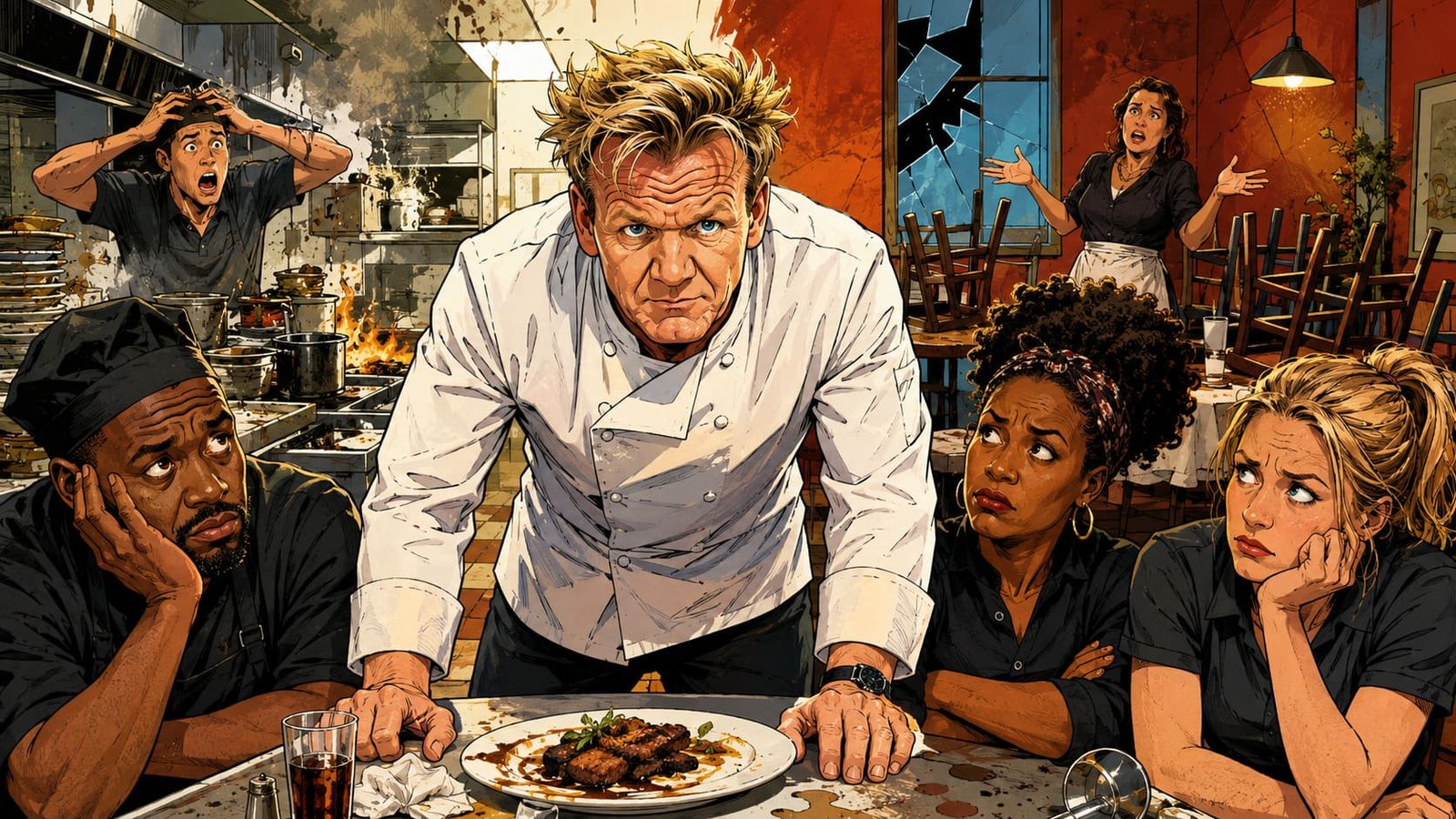
Grease clung to kitchen walls in Kitchen Nightmares like the residue of abandoned ambition. Freezers groaned under forgotten food. Dining rooms sat half-empty beneath flickering lights while exhausted owners rehearsed optimism for customers who stopped believing months ago. Then Gordon Ramsay storms through the doors with the energy of a man entering burning buildings for sport. Plates slam onto counters. Excuses collapse under sharp interrogation. Somewhere between the shouting, the rotting produce, and the emotional breakdowns, the series reveals something far deeper than restaurant rescue entertainment. Kitchen Nightmares is really about denial. About how human beings cling to broken systems long after reality has already left the room.
The genius of the show lies in its brutal honesty about leadership failure. Most restaurants do not collapse because the food tastes terrible alone. They collapse because communication erodes slowly. Accountability disappears. Pride hardens into blindness. Owners stop listening. Staff stop caring. Customers quietly vanish. Watching Ramsay inspect kitchens feels strangely similar to watching a crisis consultant enter failing corporations after years of executive delusion. The signs were always visible. People simply stopped confronting them honestly because emotional comfort became more valuable than truth.
One café owner in Nairobi once admitted after closing his family restaurant that he ignored customer complaints for nearly a year because criticism felt personally humiliating. “Every bad review sounded like someone insulting my entire life,” he confessed softly while stacking unused chairs in a dusty dining room. Kitchen Nightmares captures that emotional reality perfectly. Businesses often become extensions of identity. When operations fail, owners experience criticism as existential attack rather than useful feedback. That psychological trap destroys organizations faster than competitors ever could.
Ramsay himself deserves more nuanced recognition than the screaming caricature pop culture often reduces him to. Beneath the explosive confrontations sits a surprisingly sophisticated understanding of organizational behavior. He identifies dysfunctional communication patterns instantly. Passive-aggressive managers. Exhausted staff members. Founders trapped inside nostalgia. Family conflicts bleeding into operations. Many episodes resemble emergency therapy sessions disguised as restaurant makeovers. Ramsay pushes aggressively because stagnation has usually calcified over years. Soft encouragement alone cannot break systems trapped inside self-deception.
The family dynamics throughout the series are especially revealing. Countless restaurants operate as emotional battlegrounds where unresolved resentment simmers beneath customer service smiles. Fathers refuse delegation. Siblings sabotage each other subtly. Couples confuse loyalty with enabling. One restaurant owner keeps a disastrous menu because it belonged to a deceased relative. Another protects an incompetent chef out of guilt rather than logic. Kitchen Nightmares understands a painful truth modern management culture often ignores: businesses are emotional organisms before they become financial entities.
A hotel operations director named Celina once described taking over a struggling resort in Accra where employees had stopped reporting problems because previous management punished honesty harshly. Broken equipment stayed hidden. Guest complaints disappeared from records. Kitchen staff quietly improvised around shortages instead of escalating issues. “People learned survival instead of ownership,” she explained during a leadership retreat later. That sentence could summarize half the restaurants featured in Kitchen Nightmares. Dysfunction becomes normalized gradually until collapse feels ordinary.
The visual atmosphere of the series amplifies this beautifully. Kitchens sweat under fluorescent lights while old carpets trap years of cigarette smoke, spilled wine, and failed expectations. Ramsay tastes food with expressions ranging from disbelief to existential exhaustion. Yet beneath the chaos sits something strangely tender. Many owners genuinely love hospitality. They once dreamed of creating spaces where people gathered, celebrated, and connected. Somewhere along the way, stress transformed passion into bitterness. The restaurant survives physically while the original dream suffocates quietly underneath operational panic.
There is also a fascinating critique of nostalgia running throughout the show. Owners cling to outdated menus, stale décor, or obsolete business models because change threatens identity. Customers evolve faster than institutions emotionally adapt. This happens far beyond restaurants. Newspapers resisted digital transformation. Retail chains ignored ecommerce shifts. Record labels underestimated streaming culture. Kitchen Nightmares simply compresses that pattern into intimate, emotionally charged environments where consequences arrive faster and smell worse.
One bakery featured a chef named Marco who insisted on making every pastry manually despite collapsing finances and exhausted staff. Ramsay challenged him aggressively, arguing that perfection without sustainability becomes vanity. Marco broke down afterward, admitting he feared modernization would erase the artistry his father taught him decades earlier. That small moment contains enormous emotional truth. Many failing systems persist because people mistake adaptation for betrayal. Leadership often requires grieving old identities before new realities become possible.
The series also exposes modern customer psychology sharply. Diners crave authenticity, warmth, consistency, and emotional atmosphere more than theatrical complexity. Yet struggling owners frequently chase ego-driven reinvention instead of operational clarity. Ramsay repeatedly simplifies menus, streamlines processes, and restores focus. The lesson extends everywhere. Complexity impresses insecure leaders. Clarity builds durable systems. Businesses fail when they start performing sophistication instead of delivering value.
Near the end, renovated dining rooms glow warmly beneath fresh lighting while exhausted owners stare cautiously at second chances they no longer fully trust. Some businesses recover. Others collapse anyway after cameras leave. That uncertainty gives Kitchen Nightmares lasting emotional power. Real transformation rarely arrives through dramatic speeches alone. It demands painful honesty sustained daily afterward. Somewhere between burnt risotto, family arguments, and empty reservation books, the series reveals a haunting truth about ambition itself: many dreams do not die because people lacked talent. They die because pride convinced them reality was negotiable. The silence inside a failing restaurant carries a particular sadness. It sounds like people remembering who they hoped they might become before exhaustion taught them how easily passion can curdle into survival.
Editorial Disclaimer: Whether a TV Show is rooted in fiction or inspired by real events, the actions, decisions, and behaviors portrayed within are not intended to be encouraged, replicated, or endorsed in real-world settings. This review exists solely to analyze the storytelling, characters, themes, and business dynamics presented in the TV Show for educational, analytical, and entertainment purposes. Any ethical or unethical conduct depicted in the TV Show does not reflect the views, values, or endorsements of ESYRITE.
