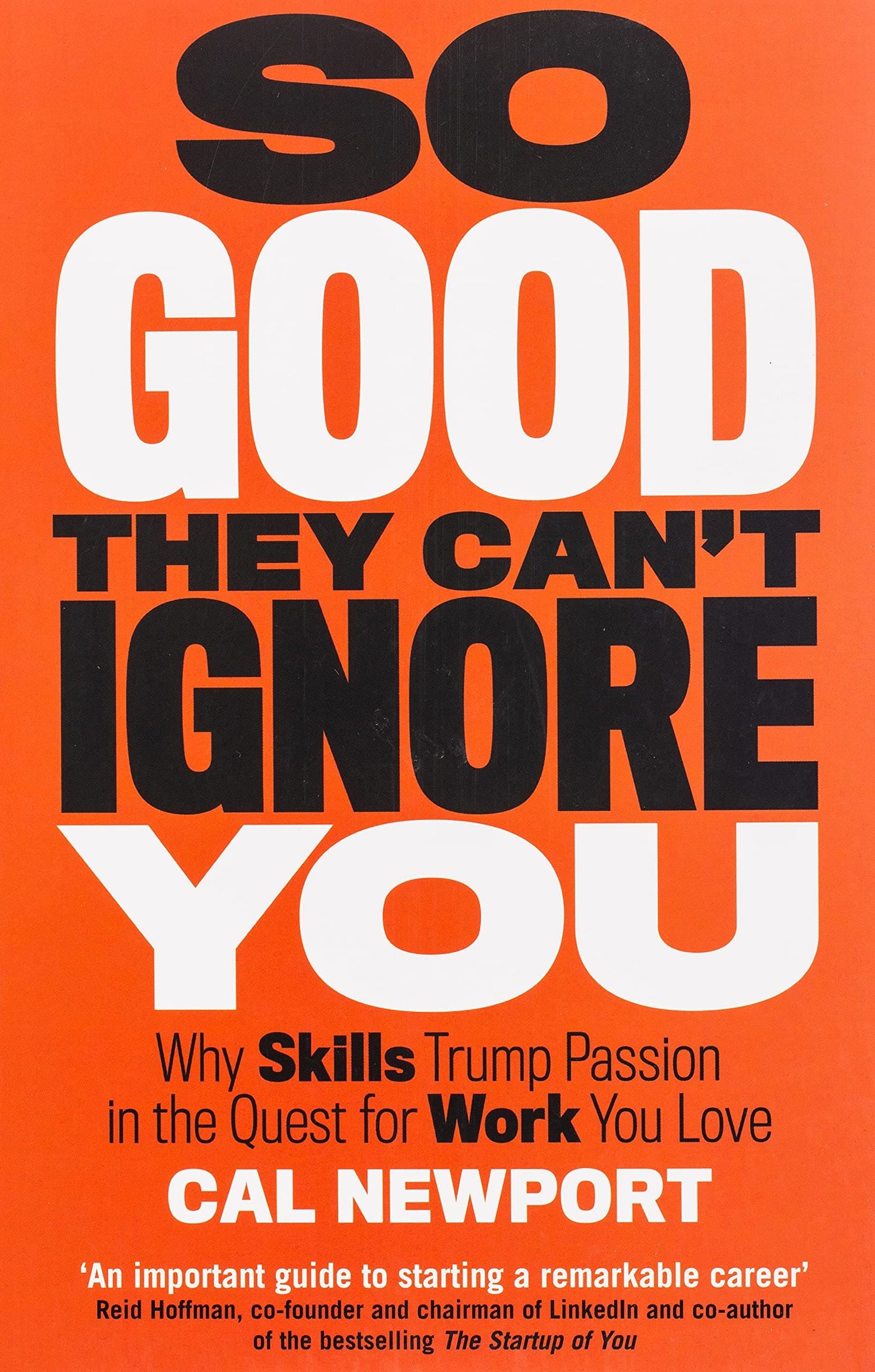
The moment you hear someone say, “Follow your passion,” it sounds like the sacred gospel of career advice. It’s catchy. It’s comforting. It feels rebellious and romantic like quitting your job to become a full-time artisan bread baker or moving to Bali to blog about sunsets. But what if this beloved mantra was, well… wrong? Cal Newport doesn’t just whisper this. He detonates it like a truth bomb.
In his provocative book, So Good They Can’t Ignore You, Newport takes a scalpel to the passion hypothesis, the idea that matching your job to a pre-existing passion is the key to professional happiness. With the precision of a scientist and the sass of a disillusioned millennial, he argues that passion isn’t something you follow; it’s something you build. Work becomes meaningful not because it’s love at first sight, but because you invest in rare and valuable skills that give you control, autonomy, and a sense of mission.
This book hits different because it dares to be inconvenient. It doesn’t sell you dreams on a sugar-coated stick. Instead, it makes you pause, scratch your head, and rethink the very foundation of how you chase success. Newport isn’t out to destroy your dreams. He’s out to help you build a career that’s real, sustainable, and actually satisfying even if it doesn’t glitter on Instagram.
Drawing from compelling case studies, research, and hard-earned wisdom, Newport flips the table on career advice. He introduces concepts like “career capital” and the “craftsman mindset,” showing how mastery and excellence; not vague enthusiasm, are the currency of a meaningful career. If you’ve ever felt stuck, misled, or uncertain about your purpose, this book doesn’t just offer clarity. It offers a map.
And let’s be honest: in an economy that rewards competence more than charisma, Newport’s argument isn’t just timely. It’s necessary. So, if you’re tired of chasing dreams that lead nowhere, welcome to a different conversation; one that puts depth over dopamine and process over passion. Buckle in. This one’s a ride worth taking.
Quick Notes: Key Truths at a Glance
- Passion is not a prerequisite for great work: it often develops after mastery.
- The craftsman mindset (focus on what value you’re offering) beats the passion mindset (focus on what the job offers you).
- Career capital (rare and valuable skills) is the fuel that powers autonomy, mission, and control in your work.
- Deliberate practice not just clocking hours: is the key to becoming so good they can’t ignore you.
- Control traps: Grabbing autonomy before you’re valuable enough to wield it can derail your progress.
Mastery Over Myth: The Real Road to Career Fulfillment
Cal Newport’s *So Good They Can’t Ignore You* unfolds in four digestible rules that challenge our romanticized ideas about passion and profession. The first rule boldly proclaims: “Don’t Follow Your Passion.” Newport dismantles the popular notion that passion is a career compass. He illustrates, using real-life stories, how blindly chasing what you “love” often leads to frustration, burnout, or worse; career paralysis. Instead, he points to research showing that very few people begin with a clear passion and that passion often follows skill, not the other way around.
The second rule, “Be So Good They Can’t Ignore You,” is inspired by a quote from comedian Steve Martin. Newport encourages adopting a craftsman mindset; where one focuses on developing rare and valuable skills as the path to career satisfaction. Through the lens of computer programmers, musicians, and other high performers, he demonstrates how becoming great at something is what unlocks true opportunities, not just enthusiasm or desire.
“Turn Down a Promotion” sounds counterintuitive, but Newport’s third rule explores the importance of control in your work. He discusses the “control trap,” warning that trying to gain autonomy too early, without having built sufficient career capital, often backfires. He spotlights individuals who’ve succeeded in negotiating control only after becoming indispensable; a move that gives them not just freedom, but the ability to wield it effectively.
The fourth and final rule, “Think Small, Act Big,” dives into the power of mission-driven work. Newport contends that a compelling mission emerges after deep work within a specific field. Once you’re competent enough to recognize the cutting edge of your craft, you can then spot problems worth solving. This, he argues, is how meaningful careers are born; not through grand visions, but through consistent refinement and action.
Together, these four rules present a cohesive, research-backed alternative to the passion narrative. Newport doesn’t just criticize mainstream advice; he replaces it with a system grounded in logic, evidence, and lived success. His framework doesn’t promise a shortcut to career bliss, but it offers something better: a process for building a career you’ll never want to escape from.
From Wishful Thinking to Winning Strategy: Five Life-Changing Lessons
One of the most disruptive takeaways from this book is that passion is a byproduct, not a prerequisite. Newport showcases that meaningful work is rarely discovered overnight. Instead, it’s earned over time as you gain mastery. Case in point: many of the most fulfilled professionals he profiles didn’t begin their careers with a deep love for their craft. It was their consistent effort, deep engagement, and progression in skill that sparked true passion; turning disinterest into devotion.
Another standout lesson is the craftsman mindset versus the passion mindset. The craftsman mindset centers on “what can I offer the world?” while the passion mindset obsessively asks, “what can the world offer me?” This subtle mental shift has massive implications. Newport’s research and stories prove that those who focus on contribution rather than consumption often build careers of deep satisfaction, while passion-seekers tend to flounder when the work gets tough.
Third, Newport introduces the concept of career capital; the building blocks of control and fulfillment. Without this capital, which consists of skills so rare and valuable they make you indispensable, you’re unlikely to earn autonomy or do work that truly matters. He compares this capital to currency: the more you have, the more you can negotiate freedom, mission, and meaning in your work. It’s a currency that’s non-negotiable for building a remarkable career.
Fourth, the trap of premature autonomy is a real danger. Newport highlights stories of people who walked away from traditional paths to pursue “freedom,” only to fall flat. Without enough value backing their independence, they lost credibility, financial stability, and even motivation. This cautionary tale forces readers to reassess the gig economy fantasy and realize that freedom must be earned, not declared.
Newport leaves readers with the insight that mission isn’t found; it’s constructed. You don’t wake up one day with a grand calling. Instead, you dig deep into a field, immerse yourself in deliberate practice, and discover opportunities that resonate. This is a message of hope, not cynicism. It shifts career success from luck to intentionality; from passion myths to practical mastery.
Your Dream Job Isn’t Found: It’s Built Brick by Brick
Cal Newport doesn’t just nudge you to rethink how you pursue meaningful work; he forces you to. So Good They Can’t Ignore You is not the book you turn to for comfort. It’s the one you grab when you’re tired of fluffy advice, tired of spinning your wheels, and ready to anchor your ambitions in something more enduring than Instagram quotes. It dares to be brutally helpful in a world obsessed with instant gratification.
This book doesn’t sell dreams; it sells process. Newport’s argument is bold: the dream job isn’t something waiting for you behind a curtain. It’s something you actively construct by becoming excellent at something the world values. This emphasis on skill, discipline, and strategy isn’t just empowering; it’s liberating. It gives you agency in a way passion never could. You’re no longer waiting for lightning to strike. You’re building your own storm.
And what’s most refreshing is that Newport isn’t merely theorizing. He’s grounding his arguments in real-world examples, from organic farmers to venture capitalists, all of whom found fulfillment not by chasing butterflies of interest but by doubling down on effort, value, and craft. These case studies make his message relatable and repeatable: greatness isn’t reserved for the lucky. It’s available to the prepared.
Perhaps the most radical idea in the book is also the most grounding: fulfillment isn’t about doing what you love, but about loving what you’ve painstakingly gotten great at. When viewed through that lens, anyone; from a teacher to a software developer to a designer can build a career of deep purpose, provided they’re willing to do the work.
So if you’ve been feeling lost, disillusioned, or betrayed by the promises of “follow your passion,” this book won’t hand you a magic key. But it will hand you a blueprint. And in the long run, that’s infinitely more powerful. Read it not to be inspired, but to be transformed. Then get to work.
About the Author
Cal Newport is a computer science professor at Georgetown University and a prolific thought leader in the realm of productivity, technology, and career strategy. Known for his deep-dive research and crisp writing, Newport is also the author of Deep Work, Digital Minimalism, and A World Without Email. Unlike most career gurus, Newport walks his talk: he’s known for his intentional living, disdain for distraction, and data-backed approach to success. His work bridges the gap between academic rigor and real-life application, earning him a devoted following among knowledge workers, creatives, and entrepreneurs who want more than surface-level motivation—they want systems that work.
Disclaimer
Note that the ideas and content in the book are solely from the author of the book and not the ESYRITE Editorial Team. All opinions expressed in this book review are entirely from the ESYRITE Editorial Team. This review may contain affiliate links, meaning ESYRITE may earn a small commission if you make a purchase through these links, at no additional cost to you.
