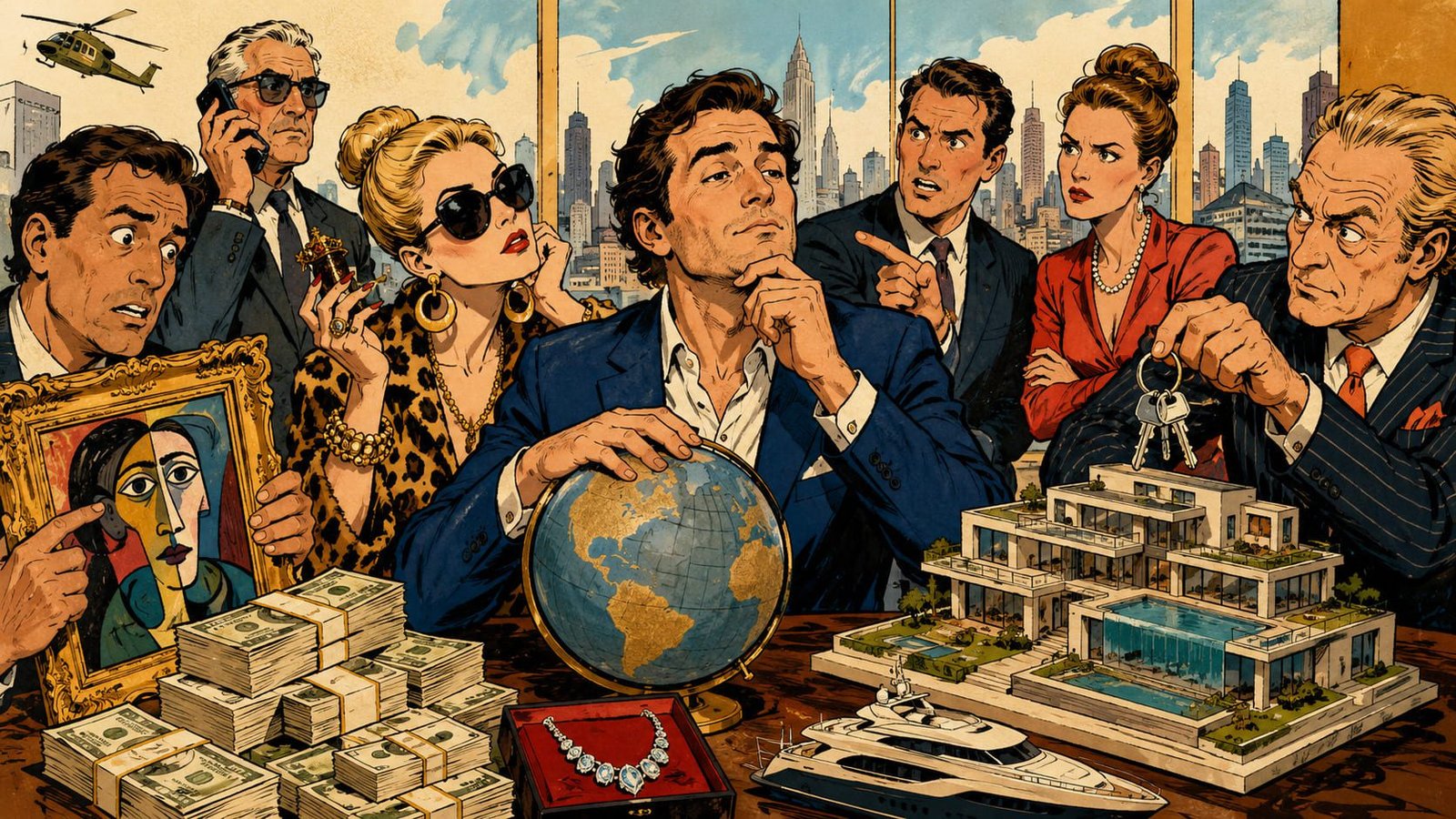
Crystal chandeliers shimmer above luxury hotels in Billion Dollar Buyer while anxious entrepreneurs smooth wrinkled shirts moments before presenting products that could either transform their lives or quietly disappear into rejection. Delivery trucks unload handcrafted sauces, artisan linens, specialty coffee, and carefully packaged dreams behind loading docks where opportunity smells faintly of cardboard, perfume, stress, and fresh bread. At the center stands Tilman Fertitta, billionaire restaurateur and casino owner, studying small business owners with the calm intensity of someone who understands markets as emotional battlefields disguised as commerce. The series presents itself as business reality television, yet underneath the negotiations and luxury settings sits something more revealing: modern capitalism as psychological audition.
The brilliance of Billion Dollar Buyer lies in how quickly it dismantles romantic myths about entrepreneurship. Motivational culture often treats business ownership like heroic liberation. Hustle harder. Believe more. Manifest success. Then reality arrives carrying inventory shortages, operational chaos, weak margins, exhausted founders, and customers who owe loyalty to nobody. Fertitta evaluates products ruthlessly because large-scale hospitality systems punish inconsistency brutally. One weak supplier can damage entire customer experiences. Watching small founders pitch their creations feels strangely intimate because viewers recognize something universal underneath the commerce. Everyone wants their effort to matter. Everyone wants validation from systems usually too large to notice individuals clearly.
Fertitta himself becomes fascinating precisely because he balances warmth with merciless practicality. He compliments passion but interrogates scalability immediately afterward. Can production increase? Can quality remain stable? Can this business survive pressure without collapsing emotionally? Those questions expose a deeper truth modern startup culture often avoids. Great ideas mean very little without operational resilience. Billion Dollar Buyer repeatedly reminds viewers that execution separates fantasy from sustainability. The marketplace rarely rewards emotional attachment alone.
A bakery founder named Selam once traveled from Addis Ababa to pitch specialty pastries to a regional hotel chain in Nairobi. She spent nights refining recipes while worrying privately about transport costs, staffing, and debt obligations. During the tasting, executives praised flavor enthusiastically but questioned whether her small kitchen could handle larger contracts reliably. “That meeting changed how ambition felt,” she admitted later over sweet tea in a crowded café. “Dreams suddenly sounded like logistics.” Billion Dollar Buyer captures that exact psychological shift beautifully. Entrepreneurship stops feeling romantic once scale enters the room.
The series becomes especially compelling whenever entrepreneurs collapse emotionally under scrutiny. Some founders respond defensively. Others become desperate to please. A few reveal remarkable composure. Those moments transform the show into a subtle study of leadership psychology. Business pressure does not create character from nothing. It exposes existing emotional architecture already hiding beneath confidence. Fertitta recognizes this instinctively. He studies people almost as carefully as products because operational partnerships depend heavily on temperament under stress.
There is also a fascinating tension between craftsmanship and scalability running throughout the series. Small business owners often build products with obsessive personal care. Handwritten notes. Family recipes. Tiny quality rituals invisible to outsiders. Large hospitality systems, however, require consistency across volume. That transition frequently wounds founders emotionally. One sauce maker resists simplifying production because the original recipe came from his grandmother. Another artisan fears automation might erase the soul of her brand entirely. Billion Dollar Buyer understands something modern capitalism rarely admits honestly: growth often demands emotional compromise alongside financial expansion.
One procurement manager named Javier once worked for a luxury resort chain in Cancún where vendors constantly pitched “authentic experiences” wrapped in expensive branding language. During private evaluations, leadership cared far less about storytelling than reliability. Could shipments arrive on time? Would packaging survive humidity? Could suppliers handle holiday demand spikes? “Nobody fails because of the dream,” Javier explained quietly during an industry conference. “They fail because systems punish weak operations mercilessly.” That sentence hangs over the series constantly. Markets reward imagination publicly while quietly worshipping consistency underneath.
Visually, the show contrasts luxury environments against entrepreneurial vulnerability beautifully. Five-star dining rooms glow beneath polished lighting while nervous founders rehearse pitches outside kitchens carrying boxes by hand. The emotional imbalance feels intentional. Billionaires evaluate products casually while small business owners attach existential hope to every meeting. One contract could change a family’s trajectory permanently. The series never lets viewers forget those stakes. Wealth creates emotional distance from risk. Smaller entrepreneurs live inside risk continuously.
The strongest episodes reveal how identity becomes entangled with business creation. Founders describe products as extensions of family history, migration stories, personal hardship, or cultural heritage. A coffee entrepreneur speaks about preserving regional farming traditions. A textile creator explains how her mother stitched fabrics late into the night after losing stable work years earlier. These moments elevate the show beyond transactional entertainment. Commerce becomes narrative. Supply chains become emotional inheritance.
There is also quiet commentary about modern consumer behavior woven throughout the series. Luxury hospitality increasingly sells atmosphere rather than functionality alone. Guests crave experiences carrying authenticity, uniqueness, and emotional texture. Billion Dollar Buyer understands that successful products must satisfy both operational logic and psychological longing simultaneously. The hospitality industry no longer sells meals or hotel stays merely. It sells curated memory.
Toward the final stretch, entrepreneurs stand inside grand hotel corridors waiting for decisions that feel disproportionately life-altering compared to the ordinary objects they brought into the room. Sauces. Candles. Coffee beans. Linen patterns. Yet somewhere between those products and the billion-dollar machinery evaluating them sits the emotional heart of the series. Human beings keep searching for proof their labor carries value beyond survival alone. Some founders receive contracts. Others leave disappointed but sharper. All confront the same unsettling truth eventually: business is not merely about making money. It is about learning whether your vision can withstand reality without losing its soul completely. And that lesson arrives far heavier than any invoice ever could.
Editorial Disclaimer: Whether a TV Show is rooted in fiction or inspired by real events, the actions, decisions, and behaviors portrayed within are not intended to be encouraged, replicated, or endorsed in real-world settings. This review exists solely to analyze the storytelling, characters, themes, and business dynamics presented in the TV Show for educational, analytical, and entertainment purposes. Any ethical or unethical conduct depicted in the TV Show does not reflect the views, values, or endorsements of ESYRITE.
