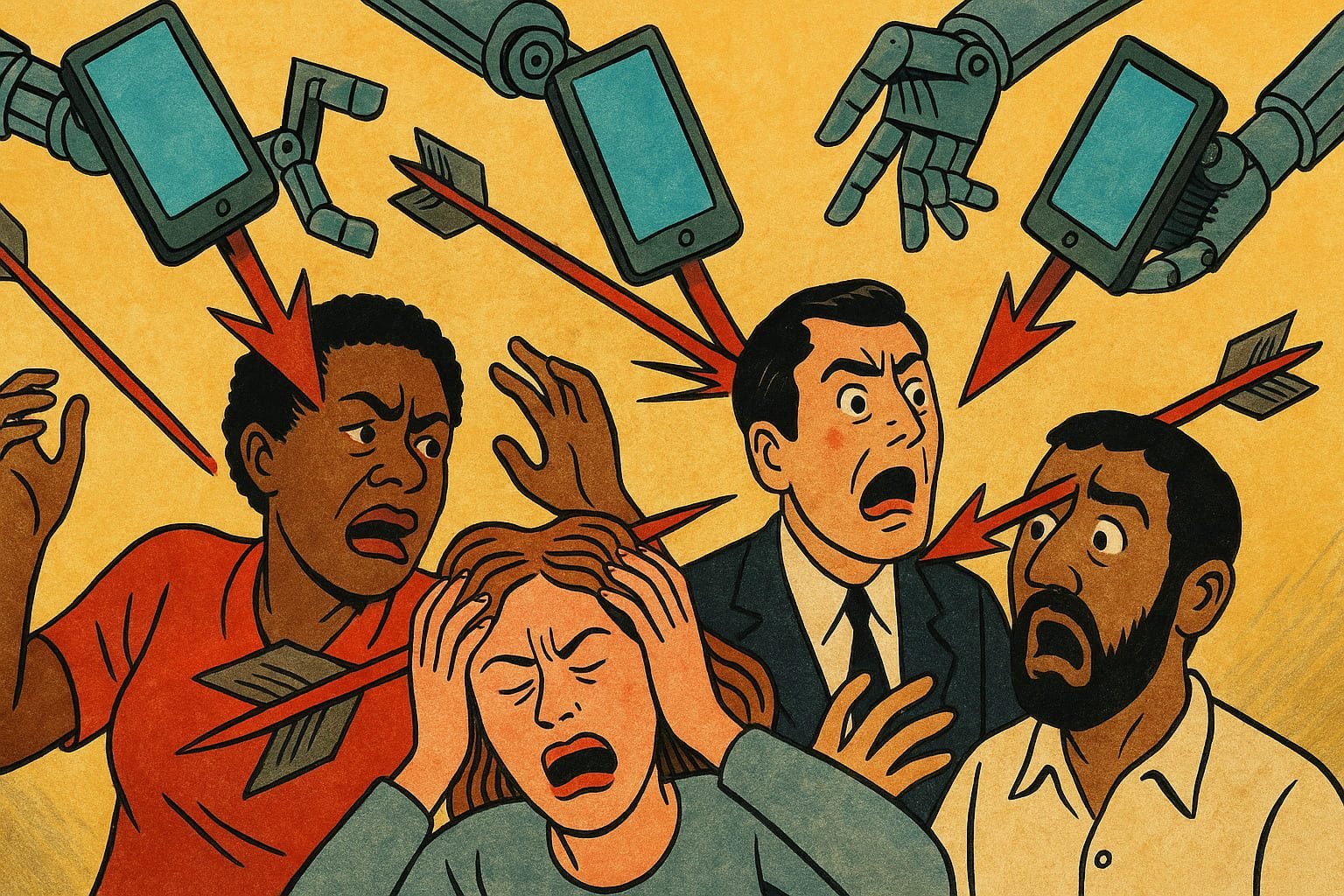
Floodlights cut through the midnight gloom, illuminating a vast stadium where nobody cheers. Instead, rows of screens shimmer with restless energy—each pixel a soldier in an unseen war. At center field, a lone teenager scrolls her phone, thumbs darting between apps, her gaze glassy and unfocused. The roar of digital notifications fills the air, drowning out the faint memory of silence. Up in a VIP box, executives toast the day’s engagement metrics, their laughter echoing above a field littered with the discarded intentions of users everywhere.
Beyond the stadium, the city pulses with similar battles. In boardrooms, engineers fine-tune algorithms to capture more minutes, more swipes, more clicks. At kitchen tables, families sit together but drift apart, hypnotized by private screens. Even dreams are invaded, as the blue light of smartphones seeps into the darkness, crowding out the quiet inner voice that once guided choices. A therapist’s office nearby is packed with patients confessing a new addiction: the endless need to check, to refresh, to never miss out.
Every notification is a shot fired in a war for human attention. The casualties are invisible—lost time, fractured focus, faded ambitions. This is not entertainment, but an all-out siege. In this new battlefield, your mind is the last territory left to defend.
Quick Notes
- Battle for the Mind: Tech giants engineer platforms to hijack attention, rewiring habits and hijacking free will.
- Invisible Manipulation: Algorithms shape thoughts, moods, and even beliefs—subtly and relentlessly.
- Real Lives Disrupted: Relationships, work, and self-esteem buckle as the attention war escalates, leaving a trail of burnout and regret.
- Resistance Movements Rise: Individuals and communities discover strategies for reclaiming time, focus, and inner peace.
- What Will You Defend?: The fight for attention is a fight for the soul—your choices shape the future of your mind.
Enter the Gladiators – How Big Tech Designs Addiction
Designers and engineers gather in glass towers, their job simple yet profound: make people stay. In San Francisco, a product manager boasts of features tested to maximize “stickiness.” Each red notification, each autoplay video, is a calculated move. Users feel in control but find themselves scrolling long after they meant to stop. In one legendary meeting at a major social network, an executive asked, “How can we keep them coming back?” The answer: tweak the variable rewards, make every click a roll of the dice.
A teenage gamer in Seoul admits he sometimes forgets to eat while chasing digital trophies. His parents worry, but the game’s designers call it “deep engagement.” At a university, a psychology professor teaches a class on habit formation, using real-world apps as case studies. Students marvel at how their routines—morning, noon, and night—have been captured and commodified.
Notifications are engineered interruptions. A mother in London describes her phone buzzing at dinner, pulling her into a work chat while her child quietly pokes at cold peas. The guilt is immediate, but the habit is harder to break. “It’s like being on a leash,” she confides to her friend.
Big Tech rewards loyalty with streaks, badges, and endless feeds. Each new update is framed as empowerment, but the real beneficiary is the platform’s bottom line. At a conference, a former designer for a dating app reveals, “We knew exactly when to send matches to trigger the next session.” The industry applauds—innovation means more time, more data, more power.
Every screen, every app, every buzz is a gladiator in the arena, trained to capture one thing: your attention. The winners are measured in hours and dollars; the losers are anyone who hoped to use their time for something else.
Manipulation in Plain Sight – How Algorithms Rewrite Reality
Most people believe they shape their feeds, but the truth is more unsettling. Algorithms sift through likes, comments, pauses, and even lingering glances, constructing a personalized cage. A high school teacher in Toronto is shocked when conspiracy theories flood her news feed after a single click. “I didn’t ask for this,” she tells her husband. The algorithm didn’t ask either—it simply calculated the odds and went to work.
Mood is no longer private. Platforms sense when users are sad, anxious, or angry, tweaking content to intensify the feeling. A study finds that people exposed to more negative posts report higher stress and worse sleep. Users blame themselves, not realizing their emotions are managed by unseen hands.
Micro-targeted ads shape decisions before they’re conscious. A barber in Lagos sees promotions for beard oil after texting a friend about shaving. The coincidence is eerie, the effect profound. He finds himself buying products he never planned to consider, persuaded not by reason but by persistent nudges.
Echo chambers deepen as algorithms reinforce existing beliefs. Political arguments erupt online, fueled by recommendation engines designed to spark outrage. A journalist in Sydney tracks the polarization, noting how friends stop speaking after one viral argument. The platforms deny responsibility, insisting they “connect the world.” The connections grow brittle, easily snapped by manufactured conflict.
Reality itself bends to the will of code. Deepfakes, fake news, and manipulated trends flood the public square. Trust collapses. People grow suspicious, isolated, anxious that what they see is never quite what it seems.
The Human Cost – Broken Focus, Fractured Lives
The casualties of the attention war are hard to count, but easy to find. A college student in Boston flunks an exam after binge-watching short videos into the early morning. She confesses to her roommate, “I can’t stop, even when I know I should.” Her story is common; support groups for “digital addiction” spring up on campuses everywhere.
Work suffers as notifications invade every quiet moment. An architect in Mumbai misses a crucial detail on a blueprint, distracted by a constant stream of team updates. His boss is sympathetic, but the client is not. The pressure to multitask leaves no room for deep thought, no time for flow.
Relationships unravel. Partners fight over screen time, parents struggle to engage distracted kids, friends meet for coffee but spend more time photographing their lattes than talking. A therapist in New York reports a surge in couples counseling driven by digital neglect. “They’re together, but alone,” she observes. “Screens come first.”
Self-worth takes a beating. Influencers live by likes, ordinary users compare themselves to curated perfection, and the gap between real life and digital fantasy widens. An athlete in Cape Town deletes her social apps after falling into a spiral of self-doubt. “I was measuring myself by numbers,” she says, “and it nearly broke me.”
Burnout follows. The need to always be “on,” to keep up, to respond immediately, drains energy and joy. Sleep is sacrificed. Creativity shrinks. The mind becomes a battlefield, littered with unfinished tasks and forgotten dreams.
Fighting Back – Stories of Resistance and Renewal
Despite the onslaught, not everyone surrenders. Some reclaim their attention with bold acts of defiance. A tech CEO in Zurich bans phones from meetings, reporting shorter sessions and deeper insights. Her team protests at first, then thrives. “We started listening again,” she tells an interviewer.
Families draw boundaries, setting device-free hours or designating “phone baskets” at the door. A father in Nairobi leads nightly walks with his children, leaving devices behind. The conversations return, the silence becomes comfortable, and the bonds grow stronger.
Schools experiment with mindfulness and digital literacy. At a charter school in Melbourne, students keep journals of their screen habits, reflecting on what they gain and lose. Teachers report higher grades and happier kids. The principal says, “We’re learning to use tech, not be used by it.”
Communities form around slow, intentional living. Book clubs, hiking groups, and even analog gaming nights see a resurgence. A bar in Brooklyn offers discounts to patrons who lock their phones in a box during happy hour. The laughter is louder, the memories sharper, the sense of presence unmistakable.
Tech companies, pressured by users and regulators, begin to offer real “pause” buttons, transparency tools, and options to limit tracking. The changes are slow but signal a shift. The war is not over, but the resistance is real.
Choosing What Matters – Reclaiming the Mind’s Frontier
The attention war is a test of values, a daily decision about what deserves time and energy. Some choose radical simplicity, unplugging entirely or adopting minimalist devices. A graphic designer in Paris ditches her smartphone for a classic flip phone, finding peace in the absence of constant demands. “I feel alive again,” she writes in her notebook.
Others cultivate intentional habits. A software engineer in Dubai uses app blockers and schedules “focus hours,” treating attention as a precious resource. Productivity soars. He rediscovers hobbies long neglected, including music and painting.
Organizations support well-being with policies that prioritize deep work. A consultancy in Vancouver introduces “focus Fridays”—no meetings, no emails, just space to think. Employee satisfaction climbs, turnover drops, and innovation returns.
Mental health professionals advocate for “digital hygiene,” helping clients set boundaries, prioritize rest, and reconnect with their own thoughts. Group therapy sessions teach skills for managing notifications, confronting FOMO, and rediscovering solitude.
The journey to reclaim attention is personal, but never solitary. Each person who wins back their mind becomes a beacon for others, proving that life can be lived on purpose, not just on autopilot. The war is winnable, one choice at a time.
The Last Quiet Room: Guarding the Mind’s Flame
In a quiet apartment above a bustling street, a lamp glows beside an unopened book. The world’s noise is distant, filtered by heavy curtains and the steady breath of someone finally at rest. Outside, the city roars, but inside, time slows to a gentle hum. The phone sits silent, a powerless relic on the table.
A child’s laughter drifts in from the hallway, unburdened by urgency or digital applause. In the soft darkness, the mind stretches, yawns, and dreams unencumbered by algorithmic demands. The world still wants attention, but tonight, it waits politely at the door. The heart guards its flame, choosing presence over performance. Now, you decide what gets in, and what stays outside.