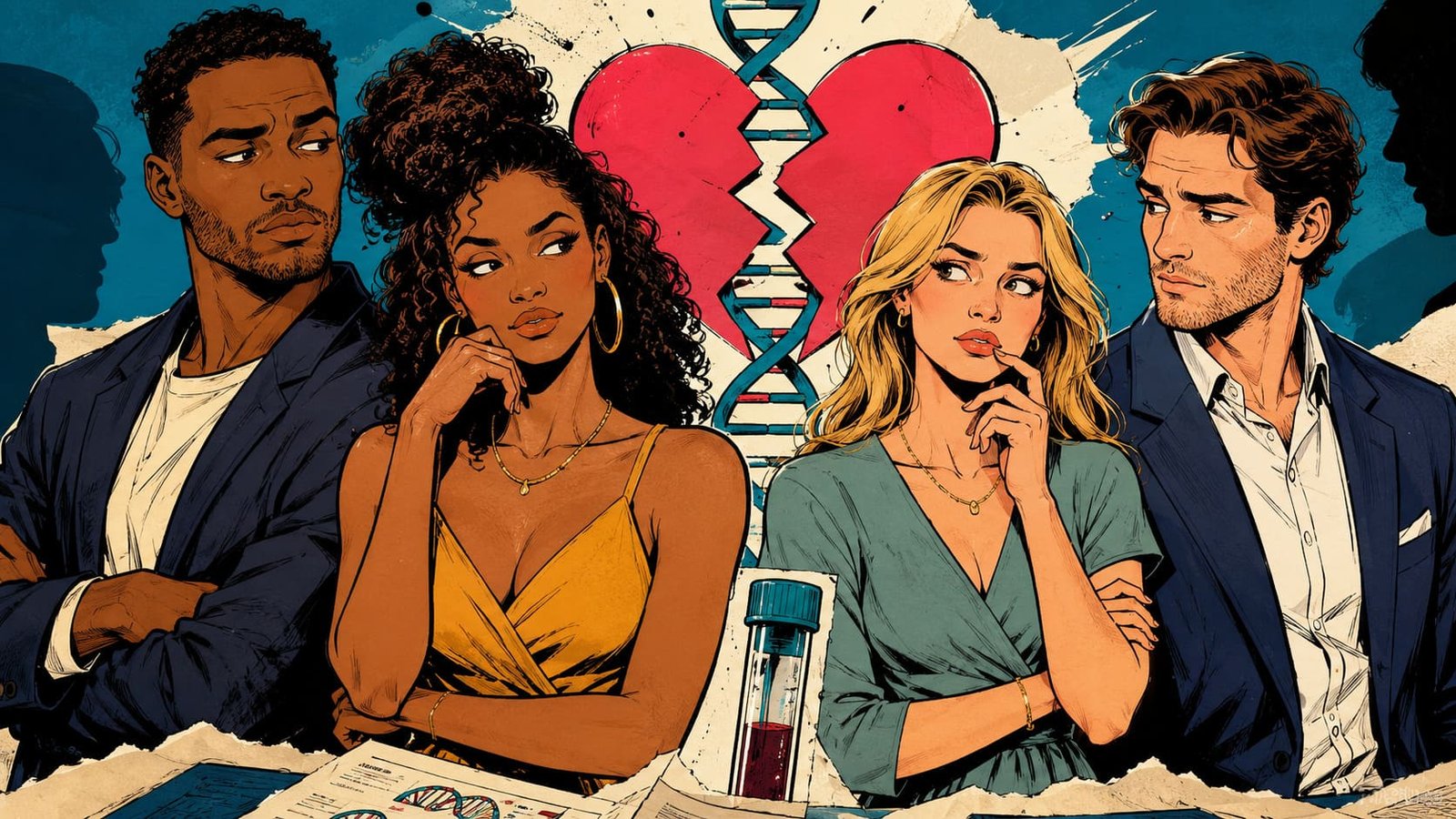
Rain shimmered against the glass walls of futuristic laboratories in The One while lonely people across the world stared at their phones as though salvation might finally arrive through notification alerts. The series opens with a deceptively seductive premise: science discovers a way to match every human being with their genetically perfect soulmate. One strand of hair. One laboratory test. One supposedly undeniable truth about love. At first glance, it sounds like romance upgraded by technology. Then the deeper horror slowly emerges. What happens when intimacy becomes data? What happens when desire stops being mysterious and starts behaving like predictive software?
Hannah Ware’s Rebecca Webb glides through the series with the unsettling confidence of a founder who mistakes innovation for moral exemption. She belongs to a recognizable modern archetype: the visionary entrepreneur intoxicated by disruption. Rebecca does not merely sell matchmaking technology. She sells emotional certainty to exhausted people drowning in modern loneliness. That distinction matters. The series understands something Silicon Valley repeatedly exploits: individuals rarely buy products alone. They buy relief from psychological discomfort. Dating apps promised connection. Social media promised belonging. Wellness brands promised inner peace. The One simply pushes that logic toward its most dangerous extreme.
There is something profoundly disturbing about how quickly society inside the show surrenders complexity for convenience. Relationships built through years of compromise, memory, forgiveness, and ordinary tenderness begin collapsing under algorithmic temptation. Marriages dissolve because a database suggests a biologically superior emotional outcome elsewhere. Loyalty starts looking irrational. Commitment starts looking inefficient. The show quietly exposes a cultural sickness already visible today. Modern systems increasingly frame human friction as design failure rather than emotional reality. Every inconvenience must be optimized away. Every uncertainty must become measurable.
A behavioral psychologist in Cape Town once described overhearing two executives discussing dating apps during an airport delay. One man spoke about romance exactly the way venture capitalists discuss market inefficiencies. Better filtering. Better targeting. Better compatibility metrics. The language sounded clinical enough to sterilize the entire idea of love itself. Watching The One afterward unsettled her deeply because the show magnifies instincts already hiding in plain sight. Human beings have started treating intimacy like product discovery. Swipe. Compare. Upgrade. Exit. Repeat.
The series becomes especially fascinating whenever it explores identity fragmentation. Characters begin questioning whether their deepest emotions belong to authentic choice or biological inevitability. That philosophical tension gives The One unusual intellectual bite. If science can predict attraction perfectly, what happens to free will? Are relationships meaningful because they are destined, or because people choose each other repeatedly despite uncertainty? The show never answers comfortably. Instead, it traps viewers inside emotional ambiguity. Soulmates become less romantic than invasive. Fate begins resembling surveillance technology wearing perfume.
Rebecca herself represents one of the sharpest critiques of modern leadership culture seen in recent television. She speaks the language of empowerment while quietly orchestrating manipulation beneath the surface. Countless founders operate similarly in reality. Elizabeth Holmes at The Dropout sold revolutionary healthcare narratives while concealing dysfunction. Adam Neumann from WeCrashed marketed communal enlightenment through office rentals wrapped in spiritual branding. Rebecca belongs comfortably beside them. The One suggests charismatic innovators often become dangerous precisely because they understand emotional hunger better than technical ethics.
One micro-story from a creative agency in Nairobi mirrors this eerily. A strategist named Alina left a stable relationship after reconnecting online with someone who perfectly mirrored her interests, humor, political views, and artistic tastes. The relationship felt almost algorithmically designed. For months she described it as destiny. Then came the strange emptiness. “Nothing surprised me anymore,” she confessed quietly over burnt espresso during a late-night brainstorming session. “It felt less like love and more like a reflection talking back.” That emotional exhaustion pulses throughout The One. Frictionless compatibility slowly begins suffocating mystery itself.
Visually, the series wraps emotional catastrophe inside sleek technological beauty. Laboratories glow with sterile elegance. Expensive apartments feel emotionally refrigerated despite their luxury. Every screen flickers with seductive certainty while loneliness quietly deepens underneath. It resembles a future designed by people who mastered efficiency but forgot texture. Even conversations carry digital coldness, as though characters increasingly communicate through optimized emotional templates rather than genuine vulnerability. Black Mirror fans will recognize the atmosphere immediately, though The One feels less cynical and more mournful.
At its core, the show functions as a meditation on modern loneliness disguised as science fiction. Technology keeps promising connection while amplifying emotional fragmentation. Social media offers visibility without intimacy. Dating apps provide abundance without grounding. Algorithms recommend music, movies, friends, news, even identities. The One simply asks the terrifying next question: if technology eventually predicts the heart perfectly, will humanity still know how to love imperfectly? That question lingers because real intimacy has never depended solely on compatibility. It depends on patience, forgiveness, contradiction, timing, sacrifice, and the willingness to remain emotionally present when certainty disappears.
Near the end, city lights blur across rain-soaked windows while lonely strangers scroll through soulmate notifications searching for transcendence inside genetic code. Rebecca stands at the center of a machine she believes can organize human longing into manageable architecture. Yet the more precise the system becomes, the more emotionally hollow the world around it feels. That haunting contradiction gives The One its lasting power. It understands that modern civilization keeps confusing prediction with wisdom and optimization with meaning. Somewhere inside those glowing screens and immaculate laboratories, humanity quietly risks surrendering the beautiful chaos that made love worth chasing in the first place. The final realization lands softly but cuts deeply: a heart perfectly mapped may no longer know how to wander toward wonder.
Editorial Disclaimer: Whether a TV Show is rooted in fiction or inspired by real events, the actions, decisions, and behaviors portrayed within are not intended to be encouraged, replicated, or endorsed in real-world settings. This review exists solely to analyze the storytelling, characters, themes, and business dynamics presented in the TV Show for educational, analytical, and entertainment purposes. Any ethical or unethical conduct depicted in the TV Show does not reflect the views, values, or endorsements of ESYRITE.
