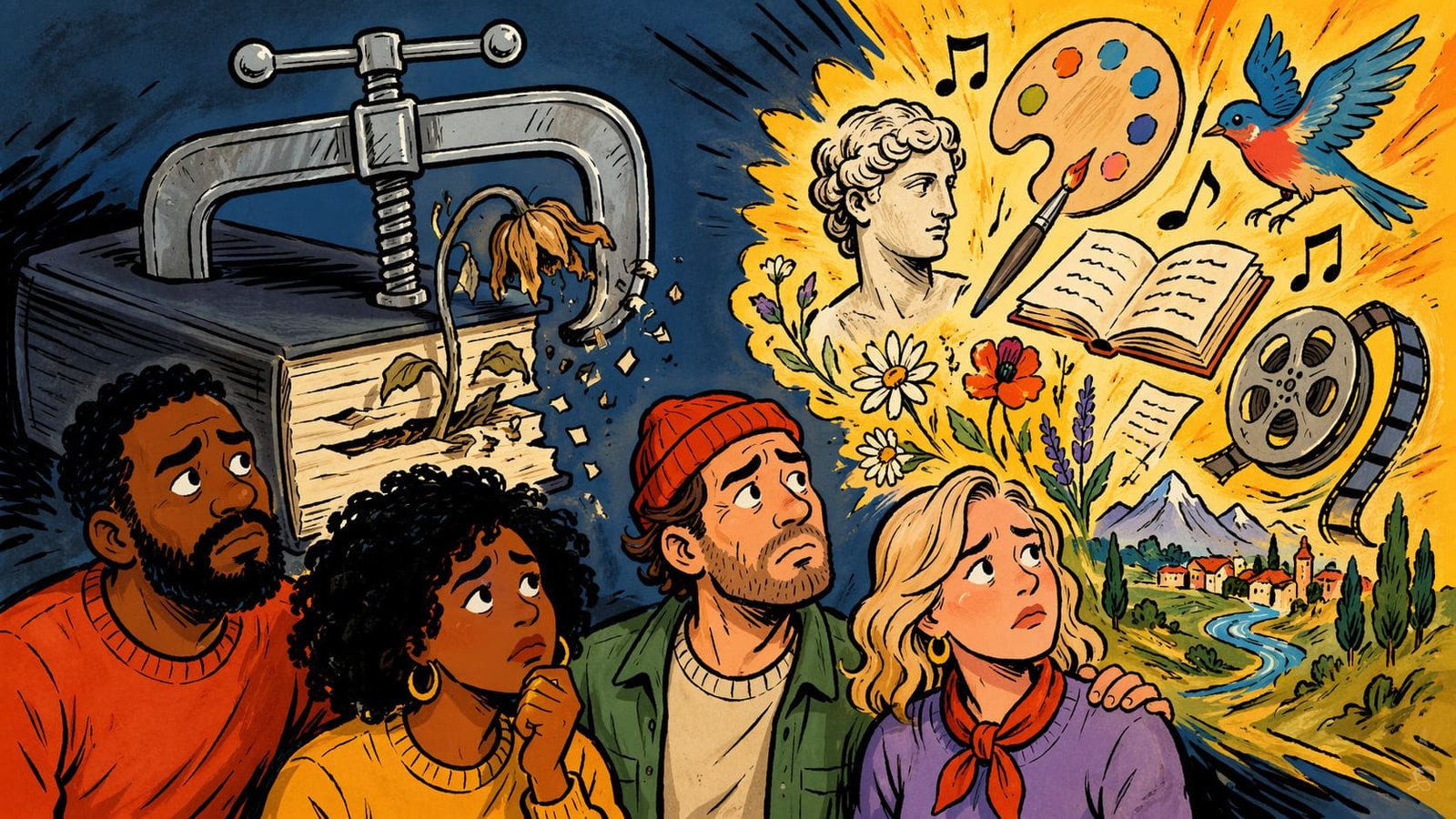
A library stands open, but the shelves feel thinner than they should. Not empty, not abandoned, just subtly restricted. A reader reaches for a story that once belonged to everyone, only to find it locked behind a quiet barrier that wasn’t there before. No alarm sounds. No visible theft occurs. Yet something has been taken. Not a book, but access. Not a thing, but a shared inheritance that used to breathe freely.
The public domain has always been culture’s oxygen. It is the space where ideas circulate without permission, where creativity borrows, reshapes, and reimagines without fear. It is how stories survive beyond their creators, how art evolves across generations. When a work enters the public domain, it does not lose value. It multiplies it. It becomes raw material for the future. That openness is not a luxury. It is the engine of cultural renewal.
Over time, that engine has slowed. Legal protections meant to reward creators have expanded, stretched, and extended. Copyright terms grow longer. Access becomes narrower. The intention may be to protect, but the effect often feels like containment. Works that could inspire new interpretations remain locked away, inaccessible to the very culture that could give them new life. The result is not silence, but a quieter, more constrained conversation.
Consider Daniela, a young filmmaker who once set out to adapt a forgotten novel into a modern story. She discovered the rights were still held, decades after the author’s passing. Negotiations stalled. Costs rose. The project faded. What might have become a new cultural artifact remained an idea. Daniela moved on, but the absence lingered. Not just for her, but for the audience that would never encounter that reinterpretation.
The history of culture tells a different story. Many of the works now considered foundational were built on what came before. William Shakespeare drew from existing tales, reshaping them into something enduring. Walt Disney built early animations on public domain fairy tales, transforming them into global icons. These creations did not diminish the originals. They extended them, giving them new relevance and reach. The public domain made that possible.
The tension lies in balancing protection with participation. Creators deserve recognition and reward. That principle is not in question. The challenge emerges when protection extends so far that it limits the ability of others to build, reinterpret, and contribute. Culture thrives on dialogue. When that dialogue is restricted, creativity becomes more isolated, less connected to the broader tapestry of human expression.
A publisher named Elias once described the shift during a conversation about modern storytelling. He noticed that younger writers were increasingly cautious, avoiding references, adaptations, or reinterpretations that might invite legal complications. Instead of engaging with the past, they created in isolation. The result was technically original, but often disconnected. The richness that comes from layering ideas across time began to fade.
There is also an economic dimension to this contraction. Large organizations with the resources to navigate complex rights systems continue to operate freely. Smaller creators, independent artists, and emerging voices face barriers that limit their participation. Access becomes uneven. The public domain, once a shared resource, starts to feel like a gated space where only certain players can move comfortably.
A musician named Kofi once attempted to sample an old recording that had shaped his childhood. The process became a maze of permissions, fees, and uncertainty. Eventually, he abandoned the idea, choosing instead to create something entirely new. The track was well received, but he admitted that something was missing. The connection to history, the dialogue with the past, had been lost in the process.
The cultural cost of a shrinking public domain is difficult to measure because it manifests as absence. It is the book that is never rewritten, the film that is never made, the song that is never remixed. These absences do not announce themselves. They accumulate quietly, leaving gaps that are felt rather than seen. Over time, the cultural landscape becomes less layered, less dynamic, more cautious.
There is a paradox at the heart of this issue. The intention to preserve value can end up limiting it. When works remain locked away, their influence stagnates. They exist, but they do not evolve. Culture, by its nature, resists stasis. It thrives on movement, on reinterpretation, on the constant reshaping of meaning. Restricting that movement does not protect culture. It confines it.
In a small studio filled with scattered notes and unfinished drafts, a writer sits with an idea that feels just out of reach. The inspiration came from a work that cannot be touched, a story that remains just beyond access. The writer hesitates, then turns away, choosing a safer path. The moment passes, unnoticed by anyone else, but it leaves behind a quiet absence that will never be filled.
The air in that room feels slightly thinner, though nothing visible has changed. The tools are still there. The desire to create remains. Yet something essential has been reduced, something that once flowed freely now constrained by invisible boundaries.
In that subtle shift, a question lingers, not as protest, but as reflection: if culture cannot breathe freely, how long before it forgets how to live?
