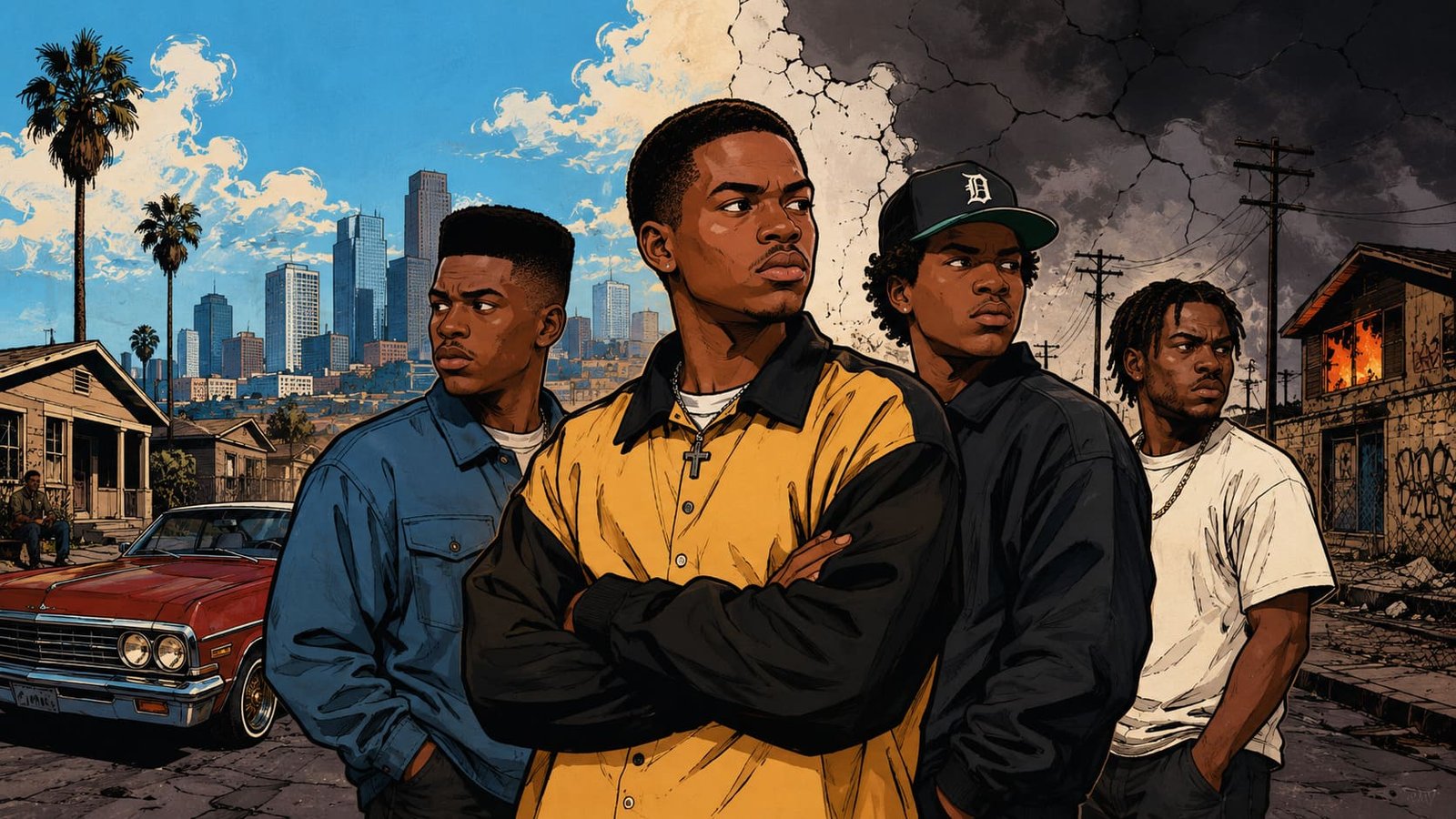
South Central Los Angeles sounded like a pressure cooker left too long on the fire. Helicopters scraped across the night sky while distant sirens folded into barking dogs and bass-heavy car stereos. Children played basketball beside cracked sidewalks carrying the weight of memorial candles and bullet holes. Mothers watched porch lights flicker with the quiet anxiety of people who understood how quickly ordinary evenings could turn permanent. Somewhere between the liquor stores, schoolyards, and patrol cars moving like silent threats through the dark, boys learned adulthood before learning peace.
Boyz n the Hood remains one of the rare films willing to examine violence without turning suffering into spectacle. Directed by John Singleton, the story follows Tre Styles, Ricky Baker, Doughboy, and their families through a neighborhood shaped by structural neglect, fractured opportunity, and emotional survival. Most coming-of-age stories frame adolescence as discovery. This film treats it more like navigation through a minefield designed generations earlier. That difference gives the movie its enduring force. The tragedy here does not feel accidental. It feels engineered.
Tre, played by Cuba Gooding Jr., grows under the guidance of Furious Styles, portrayed with unforgettable gravity by Laurence Fishburne. Furious understands something modern society often avoids admitting plainly: environments shape psychology long before individuals begin making independent choices. His lessons about responsibility, discipline, and self-worth sound less like lectures and more like emergency survival instructions passed between generations. The film becomes devastating precisely because good parenting alone cannot fully protect children inside broken systems. Wisdom helps. Structure matters. Yet entire neighborhoods still carry invisible economic traps waiting beneath daily life.
A youth counselor in Baltimore named Marcel once described mentoring teenage boys who could identify firearm calibers faster than college majors. One student arrived at after-school sessions carrying perfect attendance records and untreated insomnia after witnessing a shooting outside his apartment building. Another teenager memorized stock market terminology from YouTube videos while simultaneously calculating which bus routes avoided rival crews. Marcel recalled one rainy afternoon when a boy asked whether ambition even mattered if geography kept deciding outcomes first. “That question stayed in the room like smoke,” he admitted quietly years later. Boyz n the Hood carries that same smoke through nearly every scene.
The genius of the film lies in its refusal to flatten anyone into stereotype. Doughboy, played by Ice Cube, could have easily become a one-dimensional criminal archetype. Instead, he emerges as emotionally intelligent, wounded, funny, observant, and devastatingly aware of the system swallowing him whole. His anger feels rational inside irrational conditions. The movie understands a brutal truth about society: people often condemn behaviors created by environments they refuse to repair. Poverty becomes criminalized while abandonment becomes policy.
One unforgettable sequence involving a backyard gathering radiates warmth so genuine it almost hurts. Friends joke casually. Music drifts through the air. Smoke rises slowly beside laughter carrying brief moments of normalcy. That scene matters because the film insists Black communities contain joy, tenderness, humor, and complexity beyond headlines about violence. Hollywood frequently reduces struggling neighborhoods into symbols of danger rather than fully human ecosystems filled with ambition, love, boredom, fear, and ritual. Boyz n the Hood resists that reduction fiercely.
The film also exposes how masculinity mutates under constant threat. Boys raised inside instability often learn emotional suppression as a defense mechanism. Vulnerability becomes dangerous currency. Fear hides behind aggression because softness invites exposure. Furious tries teaching Tre another model of manhood built around emotional accountability and patience. That tension between inherited survival instincts and healthier identity forms the emotional backbone of the movie. Countless men beyond South Central recognize pieces of themselves here. Entire cultures reward emotional hardness while quietly punishing tenderness.
A restaurant owner in Manchester named Amina once hired several young men from difficult housing estates into her kitchen after a community program connected them. One employee named Tariq startled customers occasionally because he flinched whenever plates shattered unexpectedly. Months later during a late cleanup shift, he admitted loud noises still triggered memories from violent nights growing up. Amina remembered realizing how many adults move through professional life carrying nervous systems shaped by childhood chaos nobody else can see. “People judge behavior without understanding survival,” she said softly. Boyz n the Hood understands that reality with painful precision.
John Singleton directs the neighborhood itself like a living organism. Streets breathe with tension. Police helicopters feel omnipresent, almost predatory. Even silence carries unease. Yet the film never loses sight of individual humanity inside broader systems. Ricky dreams of football scholarships because hope remains one of the few available escape routes. Tre clings to discipline because structure offers psychological resistance against chaos. Doughboy drifts toward fatalism because repeated exposure to death reshapes imagination itself. These are not abstract social issues. They are emotional climates shaping real lives.
As the story moves toward its devastating final stretch, Los Angeles no longer resembles a glamorous entertainment capital. It feels more like a neglected pressure chamber where generations inherit unresolved trauma alongside rent and street names. Porch lights still flicker. Families still gather around dinner tables carrying both affection and fear. Somewhere another young boy listens to helicopters overhead while trying to imagine a future beyond survival. Boyz n the Hood leaves behind a truth sharp enough to haunt decades later: societies often demand personal responsibility from people trapped inside structural abandonment. And when entire communities are forced to fight for dignity while the rest of the world debates statistics comfortably from afar, even hope begins sounding like a form of rebellion.
Editorial Disclaimer: Whether a film is rooted in fiction or inspired by real events, the actions, decisions, and behaviors portrayed within are not intended to be encouraged, replicated, or endorsed in real-world settings. This review exists solely to analyze the storytelling, characters, themes, and business dynamics presented in the film for educational, analytical, and entertainment purposes. Any ethical or unethical conduct depicted in the film does not reflect the views, values, or endorsements of ESYRITE.
