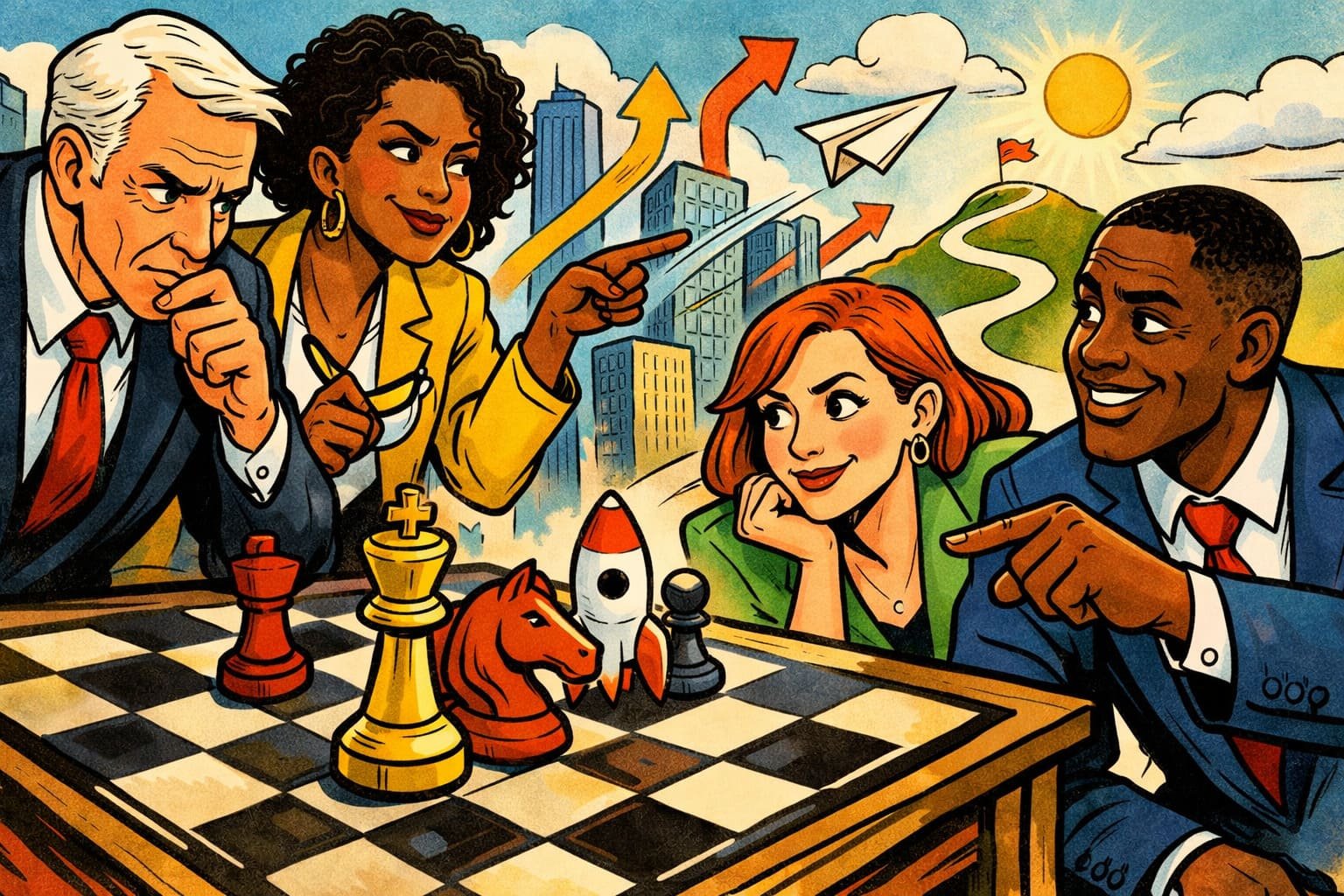
Some executives would be emotionally unrecognizable without crisis. Calm makes them restless. Predictability feels suspiciously unproductive. If nobody is rushing, escalating, improvising, or announcing a strategic emergency in language that sounds faintly military, they begin to suspect leadership itself has gone missing. Many businesses are not poorly managed because their leaders lack intelligence, they are poorly managed because adrenaline has become their operating system.
Fast Chaos: The Leaders Addicted to Urgency
A chief executive named Octavian once began a quarterly planning session by proudly declaring, “We work best when our backs are against the wall.” Half the room laughed with the exhausted politeness of people who had heard the line before. A finance director quietly wrote the sentence in her notebook, then circled it twice, because it explained five years of preventable dysfunction more elegantly than any consultant deck ever had. Strategic chaos often survives because charismatic leaders narrate recklessness as resilience. Employees call it culture when they have forgotten alternatives exist.
There is something culturally seductive about improvisation. Films celebrate founders making impossible decisions at the final minute while dramatic music persuades audiences that planning is bureaucratic cowardice. Business folklore worships instinctive operators who “move fast,” often omitting the trail of operational wreckage left behind. Improvisation can absolutely rescue companies in acute moments. The pathology begins when emergency behavior becomes permanent governance.
A retail operations leader named Sabela once described her organization with devastating precision. “We plan catastrophes with astonishing professionalism,” she said, “and ordinary Tuesdays like amateurs.” That line belongs framed in executive offices globally. Strategic planning is not about removing uncertainty. It is about refusing to make chaos your preferred management aesthetic.
This is where strategic planning gets unfairly misunderstood. Many leaders hear planning and imagine slowness, bureaucracy, or committees with deeply moisturized people debating spreadsheet colors. Real planning is disciplined anticipation. It creates decision quality under pressure because the thinking happened before panic entered the bloodstream. Smart businesses move faster precisely because they prepared before the room got loud.
Beautiful Delusion: Motion Mistaken for Strategy
Modern management has developed an unfortunate romance with movement. Full calendars look strategic. Rapid decisions feel impressive. Slack channels exploding at midnight create the illusion of commercial vitality. Yet movement and direction are not romantic partners. They barely know each other.
A founder named Thiago ran a consumer electronics startup where activity achieved religious significance. Employees admired his intensity because he moved through offices like a man personally negotiating with time itself. Product priorities changed weekly. Hiring plans mutated monthly. Sales teams pitched features engineering had quietly abandoned. Investors initially loved the velocity until one advisor asked a simple question nobody could answer cleanly: “What exactly is the company trying to become?” Motion is spectacular camouflage for strategic confusion.
This pathology appears everywhere because movement photographs well. Planning rarely does. Nobody posts triumphant social media photos about risk scenario mapping or demand forecasting discipline. Improvised heroics make better mythology. Quiet competence rarely becomes conference keynote material. Unfortunately, shareholders are eventually less interested in mythology than cash flow.
The downfall of WeWork remains a masterclass in strategic performance masquerading as strategic thought. Vision expanded faster than operational coherence. Narrative outpaced planning. Expansion acquired spiritual energy while fundamentals begged for adult supervision. Strategy without disciplined planning becomes charisma with invoices.
Strategic planning is often less glamorous because it forces emotional confrontation. Planning requires choosing what not to pursue. It demands admitting resource constraints, acknowledging capability gaps, and refusing intoxicating distractions. Some leaders prefer improvisation because improvisation postpones commitment. Chaos can become emotional procrastination in expensive clothing.
Decision Debt: The Interest Paid by Impulsive Companies
Financial debt is widely understood. Decision debt receives less attention, though its consequences can be equally savage. Every postponed strategic choice, every unclear priority, every emotionally convenient delay accumulates hidden cost. Confused teams create workaround behavior. Temporary fixes become shadow systems. Organizations slowly begin operating through improvisational folklore instead of intentional design.
A supply chain strategist named Imani inherited a manufacturing business where nobody could explain why vendor decisions followed certain patterns. Eventually she discovered that years earlier, one crisis-era shortcut had become informal policy because nobody revisited it after the emergency passed. Millions in avoidable inefficiency had quietly accumulated because historical improvisation hardened into institutional habit. Decision debt behaves exactly like mold. It grows enthusiastically in neglected corners.
Strategic planning matters because it reduces accumulated ambiguity. Clear planning decisions remove future friction from ordinary operations. That sounds almost boring until you realize boredom can be astonishingly profitable. Operational drama consumes managerial attention with frightening efficiency. Some companies are exhausted not because markets are difficult, but because internal ambiguity has become labor-intensive.
Amazon’s planning discipline often receives less cultural admiration than its ambition, which is unfortunate because the discipline explains much of the ambition’s durability. Long-horizon thinking, scenario discipline, and deliberate strategic clarity created organizational resilience beneath experimentation. Planning did not slow Amazon. Planning industrialized intelligent speed. That distinction deserves more respect.
The emotional trap is subtle. Leaders often delay planning decisions because ambiguity preserves optionality, and optionality feels psychologically comforting. Yet perpetual optionality can become strategic cowardice. Businesses eventually pay interest on uncertainty whether they acknowledge the debt or not. Tomorrow always sends the invoice.
Forecast Fever: Why Smart Leaders Misread the Future
Strategic planning is often attacked for failing to predict reality accurately. That criticism misunderstands the point. Planning is not fortune-telling. It is structured preparedness. The purpose is not prophetic perfection, but better decision-making when reality inevitably behaves like itself, messy, opportunistic, and mildly disrespectful.
A healthcare executive named Daciana once killed a planning exercise because actual market behavior had diverged from the forecast. Her reasoning sounded logical until a strategist asked whether seatbelts should be abandoned because drivers still experience collisions. The room went quiet in the particular way rooms do when bad assumptions suddenly lose oxygen. Forecasts are not sacred because they are correct. They are useful because they expose assumptions before reality weaponizes them.
This is why scenario planning matters more than deterministic prediction. Great strategic planners respect uncertainty instead of pretending to conquer it. Shell famously institutionalized scenario thinking because markets punish linear assumptions with unusual creativity. Planning builds adaptive intelligence. Rigid certainty builds future embarrassment.
Executives sometimes reject planning because previous plans failed. That logic is emotionally understandable and strategically unserious. Failed planning often reveals poor planning discipline, not the uselessness of planning itself. Nobody abandons accounting because a forecast missed expectations. Yet planning gets treated like fragile philosophy instead of management infrastructure.
The future does not reward clairvoyance nearly as often as preparedness. Smart organizations understand that strategic planning creates cognitive readiness, decision alignment, and institutional resilience. Planning is less about predicting events than shaping responses. Businesses move smarter because they rehearse possibility before pressure demands improvisation.
The Quiet Winners: Companies That Think Before They Bleed
A building maintenance contractor named Renata once entered a conference room at dawn and found three things left behind after a leadership retreat: a half-drunk whiskey glass, a crumpled sticky note reading “fix this later,” and a laminated strategic roadmap with four different handwriting styles arguing across the margins. She laughed softly because the scene looked less like planning than hostage negotiation. Many companies call gatherings strategy when they are really documenting unresolved anxiety with stationery. Serious planning feels less theatrical and far more disciplined.
The organizations that consistently outperform are often less emotionally exciting than their chaotic peers. They do not rely on adrenaline mythology. They do not confuse executive improvisation with brilliance. They plan, revise, pressure-test, and make difficult trade-offs before urgency arrives. Calm competence is less cinematic than panic, which partly explains why weak leaders underestimate it.
Strategic planning is fundamentally an act of respect. Respect for capital. Respect for employee attention. Respect for customer trust. Respect for the simple reality that avoidable chaos is not a leadership personality trait, it is a management failure. Some companies do not lose because competitors outsmart them. They lose because internal randomness quietly taxes every decision.
There is a deeper psychological truth beneath all this. Leaders addicted to urgency often derive identity from being indispensable crisis protagonists. Planning threatens that identity because systems reduce heroic dependency. Mature leadership is willing to become less theatrically necessary. Vanity hates that arrangement. Great businesses depend on it.
So here is the question every ambitious leader should answer without performance, mythology, or caffeine-enhanced bravado: are you building an organization that moves intelligently because it planned for uncertainty, or one that keeps mistaking repeated self-created emergencies for evidence of exceptional leadership?