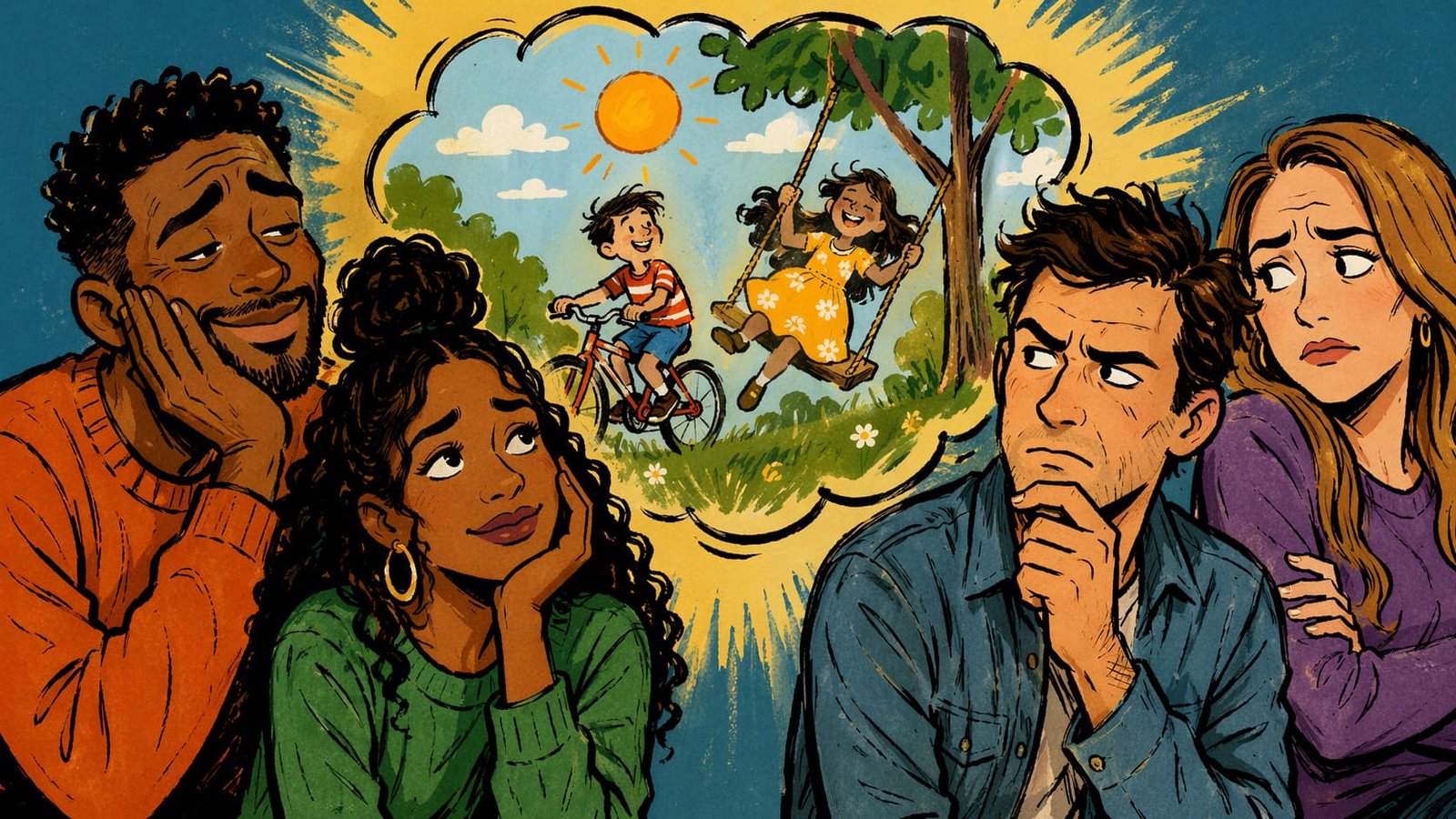
A dim living room glows with the soft flicker of an old television rerun. The colors feel warmer than they ever were. The laughter track sounds fuller, almost sincere. A familiar theme song plays, and something inside the chest loosens, like a knot remembering how to breathe. Outside, the world races with updates and upgrades, yet inside this moment, time folds gently. Nothing here demands improvement. Nothing here asks questions. Memory does not argue, it reassures.
What feels like remembrance is often reconstruction. The past does not return as it happened. It returns as it is needed. Psychologists have long noted that memory is less like a recording and more like a story rewritten with each recall. Edges soften. Conflicts fade. Small joys expand into something almost cinematic. This is not a flaw. It is a feature. The mind edits for survival, not accuracy. And somewhere along the way, entire industries learned how to monetize that instinct.
A product designer named Kavita once worked on a campaign that reintroduced a classic snack brand. The recipe had changed years earlier due to cost pressures, yet the marketing leaned heavily on childhood imagery. Old packaging returned. Fonts mimicked a previous decade. Sales surged. Customers insisted the taste felt “like before,” even though blind tests suggested otherwise. Kavita noticed something quietly unsettling. People were not buying flavor. They were buying the feeling of who they used to be.
Nostalgia operates like a gentle anesthetic against modern uncertainty. When the present feels unstable, the past becomes a safe narrative. That is why economic downturns often coincide with a surge in retro aesthetics. Music revivals, vintage fashion, rebooted films. They are not just creative choices. They are emotional strategies. Familiarity reduces friction. It whispers, “You have survived before. You will survive again.”
Streaming platforms understand this deeply. Old shows resurface not as archives, but as front-page recommendations. A viewer clicks on a series from years ago, expecting light entertainment, and instead finds an emotional anchor. The characters feel unchanged, even though the viewer is not. Time collapses into a strange intimacy. The past appears stable because it is already known. It cannot surprise. It cannot betray.
There is a subtle distortion embedded in this comfort. Nostalgia rarely remembers context. It remembers highlights. A decade remembered as carefree often contained its own anxieties, struggles, and uncertainties. Those details get edited out. What remains is a curated highlight reel that feels more real than reality ever was. This creates a quiet tension. The present, with all its raw complexity, competes against an idealized past that never truly existed.
A filmmaker named Lucas once revived a beloved franchise, convinced that audiences wanted the same magic they experienced years earlier. The film mirrored the original closely, echoing scenes, themes, even dialogue rhythms. Initial excitement surged. Then something shifted. Critics and viewers began to feel a strange emptiness. The film had captured the surface of nostalgia, but not its soul. Lucas later admitted in an interview that he had tried to recreate a feeling without understanding that the feeling belonged to a different time, a different self.
Nostalgia also acts as a social glue. Shared memories create instant belonging. Two strangers bonding over a childhood cartoon can bypass the awkwardness of introduction. Entire communities form around collective remembrance. This is powerful, but it can also become exclusionary. Those who do not share the same references may feel subtly outside the circle. Taste, once again, becomes a boundary, but this time built from memory rather than aesthetics.
There is a startup founder named Idris who built a digital platform centered on preserving local cultural memories. Old photographs, stories, and music were uploaded by users from different regions. Engagement grew rapidly. People did not just consume the content, they contributed to it. Idris realized something important. Nostalgia was not only about looking back. It was about reclaiming identity in a world that often feels too fast to understand. Yet he also noticed how certain narratives dominated while others faded, depending on who contributed more actively.
The market has learned to package nostalgia with precision. Limited edition releases, anniversary collections, retro branding. Each tactic taps into a longing that feels deeply personal but operates collectively. The success of these strategies is not accidental. It is rooted in a simple truth. People trust what they remember, even when memory is unreliable. That trust translates into loyalty, and loyalty translates into revenue.
There is a deeper tension at play. Nostalgia offers comfort, but it can also stall growth. When individuals or cultures cling too tightly to idealized pasts, they risk resisting necessary change. Progress begins to feel like loss rather than evolution. The familiar becomes a refuge that quietly resists transformation. This is where nostalgia shifts from a gentle companion to a subtle constraint.
A small bookstore owner named Elena refused to modernize her space despite declining foot traffic. The shelves remained crowded. The checkout process stayed manual. Regular customers cherished the atmosphere, describing it as “timeless.” New visitors, however, often left quickly, overwhelmed by the lack of clarity. Elena faced a difficult choice. Preserve the feeling or adapt to survive. Her story did not resolve neatly. It lingered, much like the tension itself.
In a quiet train carriage moving through a landscape blurred by speed, a passenger scrolls through old photos, pausing at images that feel warmer than the present moment. Each picture carries a version of life that feels simpler, even if it was not. The train continues forward, indifferent to memory, committed to motion. Outside, new scenes replace old ones without asking permission.
Somewhere between the glow of the screen and the rhythm of the tracks, a question settles in with quiet persistence: if the past feels better because it is edited, what does it mean to live fully in a present that refuses to be softened?
