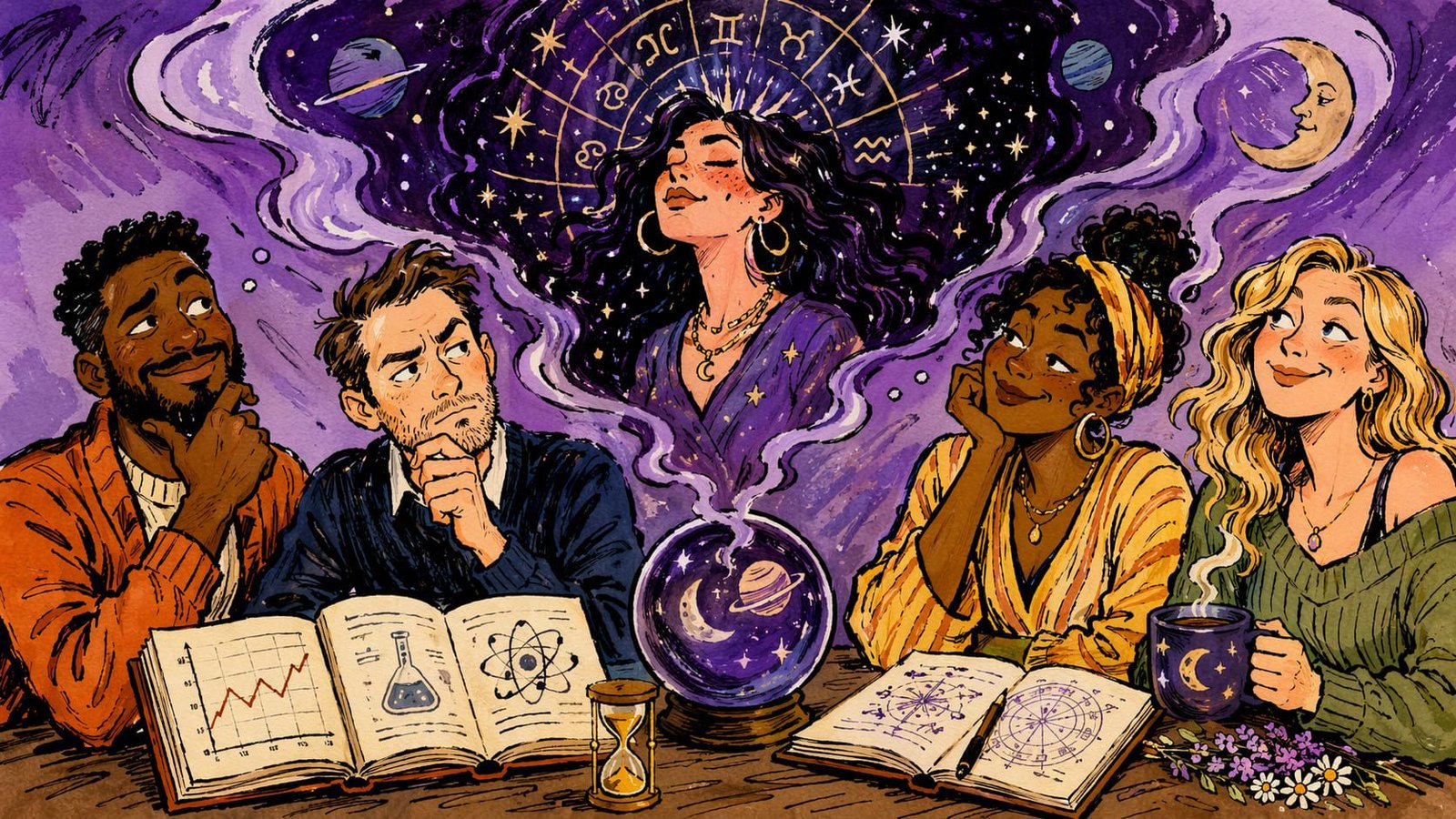
The chart glows softly on a phone screen, symbols arranged with quiet authority, as if the sky had decided to speak in code. A young woman traces the lines with her finger, not searching for proof, but for recognition. The language feels ancient, almost ceremonial, yet it arrives through a modern interface, delivered between notifications and unread emails. Around her, conversations drift from career stress to relationship uncertainty, then circle back to something older, more comforting. The stars, somehow, seem to understand.
This return to astrology is not a simple rejection of science. It is a response to a deeper absence. In a world saturated with data, metrics, and optimization, people have never had more information about how things work. What they often lack is a sense of why things feel the way they do. Reason explains, but it does not always console. Astrology steps into that gap, offering a narrative that feels personal, intimate, almost tailored.
Platforms like Co-Star and The Pattern have transformed ancient systems into daily rituals. Notifications arrive like small prophecies, nudging users to reflect, to prepare, to interpret. The appeal lies not in accuracy alone, but in resonance. A sentence that feels true carries more weight than one that is technically correct. This is where astrology thrives, in the space where feeling and meaning intersect.
The cultural context matters. Traditional institutions that once provided structure and explanation have lost some of their authority. Religion, for many, feels distant or rigid. Career paths, once linear, now twist unpredictably. Relationships shift, identities evolve, stability becomes elusive. In this landscape, astrology offers a kind of soft structure. It does not demand belief in the same way, but it invites participation. It provides a language for uncertainty.
A small story illustrates this pull. Nadia, a freelance writer in Paris, began checking her horoscope during a period of intense transition. Projects were unstable, relationships uncertain, decisions carried more weight than clarity. One morning, she read a line suggesting a period of reflection and recalibration. It was vague, almost generic, yet it landed with precision. Not because it predicted her future, but because it named her present. That naming brought a strange sense of relief.
There is also a communal dimension that often goes unnoticed. Astrology creates shared frameworks for conversation. Friends compare charts, discuss compatibility, joke about retrogrades. It becomes a social language, a way to connect without the heaviness of more direct self-disclosure. Saying “Mercury is in retrograde” can sometimes feel easier than saying “I feel unsettled and I don’t know why.” The symbolism carries emotion without exposing it entirely.
Pop culture has embraced this shift with enthusiasm. Celebrities like Dua Lipa openly reference astrology, weaving it into public identity in a way that feels both playful and sincere. Memes circulate daily, turning complex astrological concepts into quick, relatable insights. The tone is often light, even humorous, yet beneath it runs a deeper current. People are not just consuming astrology as entertainment. They are using it as a tool for interpretation.
Critics often point to the lack of empirical evidence, framing astrology as irrational or misleading. That critique, while valid in a strict scientific sense, misses part of the picture. The appeal of astrology is not rooted in its ability to predict events with precision. It lies in its capacity to provide narrative coherence. Humans are meaning-making creatures. When traditional narratives weaken, alternative systems emerge to fill the space.
Consider Leo, a software engineer in Berlin, who approached astrology with skepticism. He valued logic, data, systems that could be tested and verified. Yet during a period of personal upheaval, he found himself reading his birth chart late at night, not because he believed in its accuracy, but because it offered a framework to think through his experiences. It gave shape to feelings that had previously felt scattered. The contradiction did not bother him. It felt oddly practical.
The tension between reason and meaning is not new. Philosophers have long grappled with the limits of rational explanation. Science excels at describing mechanisms, but it often leaves existential questions open. Why does this matter? What does this mean for me? Astrology does not answer these questions definitively, but it engages with them in a way that feels accessible. It speaks in symbols rather than equations.
There is a risk, of course, in leaning too heavily on any system that simplifies complexity. Astrology can become a shortcut, a way to externalize responsibility or avoid deeper introspection. When every decision is filtered through a chart, agency can quietly erode. The key lies in balance, in using the framework as a lens rather than a script. Meaning should guide, not dictate.
At the same time, dismissing astrology entirely overlooks its emotional utility. In uncertain times, people seek anchors. Not all anchors need to be empirical to be effective. Some operate on a different level, providing comfort, structure, or a sense of belonging. The value lies not just in truth as measured by data, but in truth as experienced by the individual.
Somewhere, beneath the glow of that phone screen, the symbols remain unchanged, yet their interpretation shifts with each person who engages with them. The stars do not speak in words, yet people continue to listen, not for answers alone, but for recognition. The act itself carries meaning, regardless of the outcome.
And in that quiet exchange between sky and self, a more unsettling question begins to form, one that lingers beyond belief or skepticism: if meaning feels real enough to guide your choices, does it matter whether it can be proven at all?
