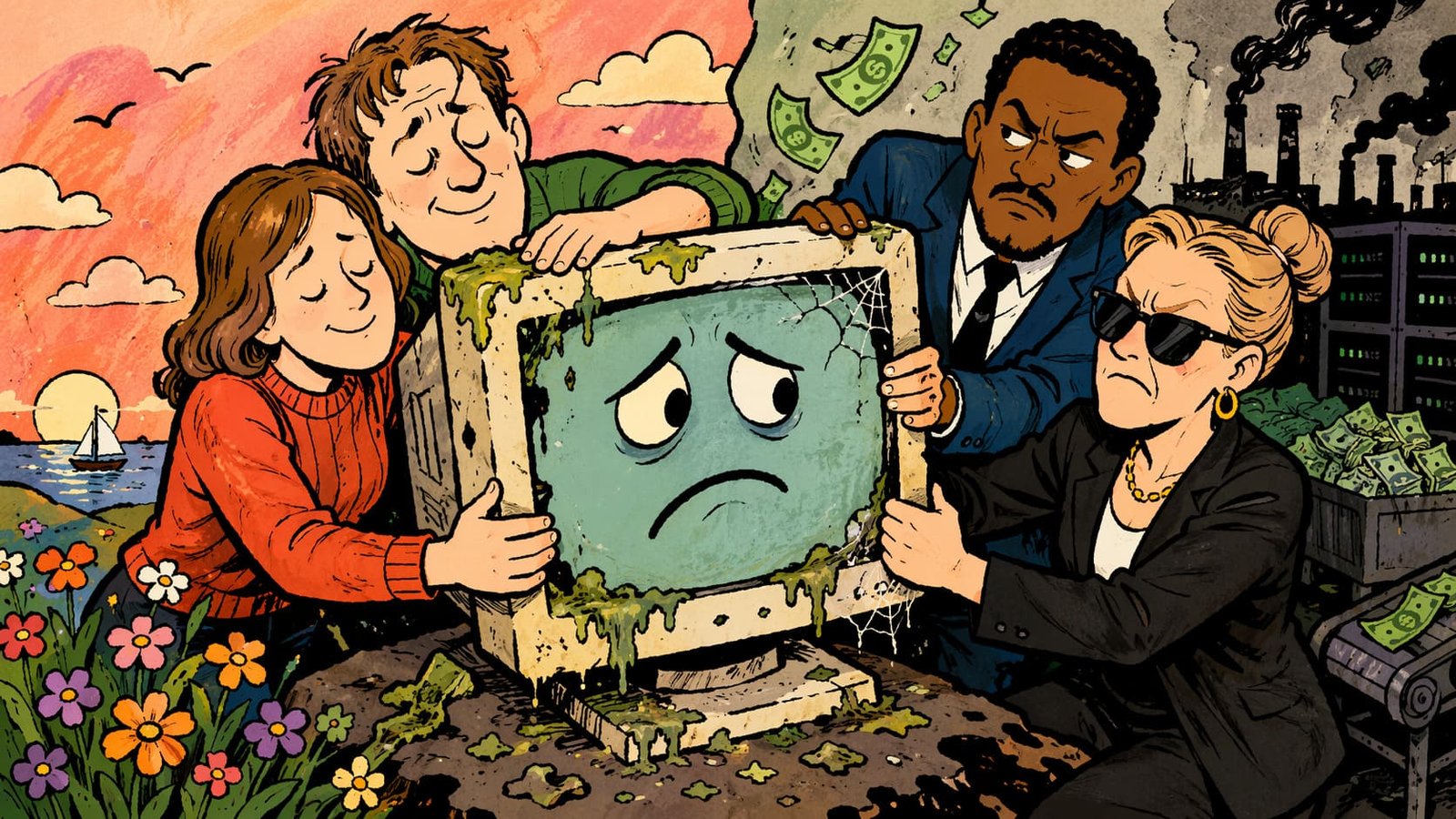
The homepage still loads, but it feels like walking into a house where the furniture remembers you more than the people do. The logo sits exactly where it used to, the colors almost identical, the layout familiar enough to trigger recognition before thought. Yet something underneath has shifted. The space breathes differently. The silence is louder. What once felt alive now feels maintained. Not cared for, just kept running. A digital afterlife, curated for clicks rather than connection. The internet did not collapse. It aged. And in aging, it learned how to extract from memory.
There was a time when websites felt like places. Not platforms, not ecosystems, but places. You visited them with intention. You stayed longer than you meant to. You developed a strange loyalty to their tone, their rhythm, even their imperfections. Early forums, niche blogs, independent media sites, they carried a kind of personality that could not be scaled. You did not just consume content there. You absorbed a worldview. The experience felt slower, more deliberate, almost intimate. And because of that, it mattered in ways that are difficult to explain now.
Then came optimization. It arrived politely, wrapped in language about growth, accessibility, and sustainability. Metrics became the new compass. Engagement, retention, conversion, these words began to shape design decisions more than taste or voice. The goal shifted from creating a distinct experience to capturing attention at scale. It sounded reasonable. It often was. But something subtle began to erode. The edges that made sites unique were smoothed out. The quirks that made them memorable were replaced with templates that performed better. Identity started to feel like friction, and friction is the enemy of optimization.
A founder named Miriam once ran a small culture site that built a loyal audience over years of careful writing. The articles were dense, thoughtful, sometimes challenging. Readers returned not for speed, but for depth. When an investor came in, the strategy changed. Headlines became sharper, more urgent. Content became shorter, more frequent. Traffic spiked. Revenue followed. Miriam watched the numbers with a mix of pride and unease. Months later, she admitted something that lingered. The site was growing, but it no longer felt like hers. The voice had been diluted into something more efficient, less distinct. The audience expanded. The identity dissolved.
This is the paradox of modern digital media. Growth often requires compromise, and the compromise usually happens at the level of taste. What begins as a community slowly transforms into an audience. The difference is easy to overlook, yet it changes everything. A community participates. It contributes. It shapes the space. An audience consumes. It arrives, scrolls, leaves. Nostalgia becomes a tool in this transition. The design stays familiar enough to retain old users, while the content strategy shifts to attract new ones. The past is preserved visually, even as it is rewritten structurally.
You can see this pattern across once-beloved platforms. Sites that were known for a specific voice now publish content that feels interchangeable with dozens of others. Headlines chase trends. Articles are calibrated for search engines. The experience becomes frictionless, but also forgettable. It is not that the content is bad. It is that it no longer feels necessary. It exists to fill space, to maintain relevance, to keep the machine running. The original spark, the sense that this place had something to say, begins to fade.
A product manager named Daniel described the shift in a way that stayed with him. “We stopped asking what we wanted to express,” he said. “We started asking what would perform.” The change was incremental, almost invisible in the moment. A headline adjusted here, a format tweaked there. Over time, the cumulative effect was profound. The site became better at attracting attention, but worse at holding meaning. Readers came in greater numbers, yet stayed for shorter periods. The metrics looked healthy. The experience felt hollow.
There is also an economic reality that cannot be ignored. Running a website costs money. Writers need to be paid. Infrastructure needs to be maintained. Monetization is not inherently corrosive. The issue is not the presence of revenue, but the methods used to generate it. When every element of a site is optimized for extraction, for maximizing clicks, time spent, ad impressions, the relationship between creator and reader changes. It becomes transactional. The site no longer serves the reader’s curiosity. It serves the platform’s growth targets.
And yet, people keep returning. Not because the experience is as good as it once was, but because memory is powerful. Nostalgia acts like a bridge, connecting past satisfaction to present habit. You revisit a site hoping to feel what you once felt there. Sometimes you catch a glimpse of it, a well-written piece, a moment of clarity that reminds you why you cared. Those moments keep you coming back, even as the overall experience continues to drift. It is a quiet form of loyalty, one that platforms learn to rely on.
In a dim corner of the internet, an old blog still exists, untouched by optimization, unbothered by metrics. Its design is outdated. Its loading speed is slow. Its content is irregular. Yet the few people who visit it feel something rare. A sense that this space exists for a reason beyond growth. It is not efficient. It is not scalable. It is, in a quiet way, alive. That kind of presence has become unusual, almost radical in a landscape defined by performance.
Somewhere, a familiar homepage refreshes again, polished and productive, carrying the shape of what it once was while quietly feeding on the memory of it, and the question lingers just beneath the surface, waiting to be felt rather than answered: when the places that once shaped your thinking start to feel like machines, will you keep visiting out of habit, or will you begin searching for something that still feels real enough to change you?
