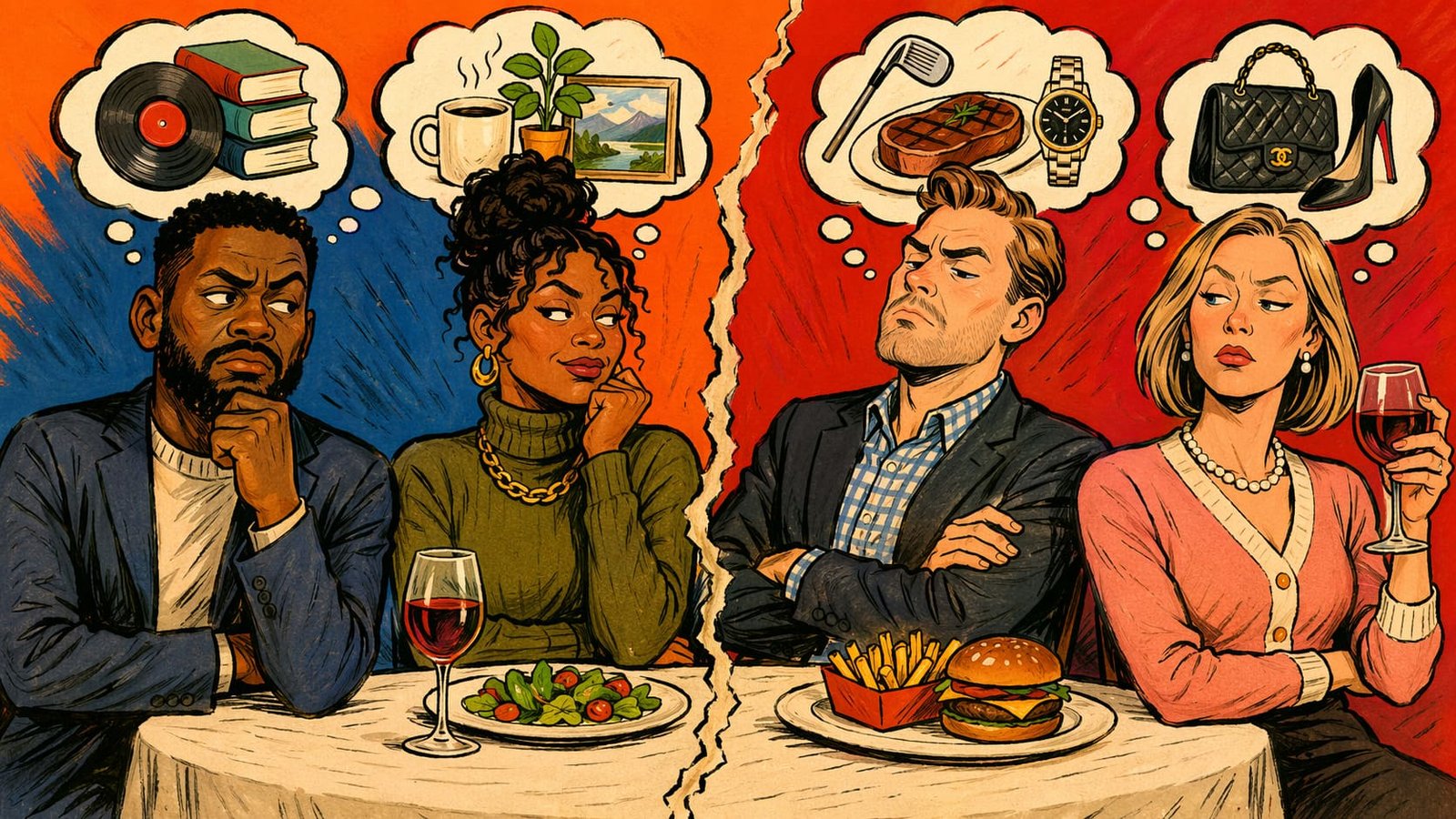
A quiet room hums with soft music that no one admits to recognizing. Glasses clink. A conversation drifts toward wine, then architecture, then a film nobody watched twice but everyone references anyway. Nothing in the room feels accidental. Even silence seems curated. Taste is performing here, not loudly, but with surgical precision. It moves like a code, invisible to outsiders, obvious to those fluent in it. Somewhere between a choice of sneakers and a sentence about “minimalism,” a hierarchy has already been decided. No one voted, yet the result feels final.
What looks like preference often behaves like power wearing softer clothes. The shift happened slowly. Food became identity, music became ideology, clothing became a quiet résumé. A person ordering black coffee signals something different from someone asking for caramel foam. Neither is wrong, yet both communicate. This is not about judgment alone. It is about pattern recognition. Culture learned to read taste as a proxy for discipline, intelligence, ambition, or rebellion. Pierre Bourdieu once framed taste as social positioning, but today it feels more immediate, more alive, almost algorithmic.
A founder named Elias once redesigned his startup’s office, replacing loud branding with neutral tones, soft lighting, and Scandinavian furniture. Clients started speaking differently the moment they walked in. Meetings felt calmer. Decisions moved faster. Nothing about the product changed, yet conversion improved. Elias later admitted the insight quietly: people trusted the company more because the space looked like restraint. Taste had done what strategy could not. It signaled competence without explanation.
The strange part is how early these signals begin. A teenager curating playlists is not just sharing music, they are rehearsing identity. A university student choosing between streetwear and tailored jackets is not just dressing, they are drafting a future narrative. By the time adulthood arrives, taste feels personal, almost sacred. Yet much of it has been inherited, absorbed, or strategically adopted. What feels like self-expression often doubles as social navigation.
Consider how streaming platforms shape this dynamic. Recommendation engines do not just suggest content, they sculpt taste itself. A person who watches documentaries about finance may soon receive more of the same, reinforcing a loop that feels like intellectual curiosity but is partly guided. Meanwhile, another viewer immersed in reality shows receives a different loop. Over time, taste diverges, and with it, perception of what is “normal,” “smart,” or “valuable.” The divide becomes less about opinion and more about environment.
There is also a quiet violence hidden inside aesthetic refinement. When minimalism becomes the dominant taste, clutter starts to look like failure. When luxury becomes subtle, overt display begins to feel unsophisticated. These shifts are not neutral. They redraw social boundaries without announcing themselves. A person excluded from certain spaces rarely hears a direct rejection. Instead, they feel out of place, unable to decode the rules. Taste becomes the gatekeeper that never admits it is guarding anything.
A marketer named Rina once tested two versions of the same product page. One used bold colors and aggressive messaging. The other used whitespace, muted tones, and restrained language. The second version performed better among higher-income buyers. Rina did not celebrate immediately. She paused. The result suggested something uncomfortable. People were not just buying a product. They were buying alignment with a certain aesthetic identity. The product solved a problem, but the taste validated a self-image.
Pop culture keeps amplifying this phenomenon. Films like The Devil Wears Prada captured it years ago, showing how a single sweater could signal belonging or exclusion. Today, the same logic plays out on social media feeds. A curated bookshelf, a specific coffee cup, a certain travel destination, all act as quiet declarations. The difference now is speed. What once took decades to evolve now shifts in months. Trends rise, saturate, and collapse, leaving behind fragments of identity that people continue to carry.
The tension sits beneath all of this. On one side, taste promises individuality. On the other, it quietly enforces conformity within groups. The more refined the taste, the narrower the acceptable variations. A person trying to stand out often ends up fitting in more precisely than they realize. It is a paradox that feels almost cruel. The pursuit of uniqueness can lead to deeper standardization.
There is a small café owner named Mateo who refused to redesign his space despite advice from consultants. The chairs were mismatched. The menu was handwritten. The lighting was uneven. Regulars loved it. New visitors sometimes felt confused. Mateo once explained his choice in a quiet moment: he wanted the space to feel human, not optimized. Revenue grew slowly, not explosively, but loyalty ran deep. Taste, in his case, resisted performance. It chose authenticity over signaling, though even that became its own signal.
What emerges from these stories is not a simple rejection of taste, but a deeper awareness of its mechanics. Taste is not the enemy. It is a language. The danger lies in mistaking fluency for truth. When preference becomes politics, it stops being about what feels good and starts becoming about what feels correct. That shift is subtle, but it changes everything.
In a dim studio apartment somewhere above a restless city, a young designer scrolls through inspiration boards, saving images that feel like fragments of a future life. Each choice feels personal. Each selection feels earned. Outside, the city pulses with millions of similar decisions, each one shaping invisible hierarchies that no one openly acknowledges. The designer pauses, staring at the screen, sensing something beneath the surface but unable to name it fully.
In that quiet pause, the question lingers, sharp and unsettling, almost whispered into the room: are these choices truly yours, or have they been choosing you all along?
