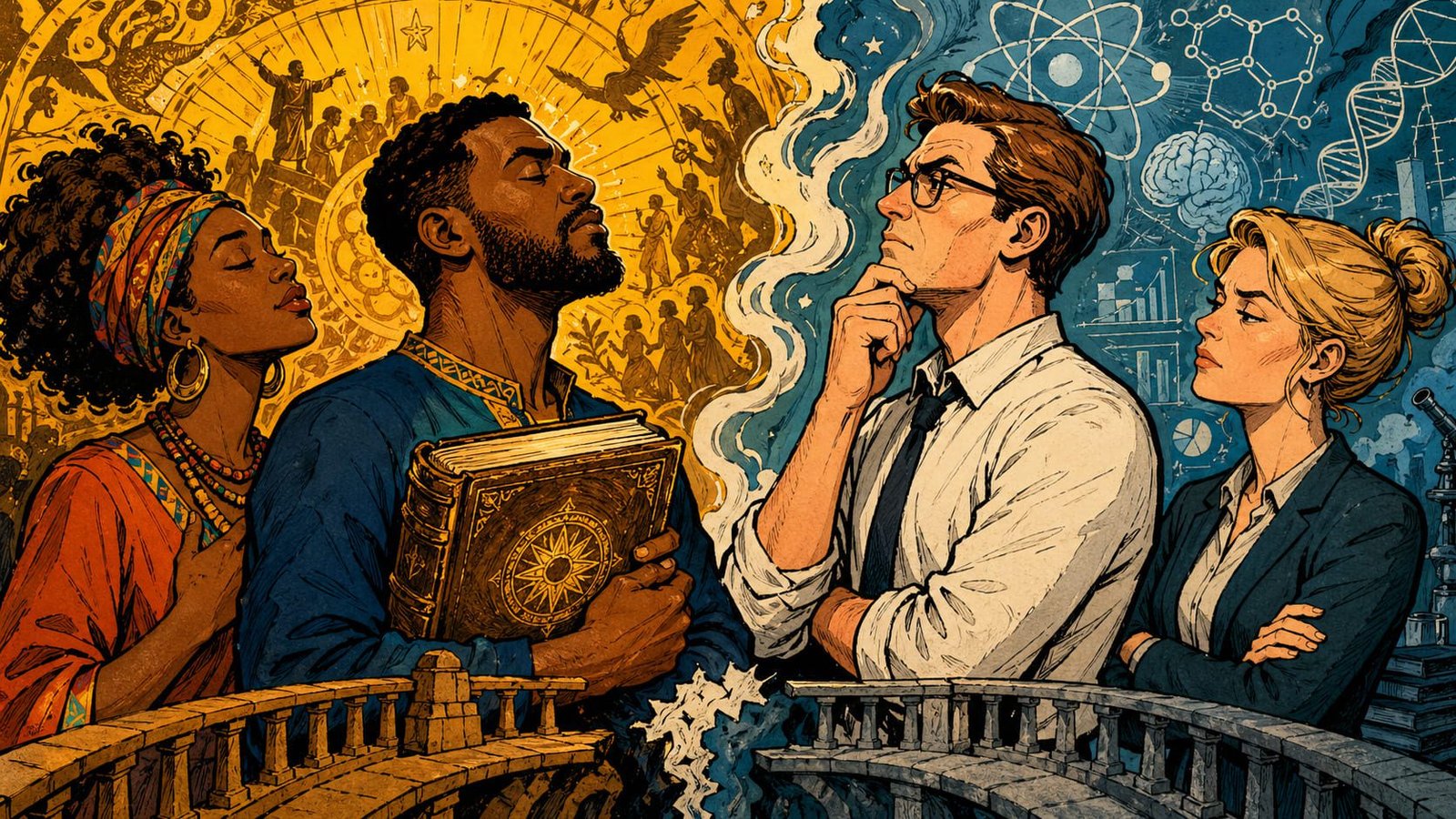
A dim archive hums beneath a city that prides itself on logic. Shelves hold no ancient scrolls, only hard drives labeled with forecasts, models, and predictive systems. The air feels sterile, almost triumphant, as if uncertainty has finally been domesticated. Yet somewhere between the numbers, a strange silence lingers. The data explains patterns, but it does not comfort. It predicts behavior, but it does not inspire it. The modern world has grown fluent in reason, fluent enough to believe it can replace the old stories that once shaped civilizations. Still, something refuses to disappear. Beneath every polished argument and algorithmic insight, a quieter force persists, guiding choices in ways reason alone cannot fully grasp. Sacred stories have not left. They have simply changed their vocabulary.
Every culture, no matter how advanced, builds itself around narratives that explain why life matters. These stories do more than entertain. They create a shared language of purpose, a way to interpret success, failure, and everything in between. Reason can analyze outcomes, but it struggles to tell people why those outcomes are worth pursuing. That gap is where stories take over. Consider Nikhil, a financial analyst known for his obsession with numbers. His spreadsheets were precise, his forecasts admired. Yet during a late-night conversation, he admitted that what drove him was not the data itself, but a personal narrative about proving something to a family that once doubted him. The numbers guided his strategy, but the story fueled his persistence.
Modern institutions often present themselves as purely rational systems. Corporations speak in metrics, governments in policies, technology in efficiency. Still, behind every structure lies a narrative that gives it meaning. Companies do not just sell products, they sell visions of identity and belonging. Movements do not just advocate change, they tell stories about justice, progress, and the future. Even personal branding, a concept that feels entirely contemporary, relies on storytelling at its core. The language may sound analytical, but the emotional engine is narrative. Without it, even the most sophisticated systems lose their ability to mobilize people.
The power of sacred stories becomes especially clear in moments of uncertainty. When logic reaches its limits, people turn to narratives that offer coherence. During a period of economic instability, a startup founder named Laila faced a collapse that no forecast had predicted. Investors withdrew, plans unraveled, and the data provided no clear path forward. What kept her moving was a story she held about resilience, about building something that mattered beyond immediate results. That narrative did not guarantee success, but it gave her a reason to continue when logic suggested retreat. It created a bridge between uncertainty and action.
Pop culture provides a vivid reflection of this dynamic. Films, series, and even viral internet moments thrive because they tap into timeless narrative structures. The hero’s journey, the fall and redemption, the search for identity, these patterns repeat because they resonate at a deeper level than information alone. A blockbuster may rely on cutting-edge technology, but its impact depends on the story it tells. People remember characters, not camera specs. They quote lines, not production budgets. This preference reveals something fundamental about how humans process meaning. Stories organize experience in a way that facts alone cannot.
There is also a tension between reason and narrative that defines much of modern life. On one hand, there is a desire for clarity, for evidence, for logical consistency. On the other, there is a need for meaning that transcends pure analysis. This tension does not resolve itself easily. It creates a push and pull that shapes decisions, relationships, and cultural trends. A consultant named Mateo once described his work as translating between two worlds. His clients wanted data-driven strategies, yet their decisions were often influenced by unspoken narratives about risk, identity, and legacy. The numbers informed the conversation, but the story determined the outcome.
History reinforces this pattern. Periods that emphasize reason often produce breakthroughs in science, technology, and governance. These advances reshape societies in profound ways. Yet they rarely eliminate the role of narrative. Instead, new stories emerge to make sense of the changes. The rise of industrialization, for instance, brought not only new machines but also new myths about progress and human potential. The digital age continues this tradition, creating narratives about innovation, disruption, and the future. Each era believes it is moving beyond the need for stories, yet each one ends up creating new ones.
The persistence of sacred stories suggests that they fulfill a role that reason cannot fully replace. They provide orientation in a complex world, offering frameworks that help people interpret their experiences. They connect individual lives to larger themes, creating a sense of continuity and belonging. Without them, life risks becoming a series of disconnected events, impressive in detail but lacking coherence. Stories do not compete with reason. They complete it. They give shape to what logic alone cannot fully express.
In a quiet corner of that archive, a technician pauses while reviewing a set of projections. The numbers are flawless, the model elegant, yet something feels incomplete. Outside, the city continues its rhythm, driven by systems that promise efficiency and control. Inside, a different realization begins to take form. The world may grow more rational, more precise, more informed, but it will never outgrow its need for stories. They are not a relic of the past. They are the invisible architecture of meaning. And long after the models are updated and the data revised, the stories will remain, shaping the way everything else is understood.
