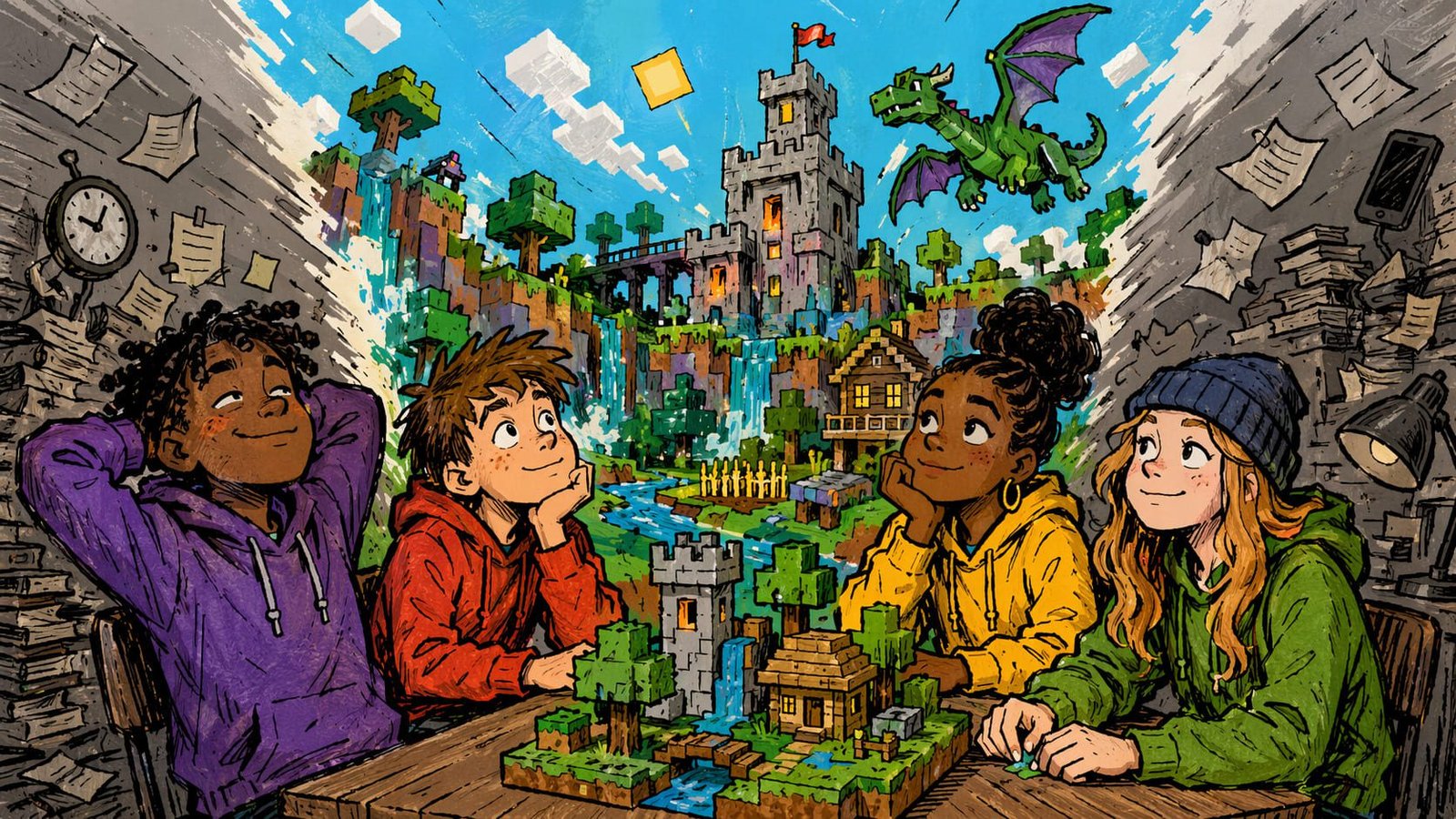
The world looks blocky at first glance, almost childish, like something that should be outgrown. Square trees, pixelated water, a sun that rises and sets with mechanical calm. Yet inside that simplicity, something quietly radical unfolds. A child logs in, surveys a landscape that offers no instructions, no predefined purpose, and begins to build. Not because they were told to, not because a system rewards them, but because the space invites it. What appears trivial from the outside carries a different weight within. This is not escape. It is authorship.
For a generation raised inside systems that feel increasingly managed, the appeal is not difficult to understand. Much of their digital life is structured, feeds curated, content recommended, interactions guided by invisible logic. Even offline, schedules tighten. Expectations arrive early. Performance becomes a language they learn before they fully understand it. In that context, a space that offers control without constant evaluation feels rare. Minecraft does not ask who you are. It lets you decide what you will make.
That freedom changes behavior. Instead of consuming a finished experience, players construct their own. They gather resources, experiment with structures, test ideas that may or may not work. Failure is not punished. It is part of the process. A house collapses, a design looks wrong, a plan needs adjustment. The system does not judge. It responds. That responsiveness creates a feedback loop that feels different from the rest of their digital environment. It rewards curiosity rather than compliance.
A boy named Ethan spent weeks building a city inside the game. Streets, towers, small details that only he seemed to notice. When asked why he kept refining it, his answer was simple. “It’s not done yet.” There was no external deadline, no metric to hit, no audience to impress. The project existed because he chose to continue it. That kind of sustained attention is increasingly rare in environments designed for quick engagement. Here, it felt natural.
This is where the deeper shift becomes visible. Minecraft offers a form of agency that contrasts sharply with the passive consumption dominant elsewhere. Players are not just reacting to content. They are shaping it. The distinction matters. It changes how they understand their role within a system. Instead of adapting to predefined pathways, they create their own. The experience becomes less about following and more about forming.
There is also a social dimension that complicates the narrative. Multiplayer worlds allow collaboration, negotiation, even conflict. Players build together, share resources, establish rules, sometimes break them. These interactions mirror aspects of real-world communities, but without the same constraints. The stakes are lower, the possibilities broader. It becomes a space where social dynamics can be explored with a different kind of freedom.
A teacher named Laila introduced Minecraft into her classroom as part of a design project. Students were asked to recreate historical structures, then adapt them to modern needs. What surprised her was not the accuracy of the builds, but the conversations that emerged. Students debated design choices, questioned assumptions, proposed alternatives. The game became a medium for thinking, not just playing. It allowed them to engage with ideas in a way that felt active rather than abstract.
Critics often frame this engagement as avoidance, a retreat from reality into a simplified digital world. That interpretation misses something important. The appeal is not the simplicity. It is the possibility. In a space where rules can be understood and modified, where outcomes are directly linked to actions, players experience a clarity that is often absent elsewhere. They see the impact of their decisions in real time. That visibility creates a sense of control that is both empowering and instructive.
At the same time, the platform is not immune to the broader forces shaping digital culture. Communities form norms. Popular creators influence styles. Certain builds gain recognition over others. Even in a space defined by freedom, patterns emerge. The difference lies in how those patterns are engaged with. Players can adopt them, adapt them, or ignore them entirely. The system allows for deviation in a way that more rigid platforms do not.
In a quiet corner of a digital landscape, a structure stands unfinished, its edges rough, its form still evolving. The player pauses, looks at what exists, and imagines what could come next. There is no script guiding the moment, no algorithm predicting the outcome. Just a choice, simple and open. Build, adjust, continue, or walk away.
Somewhere within that choice, a generation begins to understand something that extends beyond the game, a quiet realization that feels both obvious and rare: when the world offers fewer spaces to shape your own path, you will seek out the ones that let you build it yourself, and the real question is whether you will carry that instinct beyond the screen or leave it behind where it felt easiest to use it.
