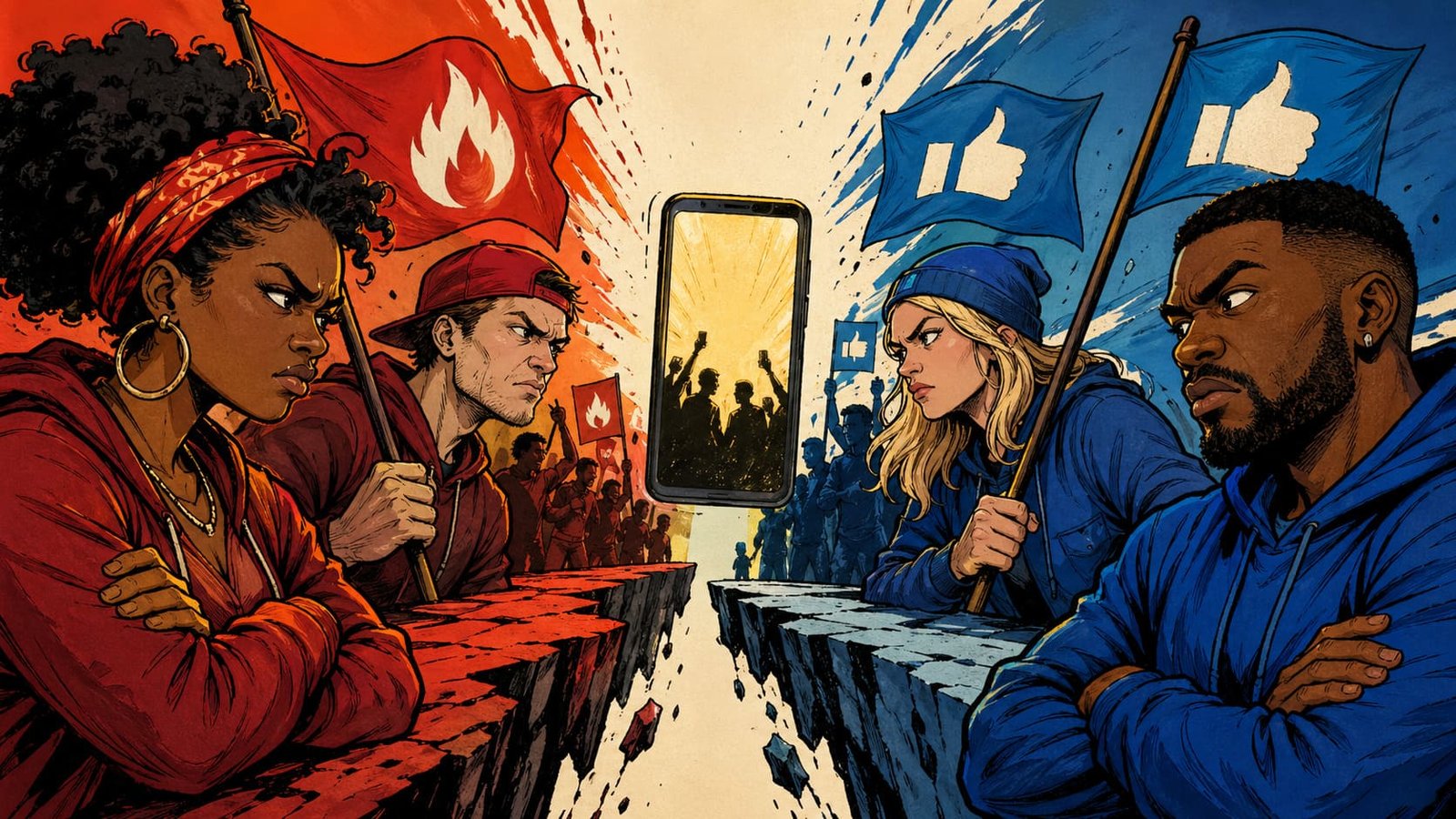
A crowd gathers in a space that has no walls, no geography, no single language. Avatars flicker, usernames pulse, and a shared belief tightens like a knot. At first, it feels like warmth. Recognition. A place where the noise of the world fades into something clearer, sharper, more certain. Then the tone shifts. Lines are drawn. Outsiders appear. What began as belonging starts to resemble a battlefield, though no one announces the transition. It simply happens, as if unity carries a hidden edge that reveals itself over time.
Communities have always shaped identity. Families, nations, cultures, all offer a sense of place. Online tribes accelerate this process. They compress belonging into symbols, phrases, inside jokes that signal who is in and who is not. The speed is intoxicating. A shared opinion becomes a shared identity almost instantly. That identity brings comfort, but it also brings pressure. To belong, you must align. To align, you must defend.
A community manager named Leila once built a forum around sustainable living. It began as a space for exchanging ideas, small experiments, practical advice. People shared successes and failures without fear. Then the group grew. New voices arrived with stronger opinions, sharper language. Conversations that once felt collaborative turned confrontational. A debate about packaging waste escalated into personal attacks. Leila watched the shift with a mix of confusion and recognition. Growth had not just expanded the community. It had hardened it.
The mechanics are subtle but powerful. Online platforms reward engagement, and conflict drives engagement. A calm discussion rarely travels far. A heated argument spreads quickly. Algorithms amplify what provokes reaction, not what builds understanding. Over time, the most visible voices in a tribe are often the most extreme. They set the tone, define the boundaries, and shape what is considered acceptable. The center quietly erodes.
A freelance writer named Tomás experienced this firsthand. He joined an online group dedicated to independent journalism. At first, it felt like a refuge from mainstream noise. Thoughtful critiques, long-form discussions, genuine curiosity. Then a few influential members began framing every issue as a battle between insiders and outsiders. Nuance became suspicion. Disagreement became betrayal. Tomás found himself hesitating before posting, not because he lacked ideas, but because he feared crossing an invisible line.
This dynamic mirrors broader cultural shifts. Political polarization has been intensified by digital spaces where like-minded individuals cluster together. Each group develops its own language, its own interpretation of events, its own sense of truth. When these groups collide, the conversation often collapses into conflict. It is not just a difference of opinion. It feels like a threat to identity itself. That intensity makes compromise difficult and dialogue fragile.
Brands have also stepped into this landscape, sometimes without fully understanding the terrain. A company like Nike has navigated this by aligning with specific cultural moments, knowing that taking a stand can strengthen loyalty within certain groups while alienating others. It is a calculated risk. In a world of tribes, neutrality can feel like invisibility. Yet alignment can also deepen divisions, turning consumers into defenders or critics based on shared identity rather than product value.
The psychological pull of belonging is hard to resist. A software engineer named Priya once described the feeling as “finally being understood.” She found a community that shared her frustrations with corporate culture, her ambitions, her humor. It felt like home. Over time, she noticed how quickly the group dismissed perspectives that did not fit its narrative. She caught herself doing the same. It was easier to agree than to question. Belonging had become a filter, shaping not just what she said, but what she thought.
There is a paradox at the heart of all this. The more connected people become, the more fragmented the experience can feel. Each tribe offers clarity, but that clarity comes at the cost of complexity. The world becomes easier to interpret, but harder to understand. The richness of diverse perspectives gets replaced by the comfort of familiar ones. It feels safer, but also smaller.
Somewhere in the endless scroll, a young student named Kwame navigates multiple communities at once. Each one offers a different version of reality, a different set of expectations. He adapts, shifting tone, language, even opinion depending on where he is. It feels natural, almost necessary. Yet there is a quiet question beneath the surface. Which version of himself is real, and which is shaped by the need to belong?
In a digital landscape that never sleeps, tribes continue to form, evolve, collide. They offer connection, meaning, a sense of place. They also carry the potential for division, for conflict, for a narrowing of perspective that feels justified in the moment. The line between community and confrontation is thin, often invisible until it is crossed.
Somewhere within that tension, a realization begins to take hold. The same force that makes belonging feel powerful can also make it dangerous, especially when identity becomes something that must be defended at all costs.
You find your people, you feel seen, and then you must decide whether belonging will expand your world or quietly shrink it.
