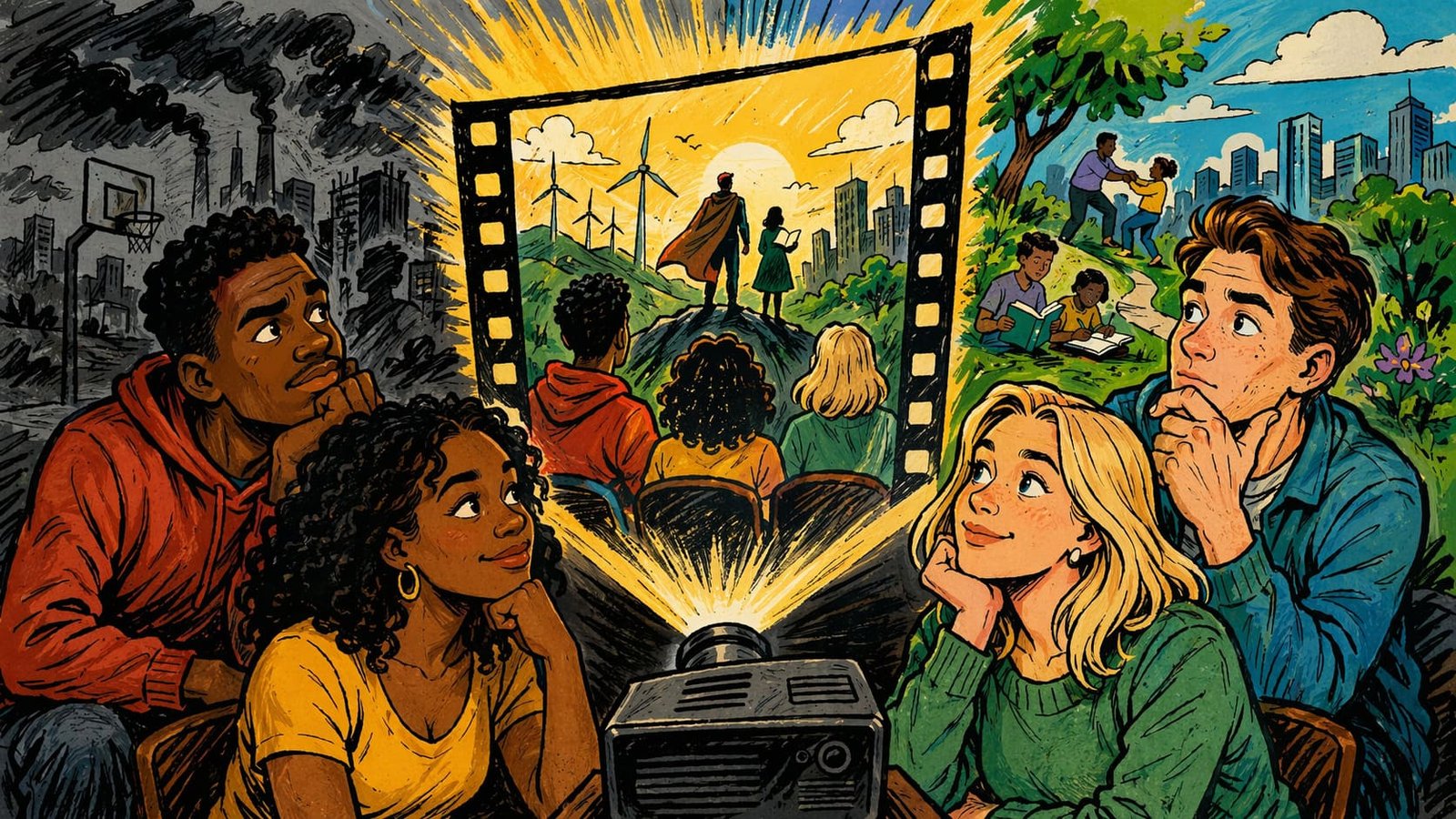
A dark theater holds its breath before the first frame appears. Strangers sit shoulder to shoulder, yet something shared already pulses beneath the silence. The screen ignites, and within seconds, the room begins to feel different. A character makes a choice, and without realizing it, the audience leans in, aligning, judging, hoping. No one announces it, but a moral universe is forming, one scene at a time, shaping what feels right, what feels wrong, what feels worth fighting for.
Stories have always carried values, but cinema amplifies them with unmatched intensity. Moving images, sound, pacing, performance, all converge to create an experience that feels immediate and immersive. A lesson delivered through narrative bypasses resistance. It is not presented as instruction. It is lived, witnessed, felt. The audience does not just hear an idea. It experiences its consequences. This is how cinema teaches without appearing to teach.
A young lawyer named Daniel once admitted that his early understanding of justice was influenced less by textbooks and more by courtroom dramas. Films like A Few Good Men shaped his sense of courage, authority, and truth. The famous confrontation scene did more than entertain. It embedded a belief that persistence could expose hidden power. Daniel later recognized the gap between cinematic justice and real legal systems, yet the emotional imprint remained.
Cinema simplifies complexity to make meaning accessible. Characters embody clear motivations. Conflicts are structured. Resolutions provide closure. This clarity is compelling, but it can also distort. Real life rarely offers such neat arcs. Ethical dilemmas often lack definitive answers. Yet repeated exposure to structured narratives can create expectations about how situations should unfold. When reality diverges, it feels unsatisfying, even when it is more accurate.
A filmmaker named Sofia once struggled with this tension while working on a project about social inequality. Early drafts leaned toward a clear hero and a clear resolution. Feedback from peers pushed her to embrace ambiguity. The final film left questions unanswered, challenging viewers rather than comforting them. Audience reactions were divided. Some appreciated the honesty. Others felt unsettled. Sofia realized that cinema’s power lies not only in what it resolves, but in what it refuses to resolve.
There is also a collective dimension to cinematic influence. Films create shared reference points that shape public discourse. A line, a scene, a character archetype can enter everyday language, guiding how people interpret situations. The concept of the “underdog,” for instance, has been reinforced through countless narratives. It frames how success and struggle are perceived, often privileging certain types of stories over others.
Consider the cultural impact of The Pursuit of Happyness. The story of resilience and upward mobility resonates deeply. It reinforces the idea that persistence leads to success, a belief that can inspire but also oversimplify. Structural barriers, systemic inequalities, and external factors often remain in the background. The narrative focuses on individual effort, shaping how audiences interpret similar real-world situations.
A teacher named Miriam once used films in her classroom to discuss ethics. She noticed that students engaged more deeply with moral questions when they were framed through characters rather than abstract principles. A decision made by a fictional figure sparked debate, empathy, disagreement. Miriam understood that cinema provided a safe space to explore complex ideas. Yet she also remained cautious. The emotional pull of a story could lead students toward conclusions that felt right but required further examination.
Cinema does not operate in isolation. It interacts with culture, reinforcing and reshaping existing values. A film reflecting societal norms can also influence them, creating a feedback loop. This is why representation matters. The characters shown, the stories told, the perspectives highlighted, all contribute to a broader understanding of what is possible, acceptable, or desirable.
A producer named Karim once advocated for more diverse narratives within his studio. He argued that expanding the range of stories would not just reflect reality more accurately, but also broaden the moral imagination of audiences. The push faced resistance. Market assumptions favored familiar formulas. Over time, however, shifts in audience demand created space for new voices. The change was gradual, but it demonstrated that cinema’s moral landscape is not fixed. It evolves with the stories it chooses to tell.
The tension within cinema’s influence lies in its dual role. It can illuminate, but it can also simplify. It can challenge, but it can also reinforce. The same medium that inspires critical thinking can also embed unexamined assumptions. The difference often depends on how the story is crafted and how the audience engages with it.
A cultural critic named Elena once described films as “emotional rehearsals for real life.” The phrase captured something essential. Watching a character face a dilemma allows the audience to simulate decision-making without consequence. These rehearsals shape intuition. They influence how situations are interpreted when they arise outside the screen.
In a quiet theater after the credits have rolled, the audience remains seated for a moment longer than necessary. The lights begin to rise slowly. Conversations start in hushed tones, as if breaking a spell. The story has ended, but its imprint lingers, subtle and persistent.
And in that lingering space, where fiction fades into memory, a question settles with quiet force: if the stories you absorb shape the values you carry, how carefully are you choosing the worlds you let define you?
