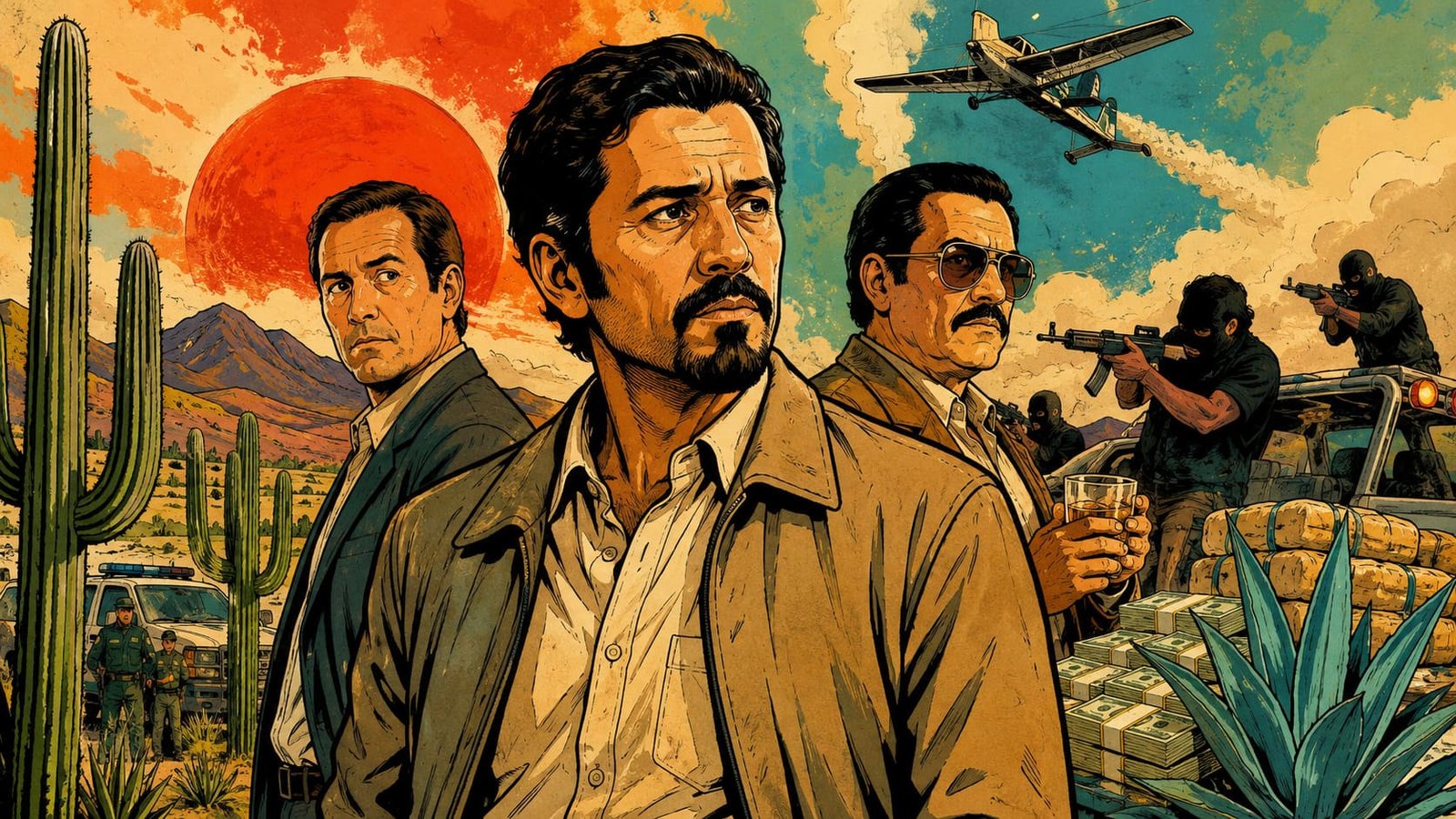
Dust floated through the air in Narcos: Mexico like ash from a civilization quietly burning itself alive. Pickup trucks rolled across desert highways under skies so wide they seemed indifferent to human morality. Politicians smiled beside military officers. Cartel leaders shook hands with businessmen. Somewhere between tequila glasses sweating on wooden tables and blood drying beneath neon motel signs, the series revealed its central truth: nations rarely collapse in one dramatic explosion. They decay through arrangements. Through convenience. Through ordinary people deciding survival matters more than principle for just one more day.
Diego Luna’s Félix Gallardo does not enter scenes like a traditional villain. He arrives like a systems engineer studying broken machinery. Calm voice. Controlled gestures. Patient calculations. That restraint makes him far more unsettling than any screaming gangster stereotype. Félix understands organization before violence. He sees fragmentation as weakness. Watching him unite plazas across Mexico feels strangely similar to observing a tech founder consolidating market share before a hostile takeover. The language changes. The psychology does not. Efficiency becomes morality. Expansion becomes destiny. Entire ecosystems get reorganized around ambition disguised as inevitability.
The genius of the series lies in how it dismantles romantic myths about criminal empires. Hollywood often treats cartels like outlaw kingdoms fueled purely by greed and adrenaline. Narcos: Mexico insists something colder and more uncomfortable. These structures thrive because institutions fail long before bullets fly. Corruption is never presented as individual weakness alone. It becomes atmospheric. Police departments absorb compromise slowly, the way old carpets absorb cigarette smoke. Politicians rationalize alliances as temporary necessities. Business elites distance themselves from consequences while benefiting from economic flow. By the time horror becomes visible, the architecture supporting it already feels normal.
A regional banker in Accra once described attending investment dinners where everyone pretended not to notice the origins of certain fortunes. Luxury watches flashed beneath soft lighting while conversations drifted toward infrastructure and “regional growth.” Nobody asked difficult questions because difficult questions threatened everyone’s comfort simultaneously. Narcos: Mexico captures that moral choreography perfectly. Every system contains participants who privately recognize corruption yet publicly maintain silence because the machine rewards cooperation faster than resistance. The frightening part is not evil itself. It is administrative adaptation to evil.
Scoot McNairy’s DEA agent Walt Breslin drifts through the series with the exhaustion of a man realizing institutions often fight symptoms while protecting causes. His narration carries the haunted rhythm of someone watching history repeat itself in different clothing. Governments launch wars against drugs while geopolitical interests quietly shape the battlefield underneath. The show never collapses into simplistic anti-American rhetoric or nationalist sentimentality. Instead, it reveals overlapping incentives. Power behaves globally. Morality behaves locally. Ordinary citizens become collateral trapped between those scales.
There is a brutal elegance to how the series handles capitalism. Cartels do not merely sell narcotics. They build supply chains, negotiate territory, manage logistics, diversify risk, and innovate distribution models faster than many legitimate corporations. One scene involving transportation routes feels almost indistinguishable from a boardroom discussion at an international shipping firm. That overlap is intentional. Narcos: Mexico forces viewers to confront an uncomfortable reality: organizational brilliance itself is morally neutral. The same strategic intelligence that builds hospitals can also build empires of destruction. Society celebrates systems thinking until systems become too efficient at producing catastrophe.
A woman named Teresa, who managed procurement operations for a textile exporter in São Paulo, once confessed during a conference dinner that her company’s internal culture resembled cartel politics more than professional collaboration. Promotions depended on invisible loyalties. Regional managers protected territories aggressively. Information became currency. One executive even sabotaged another division simply to preserve influence with leadership. Watching Narcos: Mexico afterward felt strangely familiar to her. That connection explains the show’s deeper resonance. Beneath the violence sits a recognizable human ecosystem built on fear, ambition, tribal loyalty, and survival. The costumes differ. The instincts remain ancient.
The visual atmosphere deserves recognition because it transforms geography into psychology. Sunlight feels oppressive. Hotel rooms carry the loneliness of temporary power. Even celebrations vibrate with underlying dread. It resembles a civilization dancing beside tectonic instability. Pop culture often glamorizes excess without examining emotional consequences. Narcos: Mexico lingers on emptiness afterward. Men gain territory and lose intimacy. Wealth expands while trust evaporates. Families become strategic liabilities. The empire grows larger while the soul inside it shrinks quietly from oxygen deprivation.
Toward the end, the series stops feeling like historical drama and begins resembling a political prophecy whispered through cigarette smoke. Desert winds move across borders drawn by governments but ignored by economics, corruption, and hunger. Félix stands at the center of enormous machinery he helped construct, only to discover that systems built through fear eventually consume architects alongside enemies. That revelation carries far beyond cartel mythology. Modern societies worship scale with near-religious devotion. Bigger markets. Bigger influence. Bigger reach. Yet Narcos: Mexico asks a question many institutions avoid because the answer feels dangerous: what happens when an empire becomes so efficient at feeding ambition that nobody remembers why it was built in the first place? Somewhere beneath the dust and blood, the silence answers back with terrifying calm.
Editorial Disclaimer: Whether a TV Show is rooted in fiction or inspired by real events, the actions, decisions, and behaviors portrayed within are not intended to be encouraged, replicated, or endorsed in real-world settings. This review exists solely to analyze the storytelling, characters, themes, and business dynamics presented in the TV Show for educational, analytical, and entertainment purposes. Any ethical or unethical conduct depicted in the TV Show does not reflect the views, values, or endorsements of ESYRITE.
