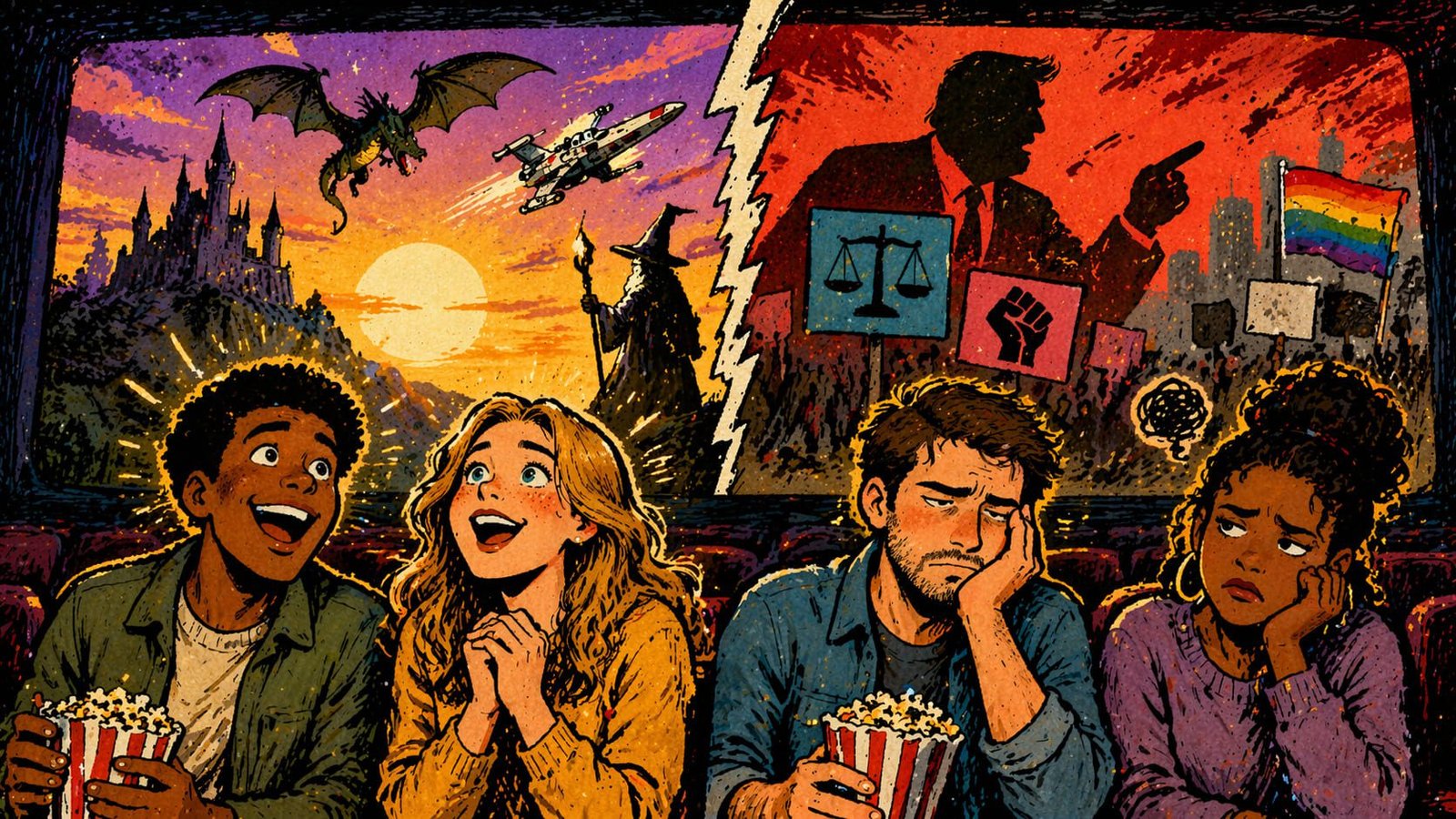
The theater darkens, not with anticipation but with a kind of polite obedience. The screen flickers alive, not as a portal but as a platform. Characters arrive already carrying arguments, dialogue lands like statements pre-approved for applause, and somewhere between the opening scene and the first act, the audience senses the shift. This is not a story unfolding. It is a message being delivered, carefully, insistently, without the risk of ambiguity.
Cinema once felt like a place where people surrendered to uncertainty. You entered without knowing what you would feel, only trusting that something unexpected might happen. The magic lived in that uncertainty. Directors built worlds that did not need to explain themselves in advance. Stories breathed. Characters contradicted themselves. Meaning emerged slowly, like something discovered rather than declared.
Then the temperature changed. Not suddenly, but steadily, like a room warming until it becomes uncomfortable. Politics did not simply enter film as subject matter. It began to shape the way stories were told. Themes that once lived beneath the surface moved to the front, often stripping narratives of the tension that made them compelling. The audience was no longer invited to interpret. It was guided toward a conclusion.
Hollywood has always reflected its cultural moment. Films like Do the Right Thing or Schindler’s List tackled deeply political themes without reducing themselves to instruction. They trusted viewers to sit with discomfort, to wrestle with complexity. The difference now lies in execution. The balance between story and statement has shifted, often tilting toward clarity at the expense of depth.
You can feel it in the rhythm of modern scripts. Dialogue becomes sharper but less human, characters speak in positions rather than voices, and conflict resolves with a sense of correctness rather than consequence. The unpredictability that once defined great storytelling begins to fade. What remains is a polished surface that rarely surprises.
A screenwriter named Daniel once described a moment that changed how he approached his craft. He submitted a script centered on a morally ambiguous protagonist, someone flawed, difficult, and painfully real. The feedback was swift. Make the character more clearly aligned. Clarify the message. Remove the elements that might confuse the audience. He rewrote it, reluctantly. The film was produced. It performed well. He never felt proud of it.
This pattern reflects a broader shift in incentives. Studios operate within a landscape shaped by public discourse, social media, and global audiences. Controversy travels fast. Clarity feels safer. When a film aligns neatly with prevailing narratives, it reduces risk. The cost of that safety is often subtle but significant. Stories lose their edges.
The audience, meanwhile, adapts in complex ways. Some welcome the clarity, finding comfort in narratives that reinforce their beliefs. Others grow restless, sensing that something essential is missing. The theater becomes less of a space for exploration and more of a venue for affirmation. Wonder, once the defining feature of cinema, begins to feel secondary.
There are still exceptions, moments where storytelling resists this pull. Films like Parasite manage to engage with social and political themes while preserving narrative tension. The film does not instruct. It unsettles. It invites interpretation rather than dictating it. The success of such works suggests that audiences still crave complexity, even if it is not always delivered.
The tension is not simply about politics. It is about the balance between art and intention. When intention becomes too visible, it can overshadow the experience. The audience begins to see the machinery behind the story, the decisions made to ensure a particular reading. The illusion breaks, and with it, a piece of the magic.
This dynamic extends beyond film into the broader media landscape. Streaming platforms amplify content at a pace that prioritizes immediacy over depth. Stories are consumed quickly, discussed briefly, then replaced. The cycle rewards clarity and relevance, often at the expense of nuance. The result is a cultural environment where narratives are expected to perform, not linger.
A director working on an independent project once shared a small, telling anecdote. During a test screening, viewers were asked what the film meant. Several responded with uncertainty, describing how it made them feel rather than what it was trying to say. The feedback was considered problematic. The director kept the film as it was. It did not become a commercial hit. It developed a devoted following that returned to it repeatedly, each time finding something new.
This speaks to a deeper truth about storytelling. The most enduring works do not resolve neatly. They leave space for interpretation, for disagreement, for reflection. They trust the audience to engage actively rather than passively receive. When that trust is replaced with guidance, something essential is lost.
The cultural conversation around representation and responsibility adds another layer to this shift. There is a legitimate desire to see diverse experiences reflected on screen, to correct historical imbalances. The challenge arises when representation becomes formulaic, when characters are shaped more by what they signify than who they are. Authenticity requires complexity, not simplification.
Actors have begun to navigate this terrain with increasing awareness. Viola Davis has spoken about the importance of portraying characters with depth and humanity, resisting the urge to reduce them to symbols. Her performances often carry a weight that transcends the script, reminding audiences of what is possible when storytelling prioritizes truth over messaging.
There is also a generational element at play. Younger audiences, raised in a highly mediated environment, are attuned to subtext in ways that previous generations were not. They recognize when a narrative is shaping their response. This awareness can lead to both appreciation and skepticism. The relationship between creator and viewer becomes more dynamic, but also more fragile.
The economic structure of the film industry reinforces certain patterns. Large budgets demand broad appeal. Broad appeal often translates into safer narratives. Independent films, while freer, struggle for visibility in a crowded market. The ecosystem favors content that can be easily understood and widely shared, which can discourage risk-taking.
Yet the desire for wonder persists. It appears in the way audiences respond to films that break the mold, that resist easy categorization. There is a hunger for stories that feel alive, that surprise, that challenge without prescribing. This hunger is not always met, but it remains present, waiting for something to satisfy it.
Somewhere in a quiet screening room, a small group watches a film that refuses to explain itself. The pacing is uneven, the characters contradictory, the meaning elusive. There is discomfort, even frustration. Then something shifts. A scene lingers longer than expected, a line lands differently, a connection forms that was not obvious at first. The experience becomes personal.
The future of cinema may not lie in choosing between politics and storytelling, but in rediscovering how they can coexist without diminishing each other. It requires a willingness to embrace ambiguity, to allow stories to unfold without immediate resolution. It asks creators to trust their audience, and audiences to accept that not everything needs to be clarified.
The screen does not need to return to some imagined past. It needs to recover its capacity for uncertainty, for contradiction, for genuine surprise. That is where wonder lives, not in the absence of meaning, but in the space where meaning is allowed to emerge.
And perhaps the next time the lights dim, the audience will feel that familiar tension again, not the comfort of being told what to think, but the quiet thrill of not knowing what will happen next.
