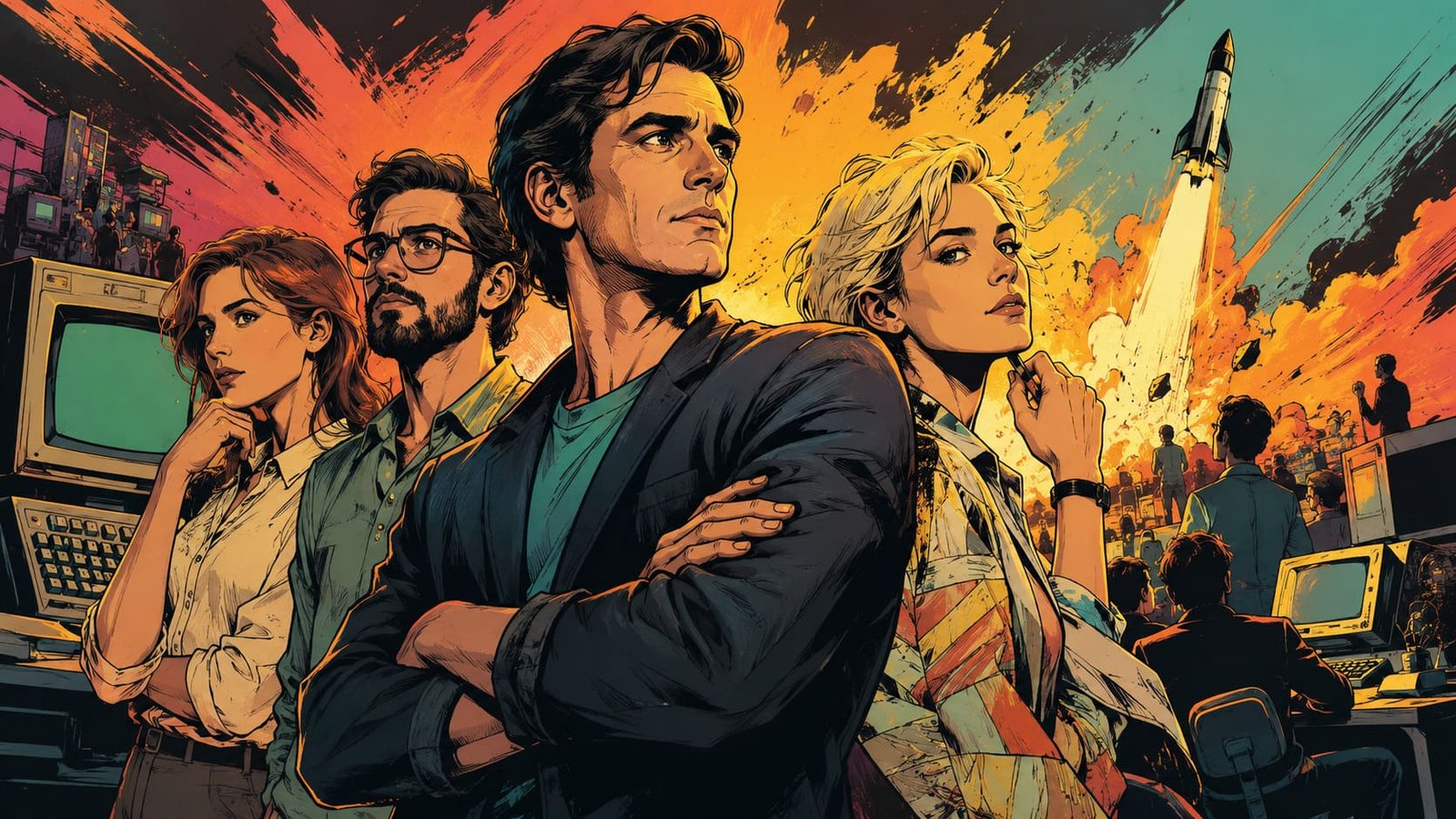
Texas in Halt and Catch Fire hums with the nervous electricity of a future still trying to invent itself. Computer parts scatter across cluttered desks beside cold pizza boxes and sleepless ambition. Fluorescent office lights flicker over engineers arguing about processors, code, and impossible dreams while the rest of the world barely notices history mutating quietly in real time. The series does not romanticize technological innovation as smooth progress. It presents invention as emotional combustion. Brilliant minds colliding against ego, loneliness, capitalism, and the terrifying possibility that building the future may destroy the people trying hardest to shape it.
Lee Pace’s Joe MacMillan enters the story like a corporate drifter carrying equal amounts charisma and existential damage. He speaks in visionary monologues sharp enough to hypnotize exhausted employees into believing impossible deadlines might somehow become destiny. Joe belongs to a recognizable lineage of modern innovators. Part Steve Jobs. Part advertising executive. Part cult leader. He understands narrative instinctively. Products matter, certainly, but stories move markets faster. Watching him manipulate rooms filled with skeptical engineers feels eerily familiar in an era where founders routinely package ambition as revolutionary philosophy.
The brilliance of the series lies in how it treats technology as deeply human rather than mechanical. Computers are never merely machines here. They become emotional mirrors reflecting insecurity, longing, competitiveness, and identity. Gordon Clark, portrayed beautifully by Scoot McNairy, represents the exhausted genius trapped between technical mastery and emotional fragility. His mind races ahead while ordinary life struggles to keep pace. Countless engineers, designers, and creators recognize that tension immediately. Innovation culture celebrates brilliance publicly while quietly neglecting the psychological cost of obsessive creation.
A software founder in Nairobi once described sleeping beneath his desk during the early years of building an educational platform. Relationships deteriorated slowly. Meals became caffeine rituals. Days blurred into debugging sessions lit by glowing monitors at three in the morning. “Everybody praised the grind afterward,” he admitted quietly during a tech panel years later. “Nobody talks about how strange your mind becomes living inside constant optimization.” Halt and Catch Fire captures that emotional transformation with painful precision. Ambition changes perception long before success arrives materially.
Mackenzie Davis gives Cameron Howe extraordinary volatility and depth. Cameron rejects institutional conformity instinctively because she recognizes how quickly corporate systems sterilize creativity. Her rebellious energy becomes one of the series’ emotional engines. Watching her clash with executives and collaborators feels less like ordinary workplace conflict and more like a philosophical war between art and monetization. Modern technology culture still wrestles with this contradiction constantly. Platforms begin as acts of imaginative experimentation, then gradually harden into profit-driven ecosystems where creativity survives only if it scales.
The relationships throughout the series carry unusual emotional intelligence because they refuse simplistic binaries. Partnerships evolve through admiration, resentment, attraction, betrayal, and dependency simultaneously. Donna Clark, played brilliantly by Kerry Bishé, emerges as one of the show’s sharpest observations about gender and invisible labor within innovation history. Women frequently stabilized technological revolutions emotionally and operationally while men absorbed public mythology. Donna understands systems deeply, yet recognition arrives unevenly. Halt and Catch Fire quietly restores complexity to narratives often flattened by masculine founder worship.
One marketing strategist named Elias once joined a rapidly growing gaming company in Berlin where employees treated product launches like military campaigns. Team members slept inside conference rooms during crunch periods while executives delivered speeches about changing culture forever. Months later, burnout shattered entire departments. “The office stopped feeling like work,” he recalled during a late-night conversation outside a tech conference. “It felt like surviving inside someone else’s obsession.” That sentence hovers over Halt and Catch Fire constantly. The future gets built by passionate people, but passion itself can become predatory when systems stop respecting human limits.
Visually, the series captures the tactile romance of early computing beautifully. Keyboards clatter loudly. Machines overheat. Cigarette smoke curls above tangled wires and half-finished prototypes. There is texture everywhere. Modern technology often feels frictionless and invisible. Halt and Catch Fire remembers when innovation still carried physical weight. People touched the future directly with scraped knuckles and exhausted eyes. That atmosphere gives the show emotional warmth even during its coldest conflicts.
The series also understands failure unusually well. Characters launch products that collapse commercially. Partnerships fracture unexpectedly. Brilliant ideas arrive before markets fully exist to receive them. Yet failure never feels meaningless. It becomes evolutionary. Modern culture worships overnight success stories because they package ambition neatly. Halt and Catch Fire insists real innovation usually looks messy, repetitive, and emotionally expensive. Entire careers disappear into prototypes history forgets. Yet those forgotten attempts still shape the future indirectly.
Joe’s greatest tragedy may be that he understands inspiration more deeply than stability. He ignites people magnificently while struggling to sustain intimacy afterward. Many visionary leaders share that contradiction. They can imagine worlds but cannot always inhabit ordinary emotional life comfortably. The series refuses easy judgment because Joe genuinely believes in possibility. That sincerity makes his flaws more heartbreaking rather than less damaging.
Toward the final stretch, glowing monitors illuminate tired faces while friendships, companies, and dreams mutate across decades of technological acceleration. The future finally arrives, sleeker and more commercialized than anyone originally imagined. Yet beneath the innovation sits lingering melancholy. Some people changed the world while quietly losing pieces of themselves in the process. That is the haunting brilliance of Halt and Catch Fire. It understands that progress often leaves emotional wreckage hidden beneath celebration. Somewhere between broken code, failed marriages, startup wars, and revolutionary ideas, the series whispers a devastating truth modern culture rarely acknowledges honestly: the people most obsessed with building the future are often trying desperately to outrun something unfinished inside themselves. The machines evolve faster than the wounds ever do.
Editorial Disclaimer: Whether a TV Show is rooted in fiction or inspired by real events, the actions, decisions, and behaviors portrayed within are not intended to be encouraged, replicated, or endorsed in real-world settings. This review exists solely to analyze the storytelling, characters, themes, and business dynamics presented in the TV Show for educational, analytical, and entertainment purposes. Any ethical or unethical conduct depicted in the TV Show does not reflect the views, values, or endorsements of ESYRITE.
