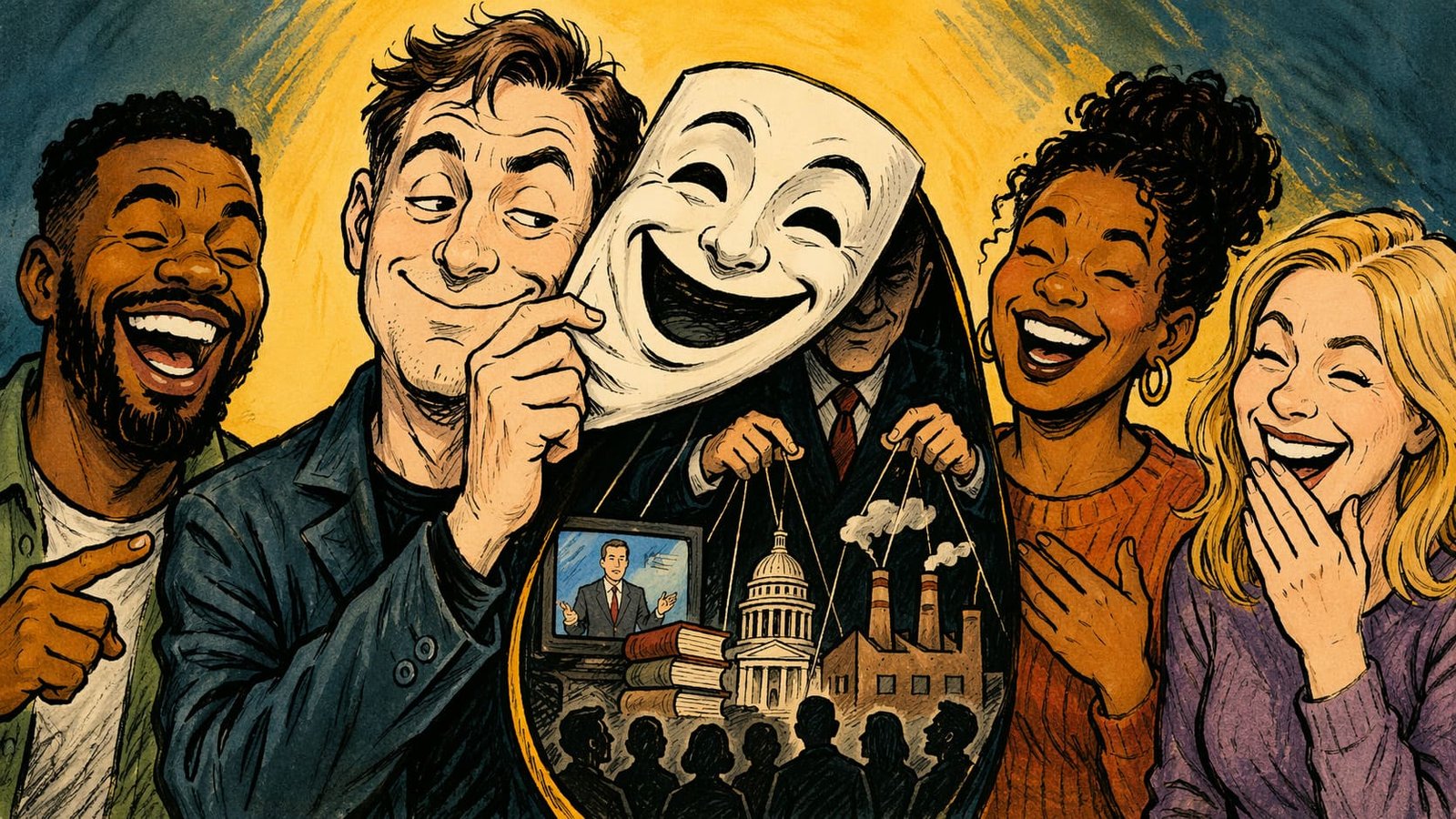
A late-night stage glows under a single spotlight. The crowd leans forward before the first punchline lands, already prepared to laugh, already disarmed. The performer smiles, pauses just long enough to create tension, then releases a line that slices through the room. Laughter erupts. Shoulders relax. Something uncomfortable has just been said, but it feels harmless now, almost generous. The joke lands, and with it, an idea slips in quietly, dressed as entertainment.
Comedy has always operated on this edge. It reveals by disguising. A truth spoken directly can provoke resistance, but the same truth wrapped in humor becomes digestible. Laughter lowers defenses. It creates a moment where contradiction can exist without immediate rejection. This is why comedians often say what others cannot. The stage becomes a space where tension is not avoided, but transformed.
A writer named Daniel once crafted a satirical sketch about corporate culture. It exaggerated meeting jargon, mocked empty productivity rituals, and highlighted the absurdity of performative busyness. Audiences laughed loudly. After the show, a senior executive approached Daniel and admitted that the sketch felt “uncomfortably accurate.” The humor had exposed a reality that formal reports often failed to articulate. The joke had carried a critique more effectively than analysis.
Comedy does not just entertain. It frames perception. A repeated joke can shape how a topic is understood. When certain groups, behaviors, or ideas become recurring punchlines, they are subtly positioned within a hierarchy of seriousness and legitimacy. The audience may not consciously adopt these frames, but repetition has a way of embedding perspective. Over time, what begins as humor can influence belief.
Consider the work of Dave Chappelle, whose performances often blend sharp social commentary with humor. His routines navigate complex issues around race, identity, and culture. Audiences laugh, but they also reflect. The laughter creates space for engagement, even when the subject matter is difficult. The balance is delicate. Too much humor, and the message risks being dismissed. Too little, and resistance returns.
There is also a commercial dimension to comedy’s power. Brands have learned to adopt humor as a strategy. Advertising campaigns use wit to create relatability, to soften persuasion, to make messages feel less intrusive. A clever line can travel further than a straightforward pitch. It invites sharing, repetition, cultural embedding. The joke becomes a vehicle, carrying not just laughter, but intent.
A marketing strategist named Leandro once led a campaign that relied heavily on humor. The product itself was ordinary, but the messaging was playful, self-aware, almost irreverent. Engagement soared. Customers felt like they were part of an inside joke. Leandro noticed that the humor created trust, even though the product had not changed. The tone suggested honesty, even when the underlying message remained promotional.
Comedy also acts as a social signal. What people find funny often reflects what they accept, question, or reject. Sharing a joke is not just about humor. It is about alignment. It signals taste, perspective, belonging. This is why certain jokes resonate within specific communities while falling flat in others. Humor becomes a language, one that communicates more than it appears to.
There is a performer named Aisha who built her reputation on observational comedy about everyday life. Her routines felt light, relatable, easy. Then she introduced a segment that touched on deeper social issues, still framed humorously but with sharper edges. The audience response shifted. Some laughed, others hesitated. Aisha later reflected that the moment revealed something important. Comedy could open doors, but it could also expose where audiences preferred to keep them closed.
Pop culture has long used comedy as a mirror. Shows like The Office present workplace dynamics in exaggerated form, highlighting awkwardness, inefficiency, and human quirks. Viewers laugh because the situations feel familiar. The humor validates shared experiences while subtly critiquing them. The office becomes both a setting and a subject of reflection.
The tension within comedy lies in its dual nature. It can challenge power, but it can also reinforce it. A joke that critiques authority can empower audiences, while a joke that targets vulnerable groups can perpetuate harm. The line is not always clear. Context, intention, and reception all play a role. This ambiguity is part of what makes comedy powerful, and risky.
A podcast host named Marcus once experimented with different styles of humor. In one episode, he used satire to critique media narratives. In another, he relied on sarcasm to comment on social trends. Listener feedback varied widely. Some praised the insight, others misinterpreted the tone. Marcus realized that humor does not guarantee clarity. It invites interpretation, and interpretation can diverge.
In a quiet comedy club, long after the crowd has left, the stage remains lit for a moment longer than necessary. The microphone stands still, holding the residue of words that were both light and heavy, both playful and pointed. The room feels different without the laughter, as if the ideas that passed through it are still settling into place.
In that lingering silence, where humor fades but meaning remains, a question begins to take shape with quiet intensity: when laughter makes something easier to accept, how often does it also make it harder to question?
