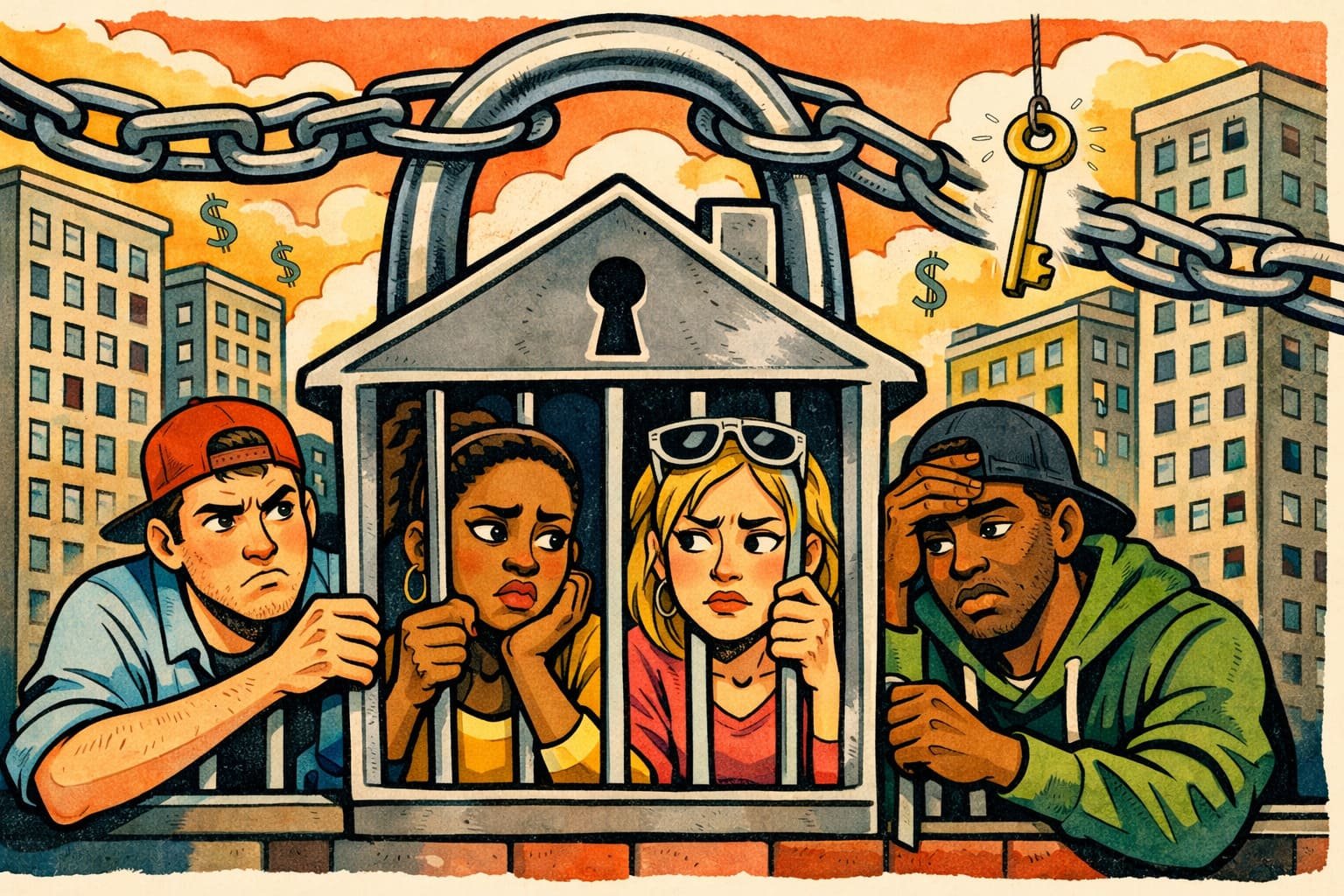
Umbrellas bob through a rainy avenue where apartment windows glow with borrowed warmth. Moving trucks stand idle beside buildings that rarely welcome new owners, while estate agents refresh listings that attract admiration more often than signatures. A generation keeps climbing professionally yet remains strangely rooted in place. Homeownership has become less like a milestone and more like a distant constellation, visible enough to inspire hope, distant enough to feel almost mythical. Rent quietly becomes the price of postponing tomorrow.
Conventional economic thinking treats renting as a temporary stage before ownership. That ladder has become harder to climb as housing prices outpace income growth in many cities, borrowing costs remain elevated, and supply struggles to match demand. Renting itself is not the problem. Long-term financial imbalance is. When rising rental costs absorb increasing shares of disposable income, households lose opportunities to accumulate wealth, invest, or build resilience against future economic shocks. Housing shifts from an asset-building engine into a recurring financial obligation.
This shift has transformed business strategy in unexpected ways. Companies such as Airbnb emerged by monetizing underused living spaces, while institutional investors expanded into residential rentals, viewing steady rental income as an attractive long-term asset. Build-to-rent developments now receive significant investment because demand remains persistent. Financial markets applaud predictable cash flows. Prospective homeowners often see the same buildings differently, wondering whether investment capital has become a stronger competitor than neighboring families searching for their first permanent home.
Amira accepted a promotion after years of disciplined work, expecting the salary increase to finally unlock homeownership. Instead, higher mortgage costs erased much of her improved earning power before she even visited a lender. She renewed her lease with reluctant practicality and postponed conversations about starting a family. Friends congratulated her career success over dinner. Nobody noticed that professional progress had quietly failed to produce personal mobility, leaving achievement feeling oddly incomplete despite every outward sign of advancement.
Balance sheets reveal why this pattern matters far beyond individual households. Persistent renting influences consumer spending, retirement planning, and intergenerational wealth creation. Businesses serving homeowners, from furniture manufacturers to renovation firms, encounter slower demand when fewer households transition into ownership. Banks experience changing mortgage activity, while governments confront affordability challenges that increasingly shape labor mobility and urban competitiveness. Housing therefore becomes more than shelter. It evolves into financial infrastructure supporting entrepreneurship, family formation, and long-term economic confidence.
Evening settles across balconies where countless tenants switch on familiar lights inside homes that never quite feel permanent. Keys still unlock front doors, laughter still echoes through hallways, and communities continue to grow. Yet ownership carries a psychological promise that renting rarely replaces, the belief that each monthly payment builds tomorrow rather than merely extending today. Economies flourish when ambition finds solid ground beneath it. Ask yourself whether rising rents are funding your future, or quietly renting it back to you.
