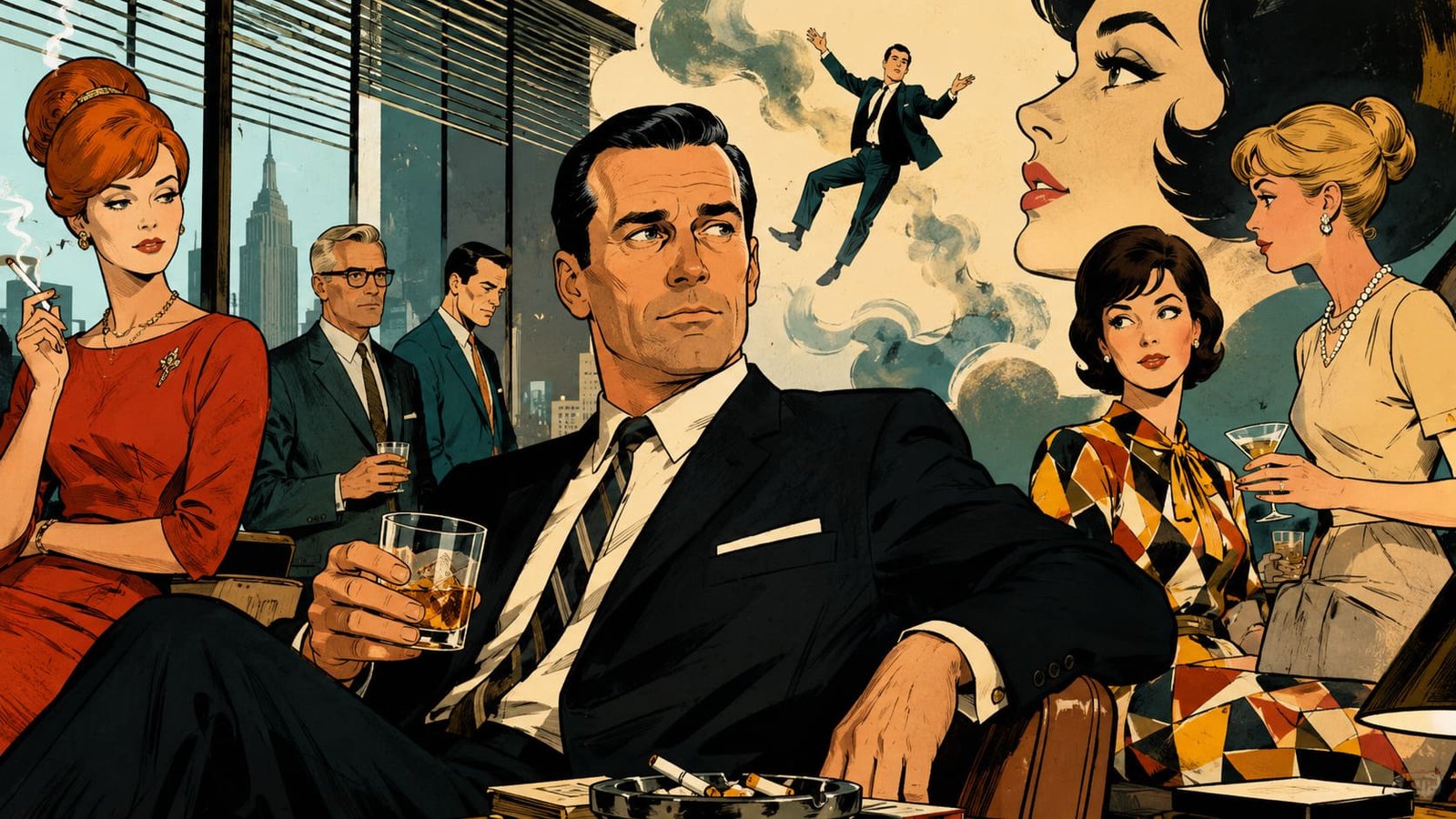
Smoke curled through Manhattan offices like ghostly handwriting from a civilization drunk on its own illusions. Ice clinked against crystal glasses before noon. Secretaries moved through hallways carrying beauty, exhaustion, and carefully rehearsed smiles while men in tailored suits sold fantasies to a nation desperate to believe happiness could be purchased between commercial breaks. Mad Men never behaved like an ordinary period drama. It functioned more like an autopsy of modern identity itself. Beneath the glamour sat a frightening question that still stalks corporate culture today: what happens when performance becomes more valuable than truth?
Don Draper walks through the series like a beautifully constructed lie searching for silence. Everything about him appears enviable at first glance. The tailored confidence. The advertising genius. The expensive whiskey glowing beneath dim office light. Yet the show slowly peels back the illusion until success begins resembling a private form of suffocation. Draper understands desire better than almost anyone around him because he himself is built from longing and reinvention. He sells products by selling emotional escape. Cigarettes become freedom. Lipstick becomes identity. Cars become masculinity. Watching him pitch campaigns feels less like marketing and more like psychological warfare conducted by poets wearing cufflinks.
The advertising world inside Mad Men feels strangely timeless because it exposes how institutions manipulate insecurity while pretending to offer fulfillment. The show’s brilliance lies in recognizing that consumer culture rarely sells objects alone. It sells imagined versions of the self. That insight remains painfully relevant in the age of influencers, algorithmic branding, and curated digital identities. Peggy Olson’s rise through the agency reveals another truth hiding beneath corporate mythology. Talent matters, but systems decide whose talent becomes visible. Her journey through sexism, dismissal, and creative hunger carries emotional weight because the audience watches intelligence fighting structures designed to underestimate it.
A brand strategist named Esteban Valez once described attending a luxury fragrance launch in Milan where executives spent hours debating the emotional meaning of a perfume bottle cap. One creative director argued the metallic click needed to “sound expensive enough to heal childhood insecurity.” The room went silent because everyone secretly understood the absurdity was also partially true. Esteban later admitted the meeting changed how he viewed marketing forever. Products were rarely the real business. Emotional aspiration was. Mad Men understood this decades before social media turned personal identity into a monetized performance loop.
The series also operates as one of television’s sharpest studies of masculinity and emotional repression. Men drink instead of confessing fear. They pursue affairs instead of intimacy. They dominate meetings because vulnerability feels fatal. Roger Sterling hides existential panic behind effortless charm while Pete Campbell weaponizes ambition to compensate for insecurity eating through him like acid. The office becomes a stage where everyone performs adulthood while quietly collapsing inside. That emotional architecture feels hauntingly familiar even now. Many modern organizations still reward emotional concealment more than honesty. Burnout hides behind polished presentations. Loneliness hides behind productivity. Entire careers become elaborate disguises.
Then there are the women, carrying worlds on their backs while pretending the weight does not exist. Joan Holloway understands power as theater long before corporate feminism turns empowerment into branding language. Betty Draper drifts through suburban perfection like a character trapped inside a designer snow globe. Peggy Olson fights for recognition with the focused exhaustion of someone forced to prove competence repeatedly in rooms where mediocrity receives automatic respect if wrapped in male confidence. Their stories give the series much of its emotional gravity. Mad Men does not merely depict sexism as historical background. It shows how systems quietly shape identity, self-worth, and ambition itself.
A creative producer named Nia Okonkwo once recalled pitching a campaign idea during a late-night strategy session in London. Her concept was ignored until a senior executive repeated the same idea thirty minutes later and received applause. Nobody acknowledged the theft. After the meeting another colleague quietly whispered, “That room heard authority, not intelligence.” Nia later said the moment taught her more about organizational behavior than any leadership seminar ever could. Mad Men thrives on these invisible transactions of status and recognition. Every conversation contains hidden negotiations about who gets to matter and who remains decorative.
At some impossible hour, long after the elevators empty and city lights smear against office windows, a lonely executive still sits beneath fluorescent light staring at a campaign slogan meant to convince strangers they are incomplete without another purchase. Somewhere below, taxis slide through wet streets while jazz drifts faintly from forgotten bars. The typewriters fall silent. The whiskey glasses sit half-empty. Yet the hunger remains. That is the enduring ache beneath Mad Men. It reveals a culture obsessed with reinvention while terrified of authenticity, a world where people become brands long before social media made the process explicit. The tragedy is not that the characters fail to achieve success. It is that success keeps arriving without curing the emptiness they hoped it would erase. And somewhere in that silence, modern society still recognizes itself.
Editorial Disclaimer: Whether a TV Show is rooted in fiction or inspired by real events, the actions, decisions, and behaviors portrayed within are not intended to be encouraged, replicated, or endorsed in real-world settings. This review exists solely to analyze the storytelling, characters, themes, and business dynamics presented in the TV Show for educational, analytical, and entertainment purposes. Any ethical or unethical conduct depicted in the TV Show does not reflect the views, values, or endorsements of ESYRITE.
