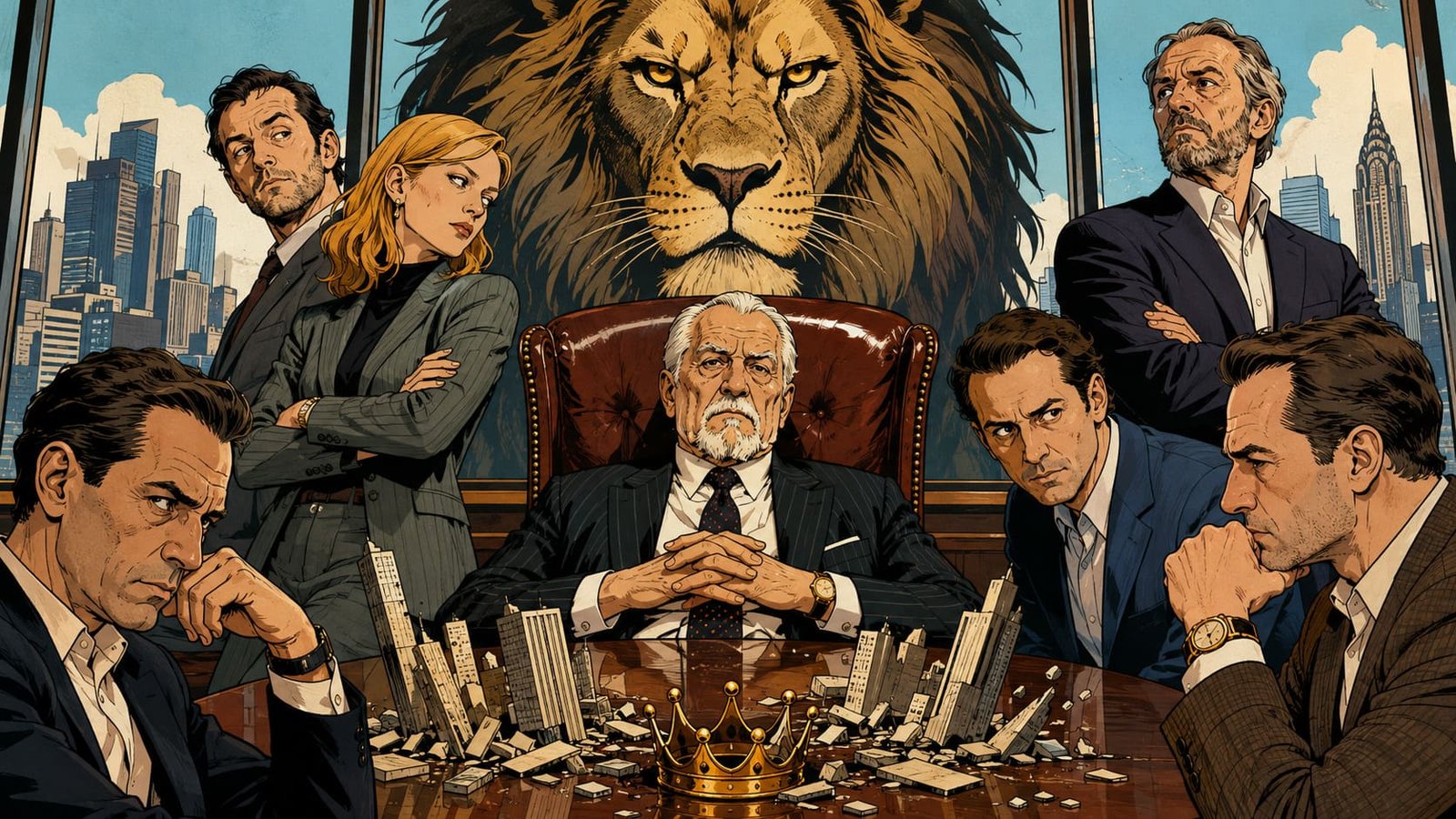
Rain pressed against the glass towers of Manhattan like a crowd locked outside a private funeral. Inside, the rooms glowed with polished wood, billion-dollar silence, and the kind of tension that turns family dinners into cold wars. In Succession, power does not arrive dressed like inspiration. It limps into the room exhausted, paranoid, hungry for approval. The Roy family speaks the language of corporate dominance, yet every conversation feels like a hostage negotiation disguised as brunch. That contradiction is what makes the series feel less like television and more like an X-ray of modern capitalism. Wealth here is not freedom. It is surveillance with better tailoring.
Logan Roy moves through the show like a dying emperor inside a collapsing cathedral, frightening everyone even when his body begins betraying him. The genius of the writing sits inside a disturbing truth many executives quietly recognize after midnight flights and cold steak dinners in luxury hotels: authority rarely creates emotional security. It creates dependency. One scene can feel like Shakespeare rewritten by exhausted investment bankers who survived too many board meetings. Another feels like a therapy session interrupted by private jets. The children orbit their father like anxious satellites searching for gravity. Kendall wants redemption but performs ambition like an addict searching for applause. Shiv hides vulnerability beneath intellectual superiority. Roman turns humiliation into humor because honesty would break him in half. The show understands something uncomfortable about elite institutions: the people closest to power are often the least emotionally free.
A venture capitalist in Singapore once described a merger negotiation that felt eerily similar to a Roy family gathering. His name was Darius Wen, a sharp operator known for closing deals while eating pistachios one shell at a time. During a tense acquisition, he watched two brothers sabotage a billion-dollar agreement simply because neither wanted the other to appear smarter in front of their father. The transaction collapsed. Months later one brother privately admitted the company had never mattered as much as winning invisible childhood arguments. That tiny confession sits at the center of Succession. The boardroom is rarely about numbers alone. It is often a theater for unresolved emotional wounds wearing expensive watches.
The series also dismantles the fantasy that intelligence naturally produces wisdom. Corporate culture loves pretending brilliance and maturity are twins. Succession laughs directly in the face of that assumption. These characters are media titans with access to economists, strategists, and political insiders, yet they regularly behave like frightened adolescents trapped inside luxury prisons. A private helicopter ride can suddenly resemble a medieval succession crisis. An election-night episode unfolds with the dread of a political thriller because the show understands media empires do not simply report reality anymore. They shape it. That idea lands differently after years of watching billionaires drift into politics, technology leaders flirt with ideological influence, and news corporations treat outrage like a renewable energy source.
Somewhere beneath the satire exists a brutal commentary about modern masculinity. Logan Roy’s empire operates on emotional starvation. Compassion is treated like weakness. Vulnerability becomes market poison. Every character learns to perform dominance because tenderness gets punished instantly. There is a haunting scene where silence around a dinner table says more than pages of dialogue ever could. Faces twitch. Eyes drift downward. Tiny gestures reveal entire psychological histories. Great management thinkers often discuss organizational culture as if it were a strategy deck. Succession understands culture is actually inherited emotional behavior. Companies absorb the wounds of the people leading them. The Roy empire feels toxic because its founder never learned how to separate fear from leadership.
A media consultant from Johannesburg named Naledi Mbeki once told a story about a television executive who screamed at junior staff moments before accepting an industry award celebrating “empathetic leadership.” Nobody in the room laughed because everyone recognized the performance. That contradiction pulses through every season of Succession. Public image and private behavior exist on opposite planets. The series exposes how prestige often disguises chaos rather than eliminating it. Watching Tom Wambsgans desperately chase approval while quietly losing pieces of his dignity feels painfully familiar to anyone who has worked inside institutions where loyalty matters more than competence. The show becomes strangely personal because most viewers have encountered miniature versions of these power games inside offices, friendships, or families.
What elevates the series beyond ordinary prestige television is its refusal to comfort the audience with easy moral categories. Nobody escapes clean. Even moments of humanity arrive stained with calculation. Yet the show never becomes cynical in a lazy way. It understands something far more difficult. Human beings can be manipulative and wounded at the same time. That duality gives the dialogue its electricity. Characters insult one another with the precision of elite comedians because cruelty often becomes armor inside competitive systems. Roman’s jokes are rarely jokes. Shiv’s confidence often masks panic. Kendall’s grand speeches collapse under the weight of his own need for validation. Their dysfunction feels grotesque, funny, tragic, and strangely recognizable all at once.
Late into the night, somewhere above the city, the windows inside a corporate tower still glow while exhausted assistants order black coffee and lawyers rehearse damage control. The elevators hum softly like machines protecting ancient rituals. In another room, an aging executive stares at a skyline that once symbolized victory and now resembles a scoreboard measuring emptiness. That is the final trick Succession pulls on its audience. Beneath the yachts, acquisitions, and brutal comedy sits a terrifying question about modern ambition itself. What happens when winning becomes the only language left inside a person? The series never answers directly. It simply leaves the silence hanging there like smoke after an explosion, daring the viewer to decide whether power is a throne, a prison, or a slowly tightening collar around the human soul.
Editorial Disclaimer: Whether a TV Show is rooted in fiction or inspired by real events, the actions, decisions, and behaviors portrayed within are not intended to be encouraged, replicated, or endorsed in real-world settings. This review exists solely to analyze the storytelling, characters, themes, and business dynamics presented in the TV Show for educational, analytical, and entertainment purposes. Any ethical or unethical conduct depicted in the TV Show does not reflect the views, values, or endorsements of ESYRITE.
