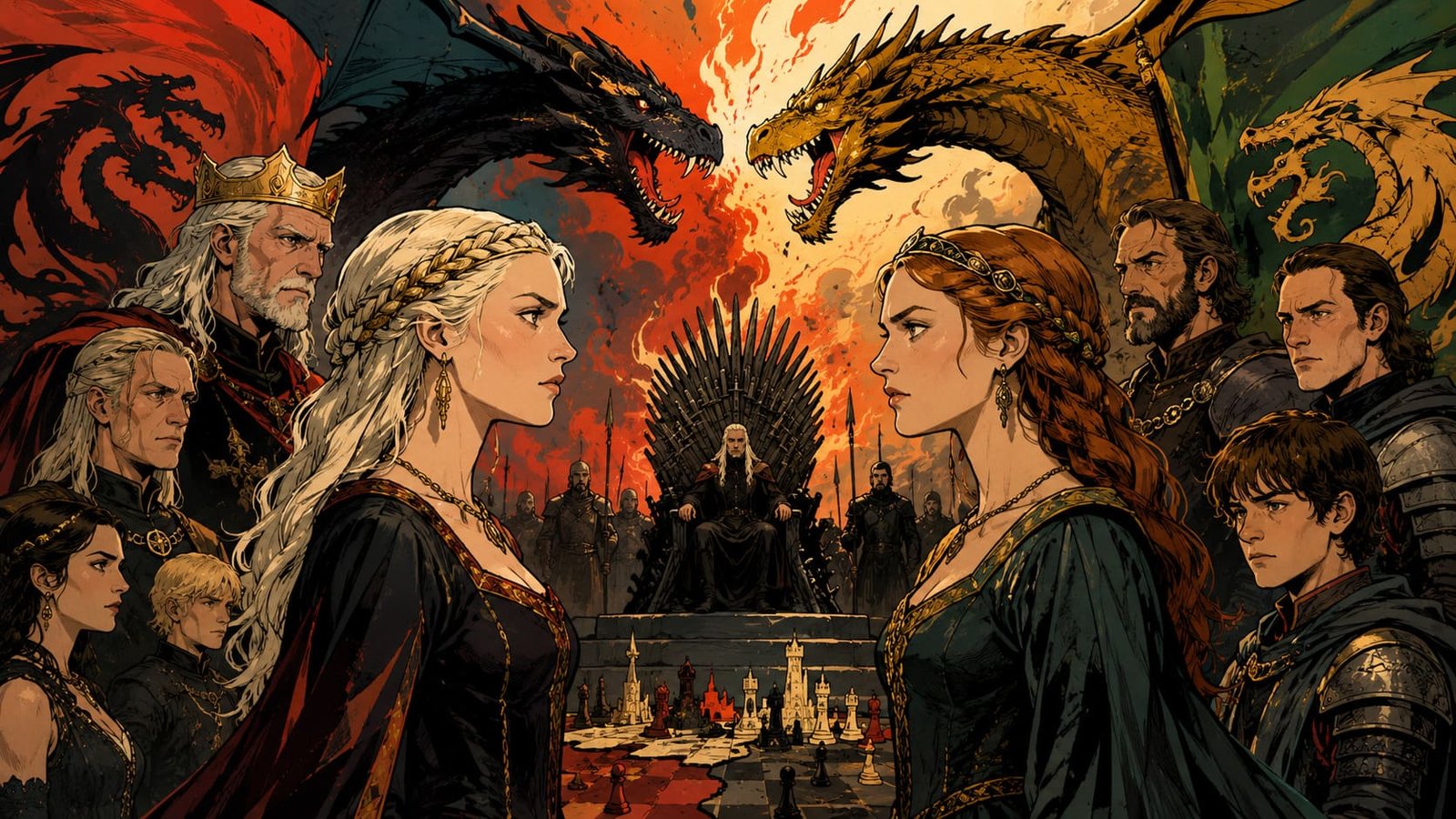
Candles trembled against stone walls as if the castle itself understood catastrophe was approaching long before the people inside did. Silver goblets scraped across ancient tables. Dragons breathed somewhere beyond the dark horizon like living warnings ignored by arrogant bloodlines convinced destiny belonged exclusively to them. House of the Dragon is not truly about fantasy creatures or medieval spectacle. It is about succession anxiety, institutional fragility, and the terrifying speed at which powerful families destroy themselves when ego becomes indistinguishable from identity. Every whispered conversation inside the Red Keep feels less like entertainment and more like a boardroom crisis wrapped in fire and prophecy.
King Viserys Targaryen rules with the exhausted softness of a man trying to preserve peace inside a culture addicted to dominance. His tragedy is painfully recognizable to anyone who has watched organizations collapse beneath weak succession planning. Leaders often believe avoiding conflict preserves stability. In reality, delayed confrontation tends to ferment into disaster. Viserys spends years attempting to hold competing ambitions together through sentiment and denial while the kingdom quietly fractures beneath him. The brilliance of the series lies in understanding that institutions rarely collapse from one dramatic event alone. They rot gradually through unresolved tension, private resentment, and leaders mistaking temporary calm for genuine unity.
Princess Rhaenyra enters the story carrying intelligence sharpened by exclusion. Every room reminds her that capability does not automatically overcome tradition. Alicent Hightower evolves differently, shaped by duty, manipulation, and survival inside a political machine that consumes emotional innocence with terrifying efficiency. Their relationship becomes the emotional engine of the series because it mirrors a timeless human tragedy. Systems built around power often transform intimacy into competition. Friendship decays beneath inheritance politics. Trust suffocates beneath expectation. By the time alliances harden into war, nobody fully remembers where the emotional fracture originally began.
A manufacturing patriarch named Renato Bellucci once delayed naming a successor inside his family-owned luxury textile empire because he feared hurting his children emotionally. Meetings grew colder each year. Executives formed private factions. One daughter quietly built external alliances with investors while a son assumed leadership was his birthright despite lacking discipline. Renato kept postponing decisions until illness removed his ability to control the situation. Within eighteen months the company fractured into lawsuits, resignations, and public humiliation. A consultant later remarked that the collapse had started years earlier during family dinners nobody took seriously enough. House of the Dragon understands this exact psychology. Kingdoms and corporations alike often die first in private conversation long before public war begins.
The dragons themselves operate as one of the series’ most intelligent metaphors. They symbolize inherited power beyond human emotional maturity. Every generation believes it can control forces that already exceeded the wisdom of the previous one. That idea lands differently in a world now shaped by artificial intelligence, nuclear weapons, algorithmic influence, and financial systems so complex few fully understand them. The Targaryens treat dragons as symbols of legitimacy while repeatedly underestimating the chaos attached to them. Human history keeps repeating this pattern. Civilization invents tools faster than it develops moral discipline. Then everyone acts surprised when control evaporates.
There is also something deeply modern about the show’s treatment of image management. Public perception matters almost as much as military strength. Ceremonies, rumors, marriages, and symbolic gestures become strategic weapons. Otto Hightower behaves less like a medieval advisor and more like a calculating political operative from a contemporary election campaign. Every smile contains positioning. Every alliance contains hidden clauses. Watching characters manipulate narrative feels eerily familiar in an era where corporations curate authenticity through branding while political leaders engineer emotional outrage through media spectacle. House of the Dragon strips away modern clothing and reveals how ancient these behavioral systems truly are.
A political strategist named Laila Ben Youssef once described observing a powerful family-owned conglomerate during succession turmoil in Casablanca. The public presentations projected confidence and unity. Behind closed doors, siblings leaked stories against one another through intermediaries while senior staff quietly placed bets on which faction would survive. During one tense dinner, a family member shattered a wine glass after hearing a seemingly harmless toast about legacy. Nobody addressed the outburst directly. Everyone understood the deeper message immediately. Laila later admitted the experience felt less like business and more like watching royalty prepare for civil war. That emotional atmosphere pulses through every frame of House of the Dragon.
Far beyond the castle walls, dragons still circle dark skies while exhausted servants clean banquet halls stained by ambition and grief. Somewhere, another heir studies the throne with equal parts longing and terror, already becoming captive to the very power they seek to inherit. Fire crackles softly against ancient stone. The kingdom waits for another mistake disguised as destiny. That is where House of the Dragon leaves its audience, staring into the brutal machinery of inheritance and realizing how often civilizations collapse not because enemies invade from outside, but because pride mutates into hunger within the bloodlines trusted to protect them. The flames become unforgettable because they reveal something timeless about human behavior: people will destroy entire worlds rather than surrender the stories they tell themselves about who deserves to rule.
Editorial Disclaimer: Whether a TV Show is rooted in fiction or inspired by real events, the actions, decisions, and behaviors portrayed within are not intended to be encouraged, replicated, or endorsed in real-world settings. This review exists solely to analyze the storytelling, characters, themes, and business dynamics presented in the TV Show for educational, analytical, and entertainment purposes. Any ethical or unethical conduct depicted in the TV Show does not reflect the views, values, or endorsements of ESYRITE.
