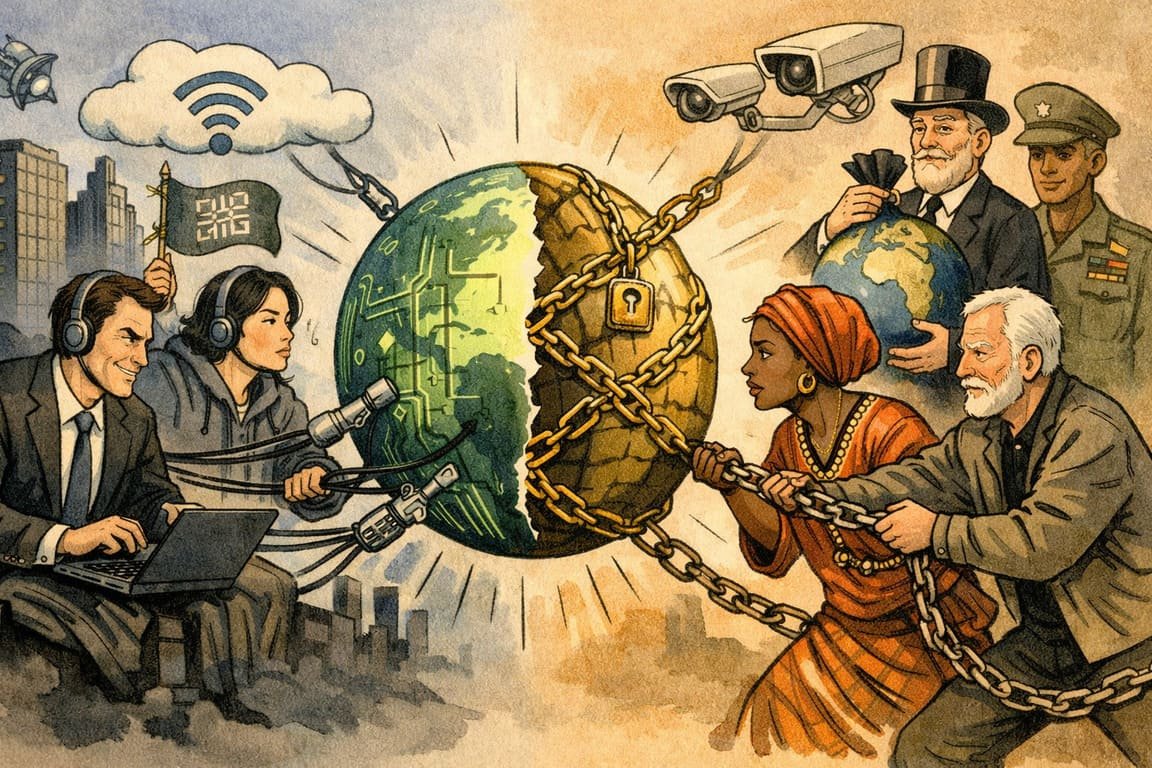
The screen glows gently in a dark room, a familiar comfort that suggests control while masking something far less settled. Beneath every click, cables pulse under oceans, servers breathe in chilled silence, and decisions travel faster than accountability. The internet feels shared, almost intimate, yet intimacy often disguises ownership. What began as a collaborative experiment has matured into contested terrain, and the struggle over control rarely announces itself with force. It reveals itself through absence, silence, and sudden restriction.
Early visions of the internet carried an almost moral certainty. Information would flow freely. Gatekeepers would dissolve. Knowledge would flatten power. That spirit lingered long enough to shape culture, but power never vanished. It adapted. Corporations built platforms that felt public while remaining private. Governments learned to watch without being seen. Users traded data for convenience, rarely pausing to measure the value of what they gave away. Ownership returned quietly, disguised as service.
Control online does not resemble fences or deeds. It lives in protocols, moderation rules, and infrastructure. Whoever sets standards decides who participates. Whoever hosts content can erase it. Whoever owns the pipes can slow or block access. These layers remain invisible until exercised. A suspended account. A throttled connection. A region suddenly offline. In those moments, architecture reveals itself as authority.
States assert power through regulation and censorship, often framed as security or social stability. Some build digital walls, shaping reality within borders. Others prefer subtler pressure, influencing platforms behind closed doors. The result is fragmentation. One internet becomes many, filtered by ideology and interest. The promise of a universal commons fractures under competing claims of sovereignty.
Corporations exercise a smoother form of control. Algorithms decide what rises and what disappears. Design nudges behavior without commands. Monetization rewards attention over accuracy. Platforms insist neutrality, claiming to mirror society rather than shape it. Yet incentives tell a different story. When outrage performs better than nuance, division scales efficiently. Ownership here lies not in speech itself, but in its amplification.
Users occupy an uneasy middle ground. Participation feels voluntary, yet exit grows costly. Friendships, livelihoods, and identity embed themselves online. Leaving can mean isolation or economic loss. Dependency shifts bargaining power. Consent thins when alternatives feel impractical. Freedom narrows without ever being revoked.
A journalist once watched years of reporting vanish after an automated moderation decision flagged their account. Appeals led nowhere. No hearing, no explanation, just silence. The experience resembled exile more than punishment. Digital spaces had become homes without due process. The lesson settled heavily. Rights feel fragile when they exist at the pleasure of platforms.
Cyber conflict sharpens these tensions further. States accuse rivals of hacking elections, stealing research, sabotaging infrastructure. Attribution remains intentionally murky. Retaliation hides behind deniability. The internet becomes both weapon and shield. Civilians rarely know when they are targets, only that trust erodes with every breach. Ownership blurs further when conflict never declares itself openly.
Philosophically, the struggle centers on sovereignty. Does it belong to nations, companies, communities, or individuals. The internet resists singular answers. Its distributed nature invites shared stewardship, yet concentration creeps in wherever scale rewards it. Decentralized alternatives promise resistance, but adoption remains uneven. Ideals compete constantly with convenience.
Economics deepen the bind. Data fuels modern growth. Whoever extracts it gains insight, influence, and profit. Users generate value continuously, often without compensation. Debates over data ownership surface, yet frameworks lag behind reality. Treating personal information as property raises ethical problems. Ignoring ownership entrenches exploitation. Every option carries cost.
Culture reflects the confusion. Online spaces feel intimate and hostile at once. Community forms quickly, dissolves just as fast. Norms shift with platform updates. Speech boundaries move without warning. Fatigue follows. Many retreat into smaller circles or disengage entirely, leaving louder extremes to dominate discourse. Silence becomes structural.
Efforts at reform struggle with scale. Regulation risks choking innovation. Self-governance buckles under profit pressure. Global coordination stalls amid geopolitical rivalry. Each solution addresses part of the problem while creating another. The internet’s strength, its borderless reach, becomes its regulatory paradox.
Still, resignation feels premature. Cooperative models thrive in open-source communities and decentralized networks. These spaces prove alternatives can exist, imperfect but functional. Power is visible. Rules are negotiated. Exit remains possible. Scaling such models remains difficult, yet their persistence challenges the idea that enclosure is inevitable.
Late at night, someone refreshes a feed, unaware of the systems shaping each pixel. The internet feels personal, almost private. That intimacy sharpens the question. Ownership determines whose voices travel, whose vanish, whose realities take shape quietly in code. The showdown does not end with a winner. It unfolds gradually, policy by policy, update by update. And the thought lingers, unsettling and unresolved: if the internet now shapes reality itself, who should be trusted to decide how open that reality remains?
