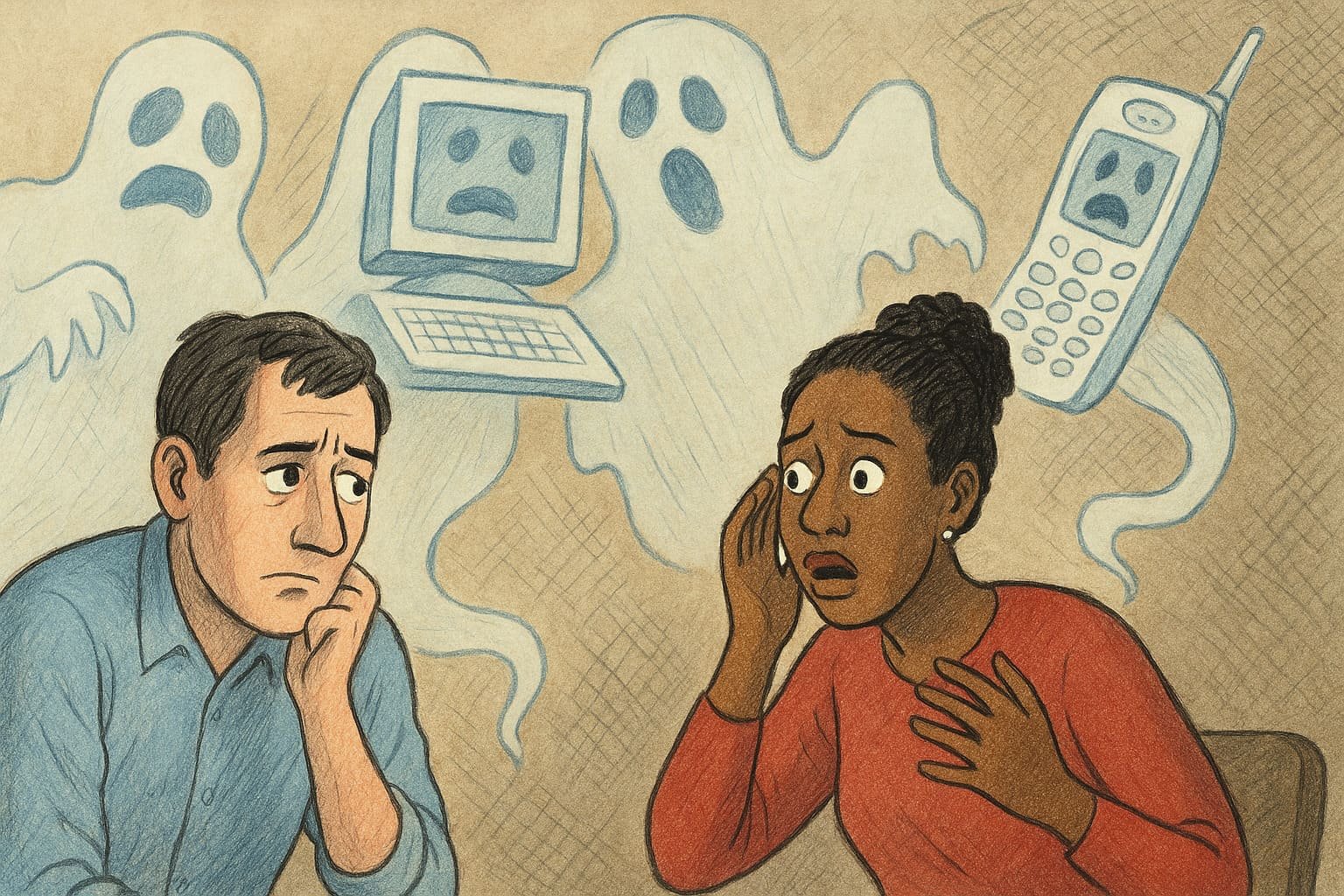
Somewhere, at the crossroads of memory and machine, a woman scrolls through a luminous feed. The room is silent but for the faint hum of old wires behind her drywall, whispering stories no living soul can hear. Every photograph, every email, every misspelled text; nothing ever truly leaves the digital graveyard. On a screen, the faces of former friends resurface, smiling with pixelated clarity. Outside, neon streaks on rain-slicked pavement blur into the anonymous glow of city life, but inside, history repeats itself, frame by forgotten frame.
In a high-rise server room a thousand miles away, exhausted engineers sip bitter coffee, eyes tracing lines of code that resurrect dormant data. A forgotten playlist shuffles to life, stirring memories long since buried beneath the clamor of daily ambition. The past, it seems, has claws. With every ping, a fragment of youth reawakens, inviting both joy and unease. Old flame messages hover like ghosts at the edge of consciousness, promising a reunion that feels more curse than blessing.
A CEO in a glass fortress checks her phone, pausing at a photo from a decade ago: a team she no longer leads, a promise she never kept. The algorithm remembers every awkward smile, every late-night brainstorm. She wonders, briefly, if the past will always have the final word. Above the city, storm clouds gather, as if the sky itself holds its breath, waiting for a story to be retold.
In the world of work, memory has become a commodity; bought, sold, and endlessly repackaged. New employees inherit old Slack threads like haunted houses, stumbling over jokes from strangers they never met. Even exit interviews linger, preserved in data lakes that never dry up. It’s not nostalgia but surveillance, and it sticks.
Not long ago, a software engineer named Raj deleted a project folder, eager to move on from the startup that broke his heart. Months later, his inbox chirped with an automated backup alert: every late-night idea, every desperate fix, immortalized in a cloud he couldn’t control. “It’s like the work never leaves you,” he said, shaking his head. “Even after you walk away, the ghosts are still coding beside you.”
The trap is set. To remember is human, but to be remembered by your technology forever and without mercy is to discover you’re not the only author of your own past.
Quick Notes
- Digital memory never truly erases: Your past lives on, pixel by pixel, in server rooms and social feeds. It’s less a scrapbook and more a haunted mansion; move one photo and a door slams shut somewhere else.
- Tech resurrects old wounds and wins alike: Ghostly reminders of triumph and regret will pop up in your notifications, whether you want them or not. Every backup is a séance, every sync an exorcism you didn’t sign up for.
- Workplaces trade in digital afterlives: Teams change, missions evolve, but chat logs and Google Docs keep telling yesterday’s story. The new hire always meets the old ghosts first.
- Forgetfulness is a luxury of the analog age: Algorithms won’t let you move on. Expect to see forgotten friends, flings, or failures resurface at the worst possible times, triggered by a smart notification that knows just when to make you squirm.
- You are both the hero and the haunted: Memory is no longer a private act. Your mistakes and masterpieces are eternal, retrievable, and viral—how you play the game now decides whether you build a legacy or just become another cautionary tale.
Specters in the Cloud: The New Haunted House
Your old college photos have never been safer, but they’ve also never been further from oblivion. Cloud servers work like relentless archivists, capturing every silly grin, every experimental hair phase, and every moment you wished the world would forget. The digital attic keeps expanding, and even your “deleted” pictures are often just out of sight, never out of reach. Companies like Apple and Google have quietly perfected the art of preservation, using redundancy to ensure that your life is stored, copied, and shared in ways that would make any Victorian ghost jealous.
When your phone serves up a “memory” from five years ago, it’s not a gentle reminder; it’s a data-driven haunting. Maybe it’s a party selfie from before the layoff, or an anniversary you missed. That surge of emotion; regret, joy, embarrassment; proves the ghost is real. The algorithm isn’t just showing you the past; it’s manipulating your present. This relentless recall, critics argue, is less about joy and more about engagement, trapping users in loops of feeling they can’t escape.
For many, the workplace is ground zero for these digital hauntings. One manager, Maria, describes inheriting a shared drive so cluttered with old presentations and half-finished documents that she started dreaming about Excel errors. “I felt like I was being watched by a hundred past versions of myself,” she jokes, and yet her laugh holds a trace of real unease. Tech ghosts don’t just clutter your desktop; they shape your decisions and color your ambitions. Every “suggested file” is a reminder that the past has not, in fact, been laid to rest.
These digital revenants aren’t just personal. Brands and businesses are learning the hard way that corporate skeletons never really disappear. From accidental leaks to viral “Throwback Thursday” scandals, forgotten files can torpedo reputations overnight. Consider the infamous incident where a PR firm’s old pitch deck resurfaced online, revealing strategic blunders and sparking memes across Twitter. The lesson: in the digital era, your past isn’t prologue; it’s ammunition.
Yet, some see a silver lining. Organizations like “Right to Be Forgotten” advocate for privacy as a human right, lobbying tech giants to allow people to truly disappear when they choose. The movement is growing, but for now, the ghosts hold court. Memory, it turns out, isn’t a choice; it’s an inevitability, sold as a feature, lurking as a trap.
Phantom Notifications: When the Past Calls Back
Nothing ruins a productive morning like a notification from a forgotten friend. Social media platforms know exactly when to hit you with a wave of old messages, tagging you in memories you never wanted to relive. These digital callbacks act as emotional booby traps, yanking you out of the present and into a mental labyrinth you thought you’d outgrown. The result is a strange cocktail of nostalgia and dread, a modern memento mori tailored by code.
Every platform has weaponized memory in pursuit of engagement. Facebook’s “On This Day” feature isn’t designed to spark joy so much as to stir the pot. Psychologists warn that these random memory jolts can trigger everything from fleeting smiles to anxiety attacks. “You start to question if you’ve really moved on,” says Dr. Lila Ferguson, a therapist who treats tech-induced stress. “The past is always knocking, and sometimes it barges right in.”
Consider the case of Dante, a project manager whose ex-colleague tags him in decade-old group photos every few months. Each ping reignites the awkward politics and unspoken feuds of jobs long left behind. “It’s like opening a tomb every time,” he says, only half joking. These reminders don’t just summon memories; they stir up feelings you worked hard to bury. In extreme cases, they even impact mental health, fueling cycles of rumination that disrupt sleep and erode confidence.
Smart notifications are getting smarter, but not always kinder. A startup called Memory Lane tried to monetize nostalgia by automatically resurfacing “peak moments” from users’ digital histories. Instead, they sparked a backlash when users complained about painful memories being dredged up without warning. “Some ghosts should stay dead,” one reviewer wrote, capturing the tension between progress and privacy.
You can’t always control what tech remembers about you, but you can control your response. The new digital etiquette is about setting boundaries, muting what hurts, and curating your feeds for psychological safety. In a world that never forgets, resilience is less about deleting the past and more about refusing to be haunted by it.
Algorithmic Afterlife: The Corporate Ghostwriter
Every keystroke, every spreadsheet tweak, and every late-night Slack rant leaves a trail. Machine learning models feast on these breadcrumbs, building profiles more accurate than any diary. Your digital footprint becomes your doppelganger, a shadow-self that lives on in HR systems, CRM databases, and project management logs. The “algorithmic afterlife” is here, and it’s writing your story in invisible ink.
Companies aren’t just using this data for analytics. In recruitment, AI tools evaluate resumes by cross-referencing your social media posts, digital portfolios, and even old blog comments. The ghosts of opinions past can sabotage tomorrow’s promotion or power up your personal brand. It’s not paranoia; it’s protocol. A single tweet can follow you into a job interview, a client pitch, or a boardroom debate. If you’ve ever wondered why an old joke from 2012 suddenly became a headline, you’ve glimpsed the machinery in action.
Sonia Patel, a CTO at a fast-scaling fintech, tells a story about a junior analyst who lost a job offer after an AI-powered background check pulled up a controversial college op-ed. The essay had been deleted, but web archives had other plans. “We had to rethink our whole vetting process,” Sonia explains. “It felt like being policed by our own memories.” In today’s workplace, the past doesn’t just inform the present; it can override it entirely.
The algorithmic ghostwriter isn’t just punitive; it can be redemptive, too. Some startups offer services to “refresh” your online presence, burying old posts with positive content and even generating glowing testimonials from satisfied clients. The irony is sharp: fighting ghosts with digital exorcists, all in pursuit of a spotless reputation. In the end, everyone becomes their own myth-maker, spinning the past to suit the demands of the algorithm.
If you’re hoping for mercy, look elsewhere. Machine memory is not compassionate. It is thorough, tireless, and incapable of forgetting. Your only hope is to own your narrative before someone or something else does.
The Personal Poltergeist: When Memories Manipulate
Sometimes the ghosts are friendly. Sometimes, not so much. The digital memory trap can embolden you, showing how far you’ve come, but it can also turn malicious, replaying failures and regrets like a glitchy horror movie. You are both archivist and captive, curating your best moments while running from the ones that sting. The result is a fractured sense of identity, a timeline both empowering and oppressive.
Apps like Timehop promise to make memories “fun,” but for many, the reminders feel invasive. One woman, Leila, describes receiving a push notification about her late father’s birthday every year, courtesy of an old photo app she can’t bring herself to uninstall. “It’s beautiful and brutal at the same time,” she says. The technology means well, but sometimes, kindness cuts deepest. Emotional wellbeing and digital hygiene are now inseparable; your phone isn’t just a tool but a co-author of your mood.
There is a movement to reclaim agency. Digital minimalism, pioneered by thinkers like Cal Newport, is gaining traction among professionals exhausted by endless digital debris. Deleting old accounts, curating social feeds, and even practicing “digital sabbath” have become modern rituals of self-defense. Still, escape is never total. Even when you silence notifications, the archive waits.
Pop culture has seized on this paradox. Black Mirror’s most chilling episodes hinge on the idea that the past, once digitized, cannot be forgotten or forgiven. Audiences see their own anxieties reflected: every swipe is a roll of the dice, every memory a potential trap. The lesson is clear. Technology is a mirror, but one that sometimes distorts what matters most.
If you want to break the spell, start by deciding what deserves to survive. The art of forgetting is the new luxury. True freedom comes from choosing what to remember and what to let fade into static.
Escape Room: Hacking the Memory Trap
Breaking free from the memory trap isn’t about deleting everything. It’s about understanding how digital memory shapes your life and making choices that put you back in control. Digital declutter is more than a buzzword; it’s a survival skill for anyone who wants to own their story instead of being owned by it.
Begin with boundaries. Audit your cloud accounts, update privacy settings, and be ruthless about what you keep. Create separate digital spaces for work and life. Consider using encrypted messaging and privacy-focused storage to keep sensitive moments from becoming tomorrow’s viral content. One cybersecurity consultant, Marcus Hill, shares how he advises clients to treat old devices like hazardous waste: “Wipe them, recycle them, then move on. Don’t let your past become someone else’s data goldmine.”
If you work in an organization, push for better policies. Companies should invest in digital hygiene training, teach employees how to manage their data footprints, and make it easier to retire old information. After all, a culture that respects forgetting is healthier than one that worships recall.
Your digital legacy isn’t just about the mistakes you make. It’s about the memories you create for others. The stories you tell, the lessons you share, the kindness you record—they’re all part of the same archive. The real win comes from shaping the narrative, turning tech ghosts into allies, not adversaries.
Some will choose radical transparency, sharing every step and stumble as a public record. Others will retreat into analog privacy, trusting paper and pen to keep secrets safe. There’s no single solution, but one truth remains: to master memory is to master your future. The ghosts are here to stay. It’s up to you to decide whether they haunt or help.
Exit Wounds: The Digital Mirror Never Blinks
In a silent boardroom, late evening light glints off empty chairs while glowing screens cast long shadows on polished wood. Files flicker open, voices echo from archived recordings, and the soft, mechanical whir of a projector fills the air with static. Here, the memory trap is no longer just an abstract fear but a living presence, turning forgotten words into fresh warnings. The CEO stares at the looping footage; an old pitch, a misstep, a moment of pride unable to decide which stings more: the memories that linger or the ones already lost.
Outside, the city pulses with possibility. Yet, every digital display; every notification, every backup, every ghostly reminder remains a portal to unfinished business. The digital mirror offers no closure, only reflection after reflection, an endless hall of self. There is no switch to flick, no curtain to drop. Only the steady pulse of memory, rewinding, replaying, rewriting.
A junior developer, finishing a late shift, catches her own reflection in the blackened monitor. Her face is lit by a thousand unseen memories both hers and those left by others before her. With a sigh, she powers down, feeling the weight of stories she never lived. The office empties. Screens fade to black, but the archive holds steady, waiting for its next visitor to awaken the past.
Somewhere between fear and fascination, people will always search for escape, for meaning, for the chance to start fresh. Yet in the age of infinite recall, the greatest freedom may be learning to forget.
So ask yourself: Are you the master of your memories, or just another character wandering the endless corridors of the digital afterlife?
Why scroll… When you can rocket into Adventure?
Ready to ditch the boring side of Life? Blast off with ESYRITE, a Premier Management Journal & Professional Services Haus—where every click is an adventure and every experience is enchanting. The ESYRITE Journal fuels your curiosity to another dimension. Need life upgrades? ESYRITE Services are basically superpowers in disguise. Crave epic sagas? ESYRITE Stories are so wild, your grandkids will meme them. Want star power? ESYRITE Promoted turns your brand cosmic among the stars. Tired of surface-level noise? ESYRITE Insights delivers mind-bending ideas, and galactic-level clarity straight to your inbox. Cruise the galaxy with the ESYRITE Store —a treasure chest for interstellar dreamers. Join now and let curiosity guide your course.