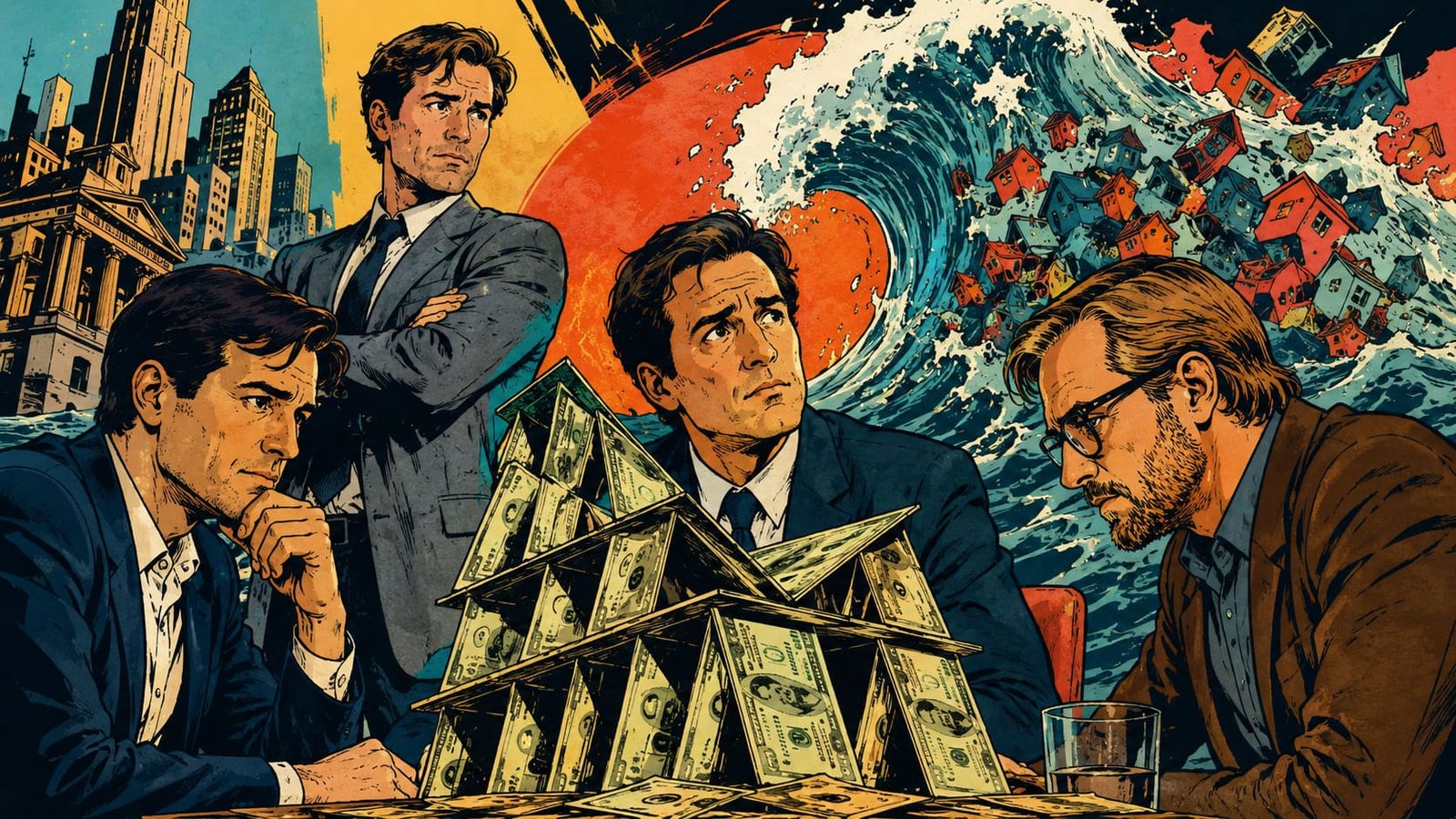
A stripper in Florida owned multiple houses she could barely describe while champagne flowed through conference halls packed with men speaking in acronyms dense enough to hide entire moral disasters inside them. Television screens glowed with smiling economists promising endless prosperity. Mortgage brokers handed out loans like nightclub flyers on a humid Friday night. Somewhere beneath the noise, the American economy had quietly transformed into a casino built from denial, arrogance, and paperwork nobody bothered reading carefully anymore. The Big Short does not simply recount the financial crisis. It performs an autopsy on collective delusion. Adam McKay directs the film like a caffeinated philosopher trapped inside a collapsing circus, using humor, rage, and absurdity to expose a terrifying cultural truth: modern systems often reward the people least connected to reality while dismissing the few still paying attention.
What makes the movie extraordinary is its understanding that intelligence alone does not protect societies from self-destruction. In fact, complexity often becomes camouflage for fraud. Christian Bale’s Michael Burry notices the housing market’s rot because he actually reads the loan data instead of worshipping institutional narratives. That detail matters enormously. Entire industries survive through strategic incuriosity. Most people inside the financial system were not stupid. Many were highly educated. The disaster expanded because incentives rewarded optimism and punished scrutiny. A compliance officer named Farah once described corporate culture as “a room where everyone hears the smoke alarm but keeps complimenting the wallpaper.” The Big Short lives inside that sentence. The film exposes how organizations gradually normalize absurdity until collapse feels impossible precisely because too many careers depend on pretending stability still exists.
Michael Burry himself feels less like a Wall Street investor and more like an isolated scientist screaming warnings from inside a bunker while the outside world continues dancing beneath neon lights. His social awkwardness becomes symbolic. People who recognize systemic danger early often appear strange because clarity disrupts social comfort. Markets reward consensus emotionally long before they reward truth financially. That pattern extends far beyond finance. Tech bubbles, political movements, startup cultures, even social media trends follow similar emotional mechanics. Nobody wants to be the person ruining the party by pointing at structural weakness. A logistics founder named Pavel once lost investors after warning his company’s growth metrics depended heavily on unsustainable discounts. Months later, the business imploded publicly. “People prefer confidence over accuracy until reality sends the invoice,” he admitted afterward over burnt coffee inside an empty coworking lounge. That observation could function as the unofficial thesis of The Big Short.
Ryan Gosling’s Jared Vennett introduces another layer entirely. He understands the corruption clearly, yet treats catastrophe like profitable entertainment. That emotional detachment feels brutally modern. Entire industries monetize dysfunction while publicly condemning it. News channels profit from outrage cycles they claim to analyze objectively. Social platforms amplify anxiety while publishing wellness campaigns about digital health. Vennett embodies the smiling opportunist who recognizes systemic failure as a revenue stream rather than moral emergency. His charisma makes the audience complicit too. The film seduces viewers with comedy before revealing the human devastation hidden beneath financial jargon. That tonal whiplash matters because real-world crises often unfold similarly. Disaster rarely announces itself wearing dramatic music and flashing warning signs. It arrives disguised as normalcy. By the time consequences become visible, institutions are already preparing public relations statements instead of solutions.
Steve Carell’s Mark Baum provides the movie’s emotional conscience because his anger never fully calcifies into cynicism. Baum sees through the machinery yet still reacts with moral disgust when confronted by its scale. One scene inside a Las Vegas financial conference lands like a psychological breakdown filmed beneath casino lighting. Traders gamble recklessly while discussing economic collapse with the emotional seriousness of people debating fantasy football. The setting feels almost too symbolic until one remembers reality behaved exactly this way. A teacher named Mireya lost her family home during the crisis while executives responsible collected bonuses large enough to purchase private islands. That imbalance gives The Big Short its lingering fury. The film understands markets are not abstract systems floating above society. They are emotional ecosystems capable of rearranging human lives permanently.
The younger investors Charlie Geller and Jamie Shipley introduce another important tension: the seduction of being right. At first, uncovering the housing collapse feels exhilarating. Outsmarting the system resembles intellectual victory. Then reality arrives. Profiting from the crash means benefiting from widespread suffering. Families lose homes. Workers lose pensions. Entire communities fracture economically. The film refuses to let financial brilliance escape moral consequence. That refusal elevates it beyond clever economic storytelling into philosophical territory. Modern culture often treats winning as automatic ethical validation. The Big Short quietly dismantles that illusion. Success inside broken systems can still leave emotional residue impossible to celebrate comfortably. One hedge-fund analyst named Elias described his bonus after a restructuring deal as “money that tasted faintly metallic.” The phrase sounds strange until one watches this movie carefully.
McKay’s stylistic choices deserve enormous credit because the chaotic editing, celebrity cameos, fourth-wall breaks, and manic pacing mirror the absurdity of the system itself. Traditional prestige-drama seriousness would have softened the material. Instead, the film weaponizes satire like a scalpel. Margot Robbie explaining mortgage bonds inside a bubble bath should feel ridiculous. Somehow it makes the underlying corruption even more horrifying because the audience recognizes how spectacle distracts from substance constantly in modern culture. Public attention has become so fragmented that entertainment often functions as the only remaining delivery mechanism for difficult truths. The Big Short understands this instinctively. The movie feels like scrolling through the internet during societal collapse while comedians and economists scream simultaneously into the same algorithmic void.
Beneath all the financial terminology sits a more universal anxiety about institutional trust. People believed banks understood risk better than ordinary citizens. They believed ratings agencies protected integrity. They believed experts would notice if the entire system became structurally insane. Those assumptions shattered publicly during the crisis. The emotional consequences still linger culturally today. Distrust expanded into politics, media, healthcare, technology, and nearly every major institution afterward. Once collective faith fractures, societies become psychologically unstable. The film captures the precise moment confidence mutates into suspicion. A retired accountant named Denise described watching the crisis unfold as “realizing adults were improvising the whole thing in real time.” That realization altered millions of people permanently. The Big Short preserves that emotional rupture with terrifying clarity.
Far beneath casino chandeliers and luxury offices, ordinary people sat in kitchens opening letters they could barely process while televisions continued broadcasting smiling market analysts promising recovery just around the corner. Somewhere else, traders celebrated impossible profits beneath the glow of Bloomberg terminals pulsing like artificial constellations in the dark. The world kept moving because systems always keep moving, even while quietly shedding human wreckage along the way. That is the enduring power of The Big Short. The film recognizes that modern civilization often confuses complexity with legitimacy until collapse forces everyone to confront how fragile the architecture really was all along. The scariest part is not that the crisis happened. The scariest part is how normal it looked while it was happening. And somewhere inside today’s polished headlines and optimistic forecasts, another invisible bubble may already be learning how to smile for the cameras.
Editorial Disclaimer: Whether a film is rooted in fiction or inspired by real events, the actions, decisions, and behaviors portrayed within are not intended to be encouraged, replicated, or endorsed in real-world settings. This review exists solely to analyze the storytelling, characters, themes, and business dynamics presented in the film for educational, analytical, and entertainment purposes. Any ethical or unethical conduct depicted in the film does not reflect the views, values, or endorsements of ESYRITE.
