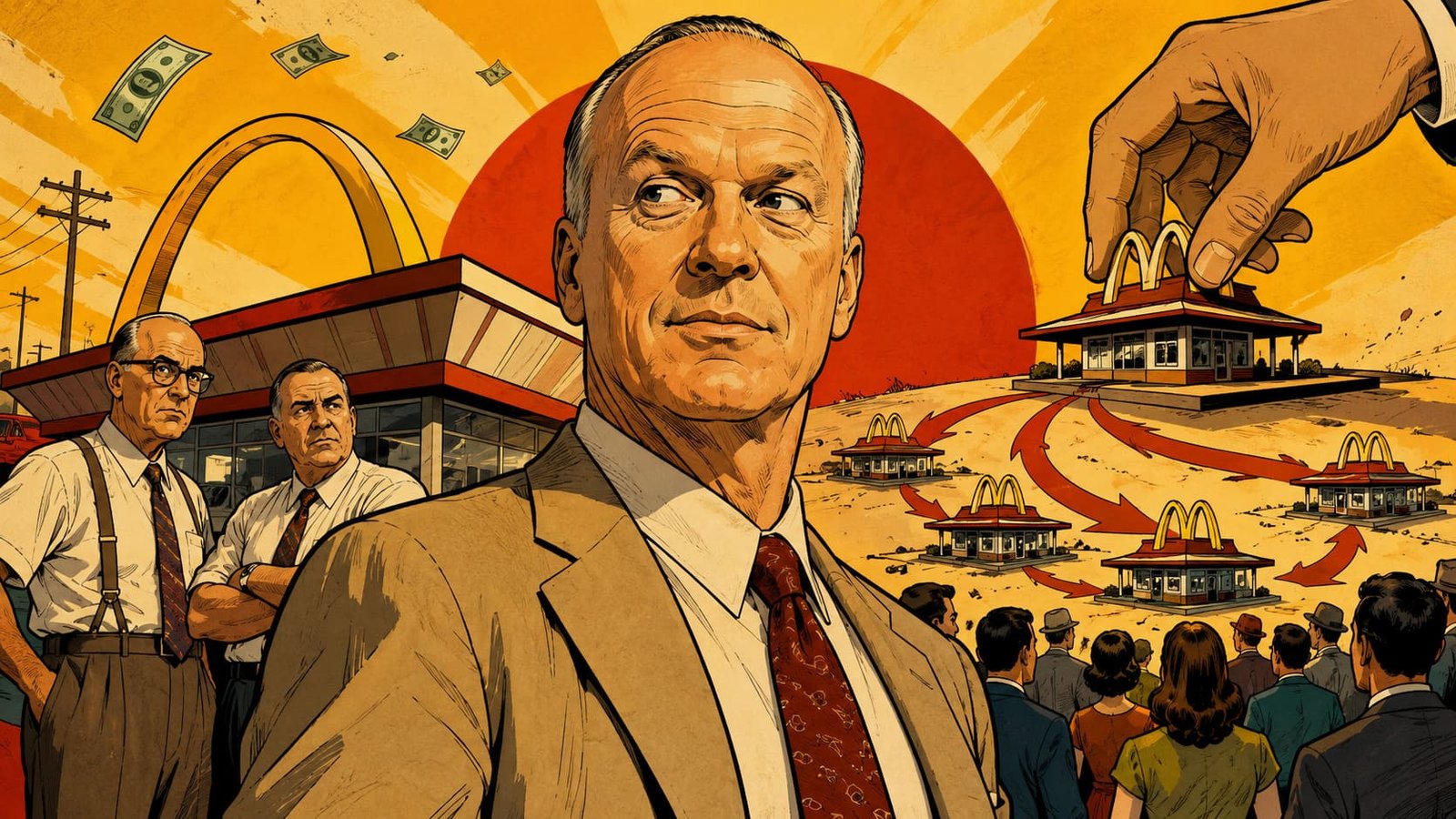
The milkshake machines screamed like factory engines while teenage employees moved across spotless kitchen tiles with military precision. Burgers slid down assembly lines faster than conversation itself. Families gathered beneath glowing signs believing they were witnessing the future of American convenience. Somewhere behind the cheerful branding and neatly folded paper bags, a quieter story unfolded about ambition sharp enough to cut through loyalty, friendship, and eventually conscience itself. The Founder wears the costume of a business success story, yet the film behaves more like a psychological study of appetite. Not hunger for food. Hunger for ownership. Hunger for scale. Hunger for immortality disguised as entrepreneurship. Michael Keaton’s portrayal of Ray Kroc turns every handshake into a negotiation between charisma and predation. The movie understands something modern culture often refuses to say aloud: capitalism rarely rewards the kindest visionary in the room. It rewards the person most willing to redefine morality as strategy.
At first, Ray appears almost lovable. Exhausted. Persistent. Slightly pathetic. A traveling salesman pushing milkshake mixers through indifferent diners while chasing the fading promise of postwar prosperity. That beginning matters because the film understands how desperation reshapes ethics gradually rather than suddenly. Ray’s fascination with the McDonald brothers feels genuine initially. Their restaurant system represents efficiency transformed into theater. Speed, consistency, cleanliness, simplicity. It resembles industrial choreography. Watching the original San Bernardino operation feels strangely hypnotic because the brothers treat operational discipline like sacred design. Long before Silicon Valley worshipped scalability, these men had already built a prototype for algorithmic culture: reduce friction, eliminate unpredictability, optimize behavior. A restaurant consultant named Celeste once described fast-food systems as “factories disguised as family memories.” That observation hangs invisibly over every scene in The Founder.
The brilliance of the McDonald brothers lies in their restraint. Dick and Mac understand limits emotionally. Ray does not. That tension powers the entire film. The brothers want stability, quality, and manageable growth. Ray wants expansion so vast it becomes inseparable from American identity itself. Modern startup culture still worships Ray’s mindset relentlessly. Scale became a moral virtue. Investors celebrate blitzkrieg growth while quietly dismissing caution as weakness. Yet The Founder exposes the hidden violence inside endless expansion. Growth changes systems psychologically. What begins as craftsmanship often mutates into machinery. A bakery owner named Tomas once rejected an opportunity to franchise across Europe after visiting industrial production facilities. “The bread stopped smelling alive,” he admitted later while kneading dough beside a fogged-up kitchen window before sunrise. Ray would have considered that sentimentality. The film quietly asks whether civilization loses something irreplaceable when scale becomes the highest value.
Michael Keaton performs Ray with unsettling emotional precision because the character never fully sees himself as immoral. He sees himself as necessary. That distinction matters enormously. Dangerous leaders rarely wake up believing they are villains. They convince themselves history requires their ruthlessness. Ray rationalizes betrayal through mythology about perseverance, innovation, and destiny. He rewrites narratives constantly until exploitation resembles vision. Entire industries operate this way now. Companies praise “disruption” while destabilizing workers’ lives. Executives frame layoffs as strategic transformation. Language becomes moral camouflage. One venture capitalist named Adrian once referred to employee burnout as “market-driven intensity.” The phrase sounded polished enough to belong inside a keynote presentation. The Founder understands how corporate rhetoric sanitizes human cost elegantly.
The real-estate revelation marks the film’s psychological turning point. Ray finally realizes the restaurant business was never truly about hamburgers. It was about land, leverage, and control. That moment lands like a philosophical punch because it exposes how power hides beneath seemingly ordinary systems. McDonald’s succeeds not merely through food but through ownership architecture. The company transforms physical space into financial dominance. Ray evolves from salesman into empire-builder the moment he understands this distinction. The lesson extends far beyond fast food. Many modern institutions operate similarly. Tech platforms rarely sell products directly. They control ecosystems. Media companies monetize attention infrastructure rather than journalism itself. The visible service often distracts from the real engine underneath. The Founder peels back that illusion coldly.
There is also something deeply American about Ray’s mythology. He embodies the national obsession with reinvention through relentless willpower. The film neither fully condemns nor celebrates this instinct. Instead, it dissects it carefully. Ray’s ambition creates extraordinary outcomes while simultaneously hollowing out personal loyalty. Relationships become transactional terrain. Even marriage deteriorates beneath his fixation on ascent. Laura Dern’s understated performance as Ethel quietly devastates because she represents emotional stability discarded by a culture addicted to forward momentum. A former executive named Nina once described corporate ambition as “watching people trade intimacy for applause one business trip at a time.” The Founder understands that exchange painfully well. Ray wins commercially while shrinking emotionally. The tragedy is that society often mistakes those outcomes for the same thing.
Nick Offerman and John Carroll Lynch portray the McDonald brothers with heartbreaking humanity because they understand craftsmanship emotionally, not just financially. Their grief feels larger than business loss. They watch something personal become industrialized beyond recognition. That emotional fracture mirrors countless modern industries where original creators lose control once systems attract capital hungry for infinite growth. Independent music scenes become streaming algorithms. Small publications become content farms. Local cafés become lifestyle brands optimized for investors rather than neighborhoods. Ray’s genius lies not in inventing McDonald’s but in recognizing how aggressively modern capitalism rewards replication over intimacy. The movie never allows viewers to forget that distinction.
Visually, the film captures mid-century America with polished brightness hiding emotional coldness underneath. Chrome surfaces gleam. Offices expand. Suburbs spread outward endlessly. Everything appears prosperous while human connection quietly erodes beneath transactional ambition. Ray’s speeches about persistence sound inspirational until one notices how often they justify emotional extraction. Even the famous line about persistence outperforming talent carries unsettling undertones in context. Persistence toward what exactly? At what cost? The film grows increasingly uncomfortable because Ray’s success remains undeniable. McDonald’s becomes a cultural empire. Millions recognize the golden arches globally. The system works operationally. Yet the movie refuses easy triumph. Achievement alone cannot answer the moral questions lingering behind it.
Late at night beneath glowing restaurant signs stretching across endless highways, families continued ordering fries beneath branding built from equal parts ingenuity and betrayal. Somewhere else, two brothers sat quietly inside the shadow of a dream they created but no longer controlled, while a salesman transformed himself into a symbol large enough to swallow their names whole. That is the unsettling brilliance of The Founder. The film understands that modern civilization often confuses scale with greatness until the original human heartbeat inside the machine disappears completely. Ray Kroc did not merely build a fast-food empire. He helped perfect a system where ambition could industrialize itself endlessly while smiling through television commercials about family values. And somewhere beneath every polished success story, another quieter question still waits patiently: when victory demands the erosion of loyalty, warmth, and human proportion, what exactly remains worth celebrating in the end?
Editorial Disclaimer: Whether a film is rooted in fiction or inspired by real events, the actions, decisions, and behaviors portrayed within are not intended to be encouraged, replicated, or endorsed in real-world settings. This review exists solely to analyze the storytelling, characters, themes, and business dynamics presented in the film for educational, analytical, and entertainment purposes. Any ethical or unethical conduct depicted in the film does not reflect the views, values, or endorsements of ESYRITE.
