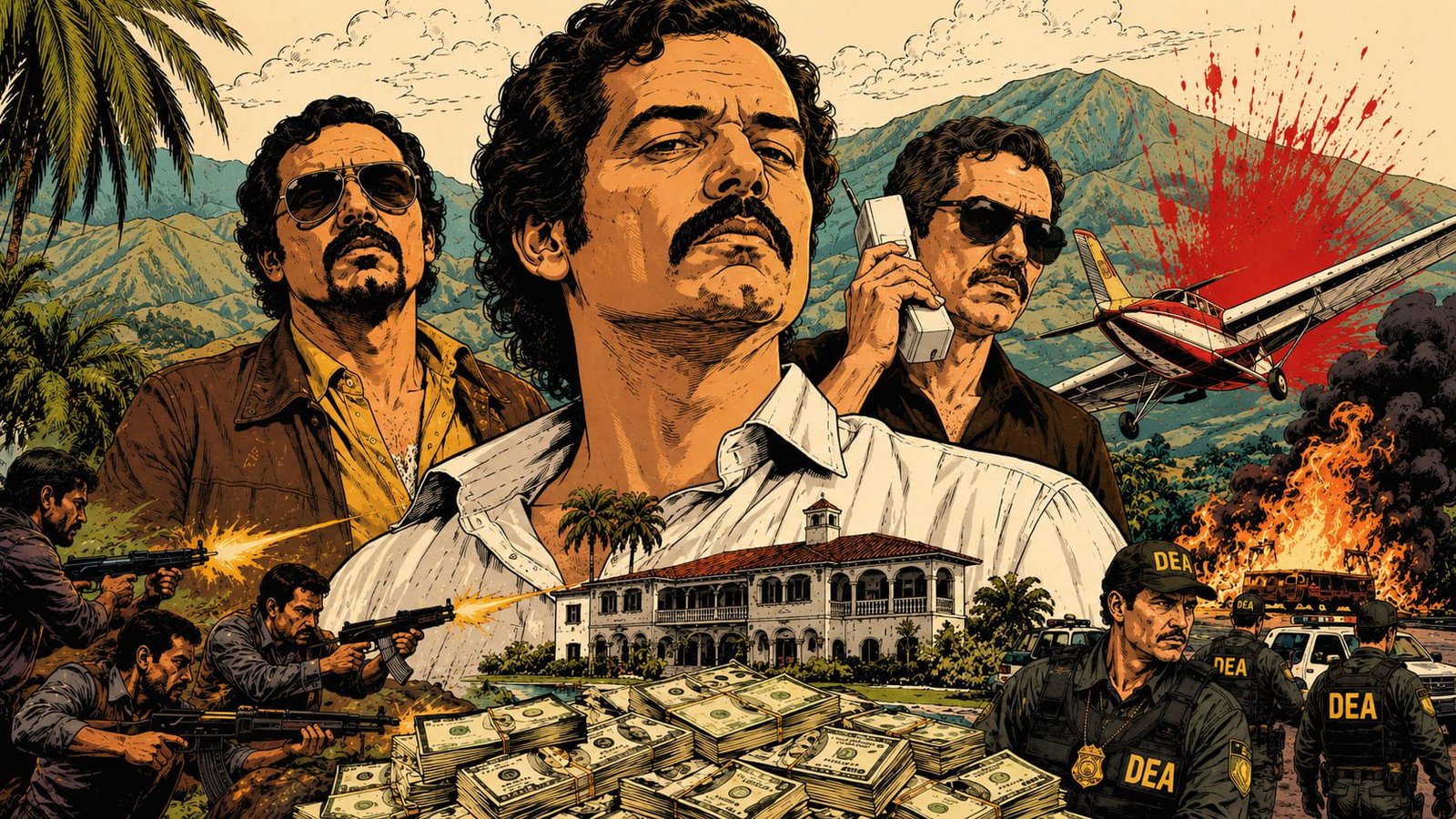
A white shirt drifted through the humid Colombian heat like a surrender flag nobody intended to honor. Helicopters carved through the sky above Medellín while mothers carried groceries past murals already beginning to mythologize violence. In Narcos, the world feels permanently trapped between seduction and catastrophe. Money arrives fast. Death arrives faster. Yet the series never treats the cocaine trade as simple criminal spectacle. It presents something more corrosive: the birth of a modern empire powered by consumer appetite, institutional hypocrisy, and the ancient human addiction to domination. Pablo Escobar did not emerge from nowhere. He emerged from demand. From politics. From aspiration. From systems already hungry for someone ruthless enough to exploit them.
Wagner Moura’s portrayal of Pablo Escobar remains one of television’s most psychologically disturbing achievements because he refuses cartoon villainy. Escobar laughs warmly with family members moments before ordering executions with bureaucratic calm. That contradiction unsettles viewers because it mirrors real concentrations of power throughout history. Tyrants rarely perceive themselves as monsters. Many see themselves as providers, builders, protectors, even patriots. Narcos understands this deeply. Escobar does not merely crave wealth. He craves legitimacy. Respectability. Historical permanence. He wants to be remembered not as a trafficker, but as a force larger than law itself. Every empire eventually develops that same appetite.
The brilliance of the series lies in its refusal to isolate criminality from broader systems. American demand for cocaine fuels entire economic ecosystems while political leaders publicly condemn the chaos they quietly help sustain. Governments posture about morality while intelligence agencies maneuver strategically beneath the surface. Journalists chase headlines. Communities absorb trauma. The machinery keeps turning. One former customs officer in Mombasa once described corruption as “a river that teaches everyone downstream how to drink differently.” Narcos captures that idea with frightening precision. Nobody remains untouched by large-scale corruption. The contamination spreads culturally long before it spreads financially.
Pedro Pascal’s Javier Peña moves through the series with exhausted charisma, like a detective slowly realizing the rulebook belongs to another century. His frustration becomes one of the show’s emotional anchors. Institutions speak constantly about justice, yet strategy repeatedly overrides principle whenever geopolitical interests enter the room. That tension gives Narcos unusual intellectual weight. The series recognizes that nations often behave like corporations protecting market interests rather than moral entities defending truth. Diplomacy becomes branding. Enforcement becomes theatre. Public outrage becomes temporary content. Beneath it all, incentives continue operating exactly as designed.
There is a remarkable scene where Escobar discusses poverty and public loyalty that feels almost impossible to dismiss outright, despite the horror surrounding him. That complexity explains why the series lingers in cultural memory. Escobar weaponizes social neglect brilliantly. He builds housing, funds soccer fields, and presents himself as a champion of forgotten communities. History keeps repeating this pattern. Whenever institutions abandon dignity, charismatic predators arrive offering belonging wrapped in danger. The audience feels uncomfortable because the mechanism remains visible in modern politics, influencer culture, extremist movements, and certain tech empires built on public distrust.
A startup founder named Elias once ran a rapidly growing delivery platform in Johannesburg. Investors adored his confidence. Employees admired his fearlessness. Competitors feared his aggression. Internal reports warning about exploitative labor conditions kept disappearing beneath expansion meetings and growth celebrations. “Fix culture later,” executives joked while champagne bottles cracked open on rooftop terraces. The company eventually imploded under lawsuits and whistleblower scandals. Watching Narcos afterward unsettled former staff because Escobar’s empire operated through the same psychological rhythm: momentum first, conscience later. Growth became its own moral defense. Success blurred accountability until collapse felt inevitable.
The visual language of the series deserves recognition because it transforms wealth into atmospheric tension. Mansions feel claustrophobic despite their scale. Expensive parties vibrate with paranoia. Every luxury object seems stained by invisible consequences. Pop culture often glamorizes excess as liberation. Narcos treats excess like infection. Escobar accumulates influence until reality itself starts bending around his desires. Politicians negotiate differently. Police departments adapt behavior. Entire neighborhoods recalculate survival strategies. This is how power truly operates in societies. Rarely through open declarations. Usually through gradual gravitational distortion.
The show also understands media mythology with startling sophistication. Escobar becomes more than a criminal figure. He becomes narrative. Some communities fear him. Others worship him. International media transforms him into spectacle. The line between condemnation and fascination grows blurry. Modern audiences recognize this instantly because contemporary culture monetizes notoriety relentlessly. Scandal drives engagement. Chaos drives attention. Outrage drives visibility. Narcos quietly exposes how societies often participate in the creation of their own monsters through obsession, fear, and entertainment economies disguised as journalism.
By the final stretch, Medellín begins to resemble a giant pressure chamber ready to rupture under the weight of accumulated ambition. Sirens echo across crowded streets while wealth, politics, and violence collapse into one suffocating atmosphere. Escobar keeps expanding influence as though scale itself might conquer mortality. Yet every empire carries an invisible expiration date hidden inside its own excess. That is the haunting revelation Narcos leaves behind. Human beings keep mistaking power for permanence. They build kingdoms, companies, movements, and identities large enough to intimidate the world, only to discover the architecture was hollow from the beginning. Somewhere beneath the gunfire and headlines, the series whispers a brutal truth modern civilization still refuses to confront: the most dangerous narcotic has never been cocaine. It has always been the intoxicating belief that consequence belongs only to other people.
Editorial Disclaimer: Whether a TV Show is rooted in fiction or inspired by real events, the actions, decisions, and behaviors portrayed within are not intended to be encouraged, replicated, or endorsed in real-world settings. This review exists solely to analyze the storytelling, characters, themes, and business dynamics presented in the TV Show for educational, analytical, and entertainment purposes. Any ethical or unethical conduct depicted in the TV Show does not reflect the views, values, or endorsements of ESYRITE.
