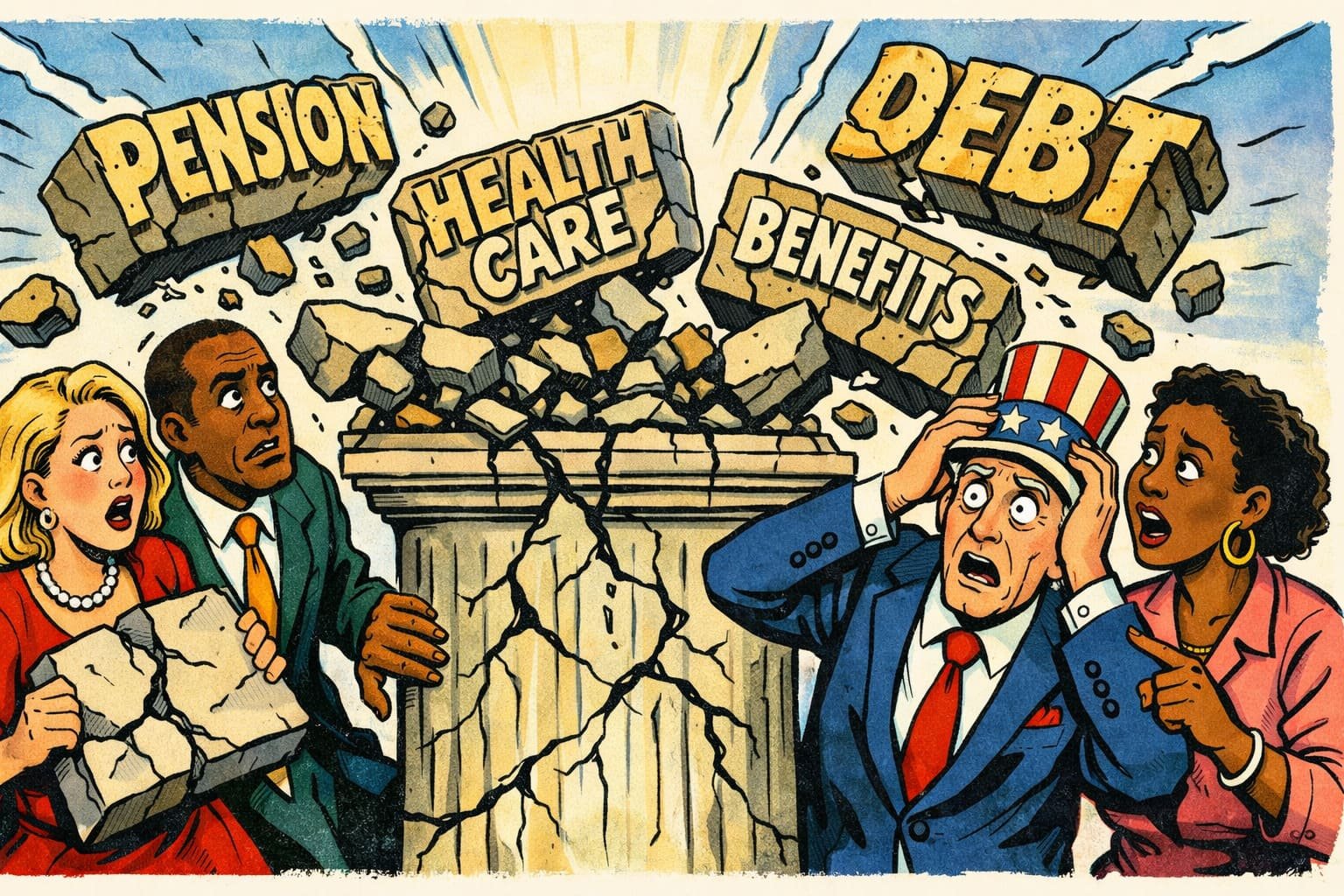
Every rich democracy has a locked room filled with beautiful promises. Pensions will be there. Health coverage will hold. Retirement will feel earned, not improvised. Old age will not become a private panic. Politicians love that room because it glows with moral certainty. Citizens love it because it offers continuity in a world that keeps shredding old guarantees. The trouble begins when demography, medicine, and debt all walk in at once. Then the promise still sounds noble, but the balance sheet starts breathing through its mouth. Entitlement pressure is not a distant budget issue. It is a stress test of the social contract.
Entitlements become dangerous when political language treats them as sacred while economic reality treats them as compounding obligations. A pension system designed in a younger, faster growing society may buckle in an older, slower one. Health systems built around acute illness strain under chronic disease, longer lives, costly treatments, and rising expectations. That does not mean the welfare state was a mistake. It means past assumptions age too. The real scandal is not that these systems are under pressure. The scandal is how long leaders pretend simple denial is compassion. It is not. It is deferred cruelty with good press.
Greece became a brutal lesson in what happens when benefits, debt, and weak growth collide. The crisis was not caused by pensions alone, but pension promises sat inside a larger structure that had run out of room. Cuts then arrived not as careful reform but as fiscal trauma. That is the pattern politicians always claim they want to avoid, right before they postpone action long enough to guarantee it. A benefit trimmed slowly can feel unfair. A benefit slashed in panic feels like betrayal. Delay does not protect dignity. It often destroys the very predictability entitlements were meant to provide.
France’s repeated pension battles reveal another truth. Retirement policy is not only actuarial. It is existential. Raise the retirement age and the argument immediately stops being technical. Citizens hear a verdict on the value of labor, the dignity of aging, and the meaning of a life spent working. A white collar analyst can extend a career more easily than a cleaner, driver, mason, or nurse. One reform applied to unequal bodies does not feel neutral. That is why entitlement reform fails when it is sold as pure math. Societies are not spreadsheets. They are accumulations of unequal wear and tear.
Japan shows the long future many nations are approaching. An aging population presses on pensions, healthcare, and labor supply all at once. The country has responded with a mix of caution, innovation, and endurance, but the basic pressure remains instructive. When more citizens draw support and fewer carry the load, the state must choose between higher contributions, lower generosity, later retirement, stronger productivity, or more debt. No speech can abolish that menu. Political culture can soften the fight, yet the choice remains. Entitlement systems fail not because compassion is expensive, but because arithmetic eventually stops accepting applause as a funding source.
The United States has its own version of the drama. Social Security and Medicare sit at the center of political life because they are both popular and deeply woven into household planning. That popularity creates paralysis. Leaders fear touching them, so debate turns theatrical. One side warns of collapse. The other promises protection without pain. Citizens are left staring at a future described either as apocalypse or permanence. Neither story is serious. What serious reform requires is emotional honesty. Benefits matter. Vulnerable retirees matter. So do taxpayers, workers, younger families, and the fiscal room needed for everything else the state claims to value.
Entitlement pressure also exposes a philosophical shift many governments still refuse to acknowledge. Welfare systems were built in eras when the average career looked more linear, families were more predictable, housing was more attainable, and the distance between worker and retiree was easier to bridge. That world has cracked. Younger adults today often face expensive rent, insecure work, delayed homeownership, thin savings, and high taxes before they are asked to finance promises made under richer assumptions. Intergenerational tension then sneaks in through the back door. The fight is no longer only about generosity. It becomes a fight over who inherited obligations and who inherited options.
None of this means entitlement states should be dismantled. That fantasy is as unserious as blanket denial. Pensions prevent poverty. Public health systems protect cohesion. Disability support, elder care, and family benefits keep private misfortune from becoming social disorder. The problem is structure, not purpose. Countries that reform early usually spread pain more fairly. They protect the poorest, slow the growth of costs, encourage longer healthy working lives, and align benefits with actual longevity and labor conditions. Countries that wait for crisis surrender control. Then bond markets, external lenders, or emergency cabinets do the editing with a butcher’s hand.
A small business owner in a high tax city often sees the debate from a different angle. She does not resent retirees. She resents a system that keeps asking her to fund yesterday’s promises while today’s public services feel thinner, permits take longer, and labor costs rise. She worries her staff cannot afford children, let alone retirement. That is the modern welfare paradox. A social model built to create security can, if neglected, generate insecurity among the very workers meant to sustain it. The state starts looking like a museum of old protections financed by new precarity.
Good reform is rarely dramatic. It is patient, boring, and politically thankless. It means indexing retirement rules to life expectancy with protection for physically demanding work. It means focusing benefits where need is greatest instead of pretending universal generosity has no opportunity cost. It means preventing health systems from rewarding volume over outcomes. It means raising labor force participation, especially among groups pushed to the margins by outdated workplace design. Entitlement reform that ignores growth is austerity in a nicer suit. Reform that ignores fairness is technocracy with a police escort. Both end badly.
The deepest crack is emotional, not fiscal. Citizens once trusted that the promises printed into law were promises carried by the future. Now many sense they are really promises carried by political timing. If the economy behaves, the benefits survive. If growth slows, reform arrives. If debt markets turn cold, the language changes overnight. That realization weakens faith in institutions faster than most ministers grasp. A promise that can be rewritten under pressure is still useful, but it no longer feels like a promise. It feels like a temporary political arrangement dressed in ceremonial language.
In the fluorescent hush of an aging society, the old contract sits under inspection like a family heirloom with hidden cracks. It is still precious. It is still worth saving. Yet reverence alone will not hold it together. The countries that endure will be the ones willing to tell the truth before panic does it for them. Entitlements were built to protect citizens from fear. When leaders protect the slogan more fiercely than the system itself, fear comes back wearing a suit and carrying a calculator. The next promise will matter less unless this one learns how to survive reality.
