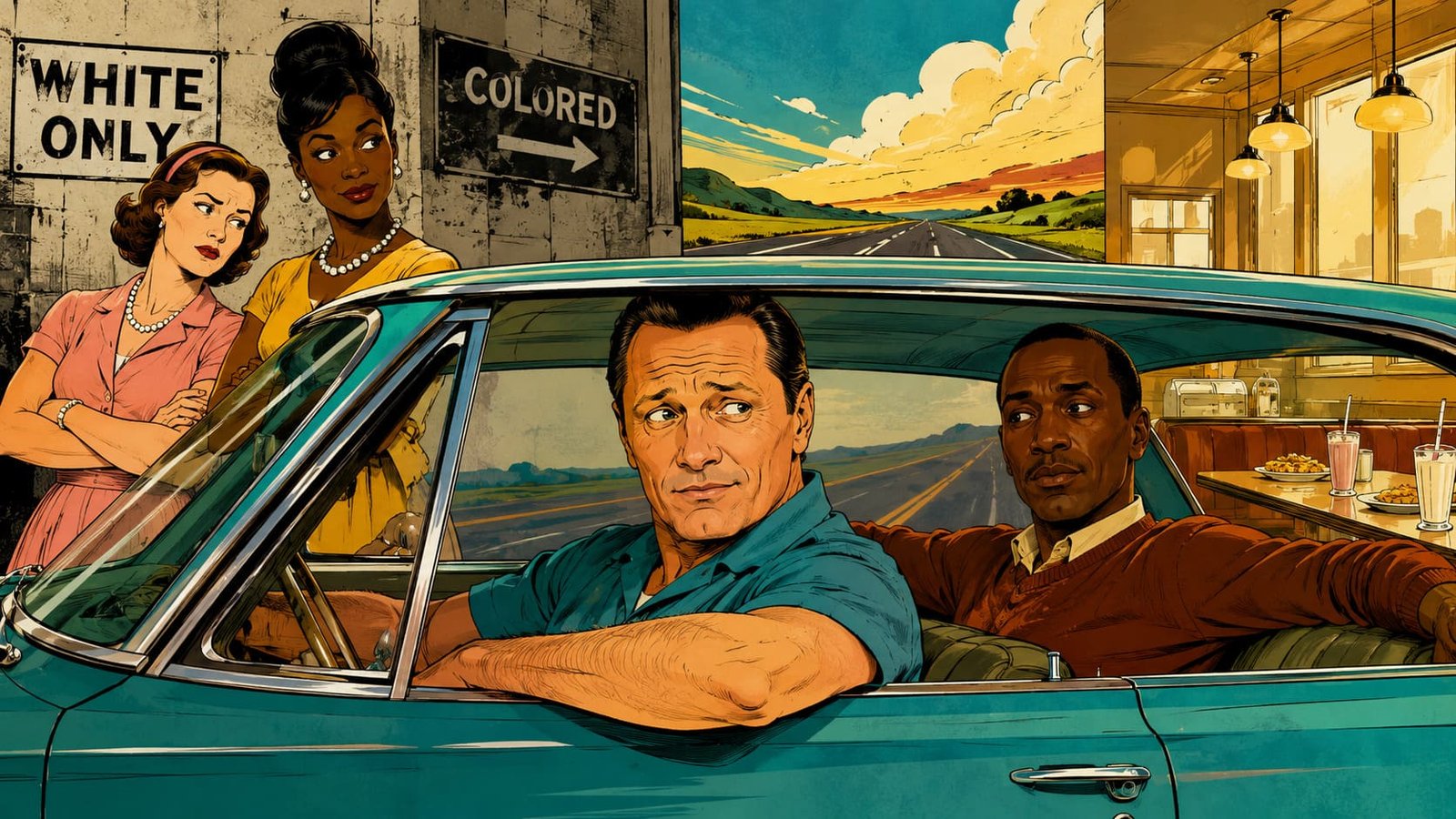
The highways of the American South stretched like long veins through a country pretending not to notice its own fractures. Neon motel signs buzzed beside diners smelling of burnt coffee and frying oil. Police cruisers lingered near empty roads with the patience of predators waiting for movement. Inside jazz clubs lit by cigarette haze and expensive whiskey, wealthy audiences applauded Black artistry while refusing Black humanity the moment the music stopped. The contradiction hung everywhere, thick as humidity. America loved performance. Equality was another matter entirely.
Green Book enters that uneasy landscape carrying charm, tension, and a surprisingly sharp understanding of social theater. Directed by Peter Farrelly, the film follows the unlikely relationship between Dr. Don Shirley, played with elegant restraint by Mahershala Ali, and Tony Vallelonga, portrayed with rough-edged warmth by Viggo Mortensen. Most road-trip stories revolve around adventure. This one revolves around recognition. That difference transforms the journey into something far more emotionally dangerous.
Dr. Shirley exists inside a painful paradox familiar to many high-achieving professionals from marginalized backgrounds. He possesses extraordinary talent, sophistication, and discipline, yet society still treats him as conditional. Admired selectively. Accepted temporarily. He can entertain elite audiences at grand venues but cannot safely eat in certain restaurants afterward. The emotional violence of that contradiction lands harder than overt cruelty because it exposes how prejudice often survives through compartmentalization. Systems allow selective inclusion while protecting deeper hierarchies underneath polished manners.
A corporate attorney in Melbourne named Farah once described attending leadership retreats where executives praised diversity publicly before confusing her repeatedly with junior staff during private dinners. One partner complimented her eloquence with genuine surprise, as though intelligence arriving through her voice disrupted some invisible expectation. Farah later admitted the exhaustion came less from obvious hostility and more from constant emotional recalibration. “It felt like being welcomed into a house while someone quietly checked whether silverware remained missing afterward,” she explained during a late train ride home. Green Book understands that emotional terrain intimately.
Tony Lip initially appears uncomplicated, almost cartoonishly blunt. Yet the film slowly reveals something deeper beneath the streetwise bravado. He survives through instinct, loyalty, and emotional directness rather than intellectual sophistication. Dr. Shirley survives through discipline, refinement, and control. Their relationship works because each man quietly envies pieces of the other’s freedom. Tony moves comfortably through ordinary social spaces. Shirley carries dignity so carefully it begins resembling armor. That emotional exchange becomes the true heart of the film. Growth happens not through moral lectures but through proximity.
The movie also slices into performative respectability with surprising intelligence. Dr. Shirley mastered elite cultural codes believing excellence might shield him from humiliation. Countless ambitious people attempt the same bargain today. Dress perfectly. Speak carefully. Achieve relentlessly. Maybe then the world grants full humanity. The tragedy is that prejudice rarely disappears through perfection. It simply becomes quieter and more sophisticated. The film captures that realization with devastating subtlety during moments when Shirley’s status evaporates instantly beneath racial boundaries no achievement can fully erase.
One memorable sequence involving rain and isolation feels almost spiritually heavy. Shirley sits suspended between worlds, too refined for stereotypes imposed upon him yet never fully embraced by the institutions benefiting from his talent. That loneliness reaches beyond race entirely. Many professionals recognize the ache of becoming psychologically homeless inside environments demanding constant adaptation. Success often requires translation. Translation eventually becomes exhausting. Green Book examines that exhaustion without losing tenderness.
A hotel owner in São Paulo named Esteban once hired a brilliant pianist from Angola to perform weekly at his rooftop lounge. Guests adored the music while repeatedly asking whether the pianist “actually lived nearby” as if artistry from certain bodies required explanation. One evening after closing, Esteban found the musician alone beside the bar staring silently into untouched wine. The pianist finally laughed bitterly and said, “People applaud what they enjoy from you while resisting what reminds them you are human too.” That sentence echoes throughout the film like distant piano notes drifting through empty halls.
The relationship between Tony and Shirley becomes powerful precisely because neither man transforms magically into perfection. Tony retains rough prejudices and emotional impulsiveness. Shirley remains guarded and painfully isolated. Yet gradual understanding emerges through ordinary moments: shared meals, roadside conversations, awkward silences, mutual frustration. Hollywood often exaggerates transformation through dramatic speeches. Real change usually arrives more quietly. Through repeated exposure. Through inconvenient empathy. Through realizing another person’s private fears resemble your own more than expected.
The film’s title itself carries symbolic weight. The “Green Book” functioned as a survival guide for Black travelers navigating segregated America. That detail sharpens the movie’s broader commentary on systems. Entire communities historically required parallel infrastructures simply to move safely through societies publicly claiming freedom and equality. The emotional implications remain relevant far beyond the historical setting. Many marginalized groups still operate with invisible mental guidebooks today, constantly calculating safety, perception, and belonging inside spaces not fully designed for them.
As the story reaches its final emotional crescendo, snowy streets glow softly beneath holiday lights while loneliness lingers quietly behind polished doors and expensive clothing. Somewhere another accomplished person sits at a crowded table feeling strangely unseen despite applause surrounding them. Green Book leaves behind a realization both comforting and unsettling: human beings rarely dismantle prejudice through ideology alone. More often, walls begin cracking when people finally witness the private loneliness hiding behind each other’s performances. And once that recognition arrives, even the longest roads start feeling less divided than before.
Editorial Disclaimer: Whether a film is rooted in fiction or inspired by real events, the actions, decisions, and behaviors portrayed within are not intended to be encouraged, replicated, or endorsed in real-world settings. This review exists solely to analyze the storytelling, characters, themes, and business dynamics presented in the film for educational, analytical, and entertainment purposes. Any ethical or unethical conduct depicted in the film does not reflect the views, values, or endorsements of ESYRITE.
