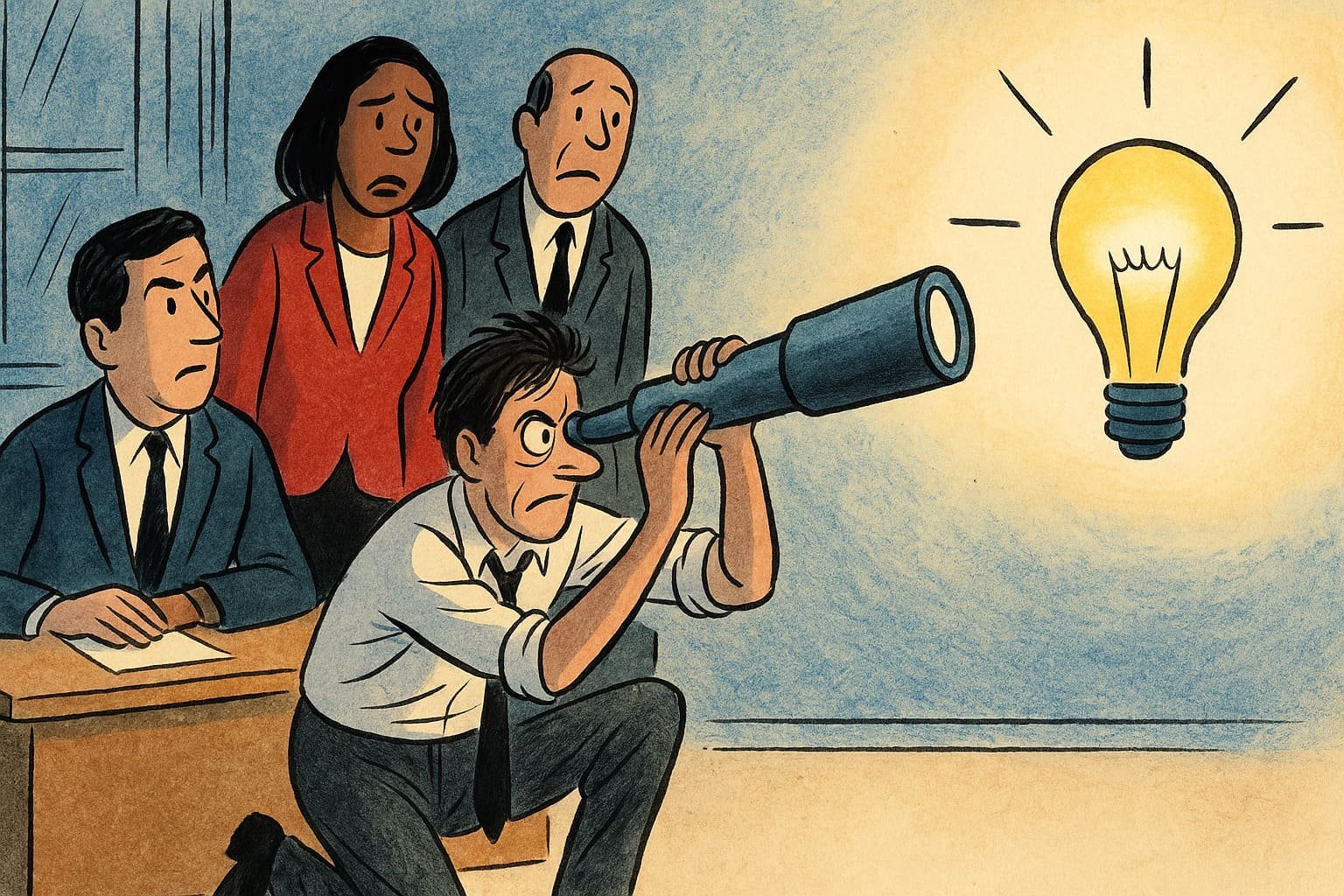
Every legendary company begins with someone who sees what everyone else dismisses. That gift has built industries, changed economies, and transformed ordinary lives. Yet the same quality that sparks innovation can quietly become its greatest threat. Vision, left unchecked, slowly hardens into certainty. Doubt disappears. Questions become inconvenient. Reality starts bending around belief instead of the other way around. The business world celebrates visionary founders, but history repeatedly shows that obsession, when mistaken for leadership, has destroyed companies just as spectacularly as it has created them.
Founders often carry an emotional connection to their ideas that employees, investors, and customers simply cannot share. That passion fuels resilience through rejection and uncertainty. It keeps businesses alive during difficult seasons. The danger appears when conviction becomes immune to evidence. Customer feedback is dismissed as ignorance. Advisors are labeled negative. Market signals are ignored because they contradict the founder’s personal narrative. At that point, leadership stops serving the business. The business begins serving the founder’s ego instead.
The rise and fall of WeWork revealed how powerful vision can become when disciplined governance begins to fade. Founder Adam Neumann inspired investors with an ambitious story about reinventing work itself rather than simply leasing office space. The vision attracted extraordinary confidence and enormous investment. Yet the company expanded faster than its business fundamentals could support. Eventually, operational reality caught up with inspirational storytelling. Charisma could no longer compensate for weak financial discipline and strategic overreach.
A different lesson emerged from Intel during periods of intense technological competition. Strong leadership encouraged bold thinking while remaining deeply committed to engineering rigor, customer needs, and measurable performance. Vision remained important, but data retained the final vote. Great companies understand that ambition and accountability must coexist. Innovation grows stronger when challenged by evidence instead of protected from it. Healthy disagreement often prevents expensive mistakes long before they appear on financial statements.
Consider Olivia, the founder of a rapidly growing education technology company. Her original platform helped teachers simplify lesson planning, and customers loved it. Success encouraged bigger dreams. Soon she insisted on adding virtual reality, artificial intelligence, cryptocurrency payments, and social networking into a single product. Engineers raised concerns. Teachers pleaded for simplicity. Olivia refused to listen because she believed customers simply could not see the future. Months later, frustrated users abandoned the platform while a smaller competitor succeeded by solving one problem exceptionally well instead of ten problems poorly.
Business strategy rewards clarity more than complexity. The strongest founders understand that saying no can be more valuable than saying yes. Every new feature, expansion plan, acquisition, or ambitious promise carries hidden costs. Strategic discipline requires protecting focus even when exciting opportunities appear everywhere. Vision should illuminate priorities rather than multiply distractions. Companies rarely collapse because they dreamed too boldly. More often, they collapse because they tried to chase every dream simultaneously without mastering the one that mattered most.
The healthiest organizations build systems capable of questioning even their most celebrated leaders. Independent boards, honest executives, empowered employees, and engaged customers all provide valuable friction. That friction may feel uncomfortable, but it protects organizations from drifting into dangerous certainty. Strong founders welcome thoughtful resistance because they understand that disagreement strengthens ideas. Weak founders confuse agreement with loyalty and criticism with betrayal. History consistently rewards the leaders who remain teachable after becoming successful.
Every founder faces a quiet crossroads that rarely appears in business textbooks. One path leads toward greater curiosity, stronger listening, and wiser leadership. The other slowly replaces learning with personal mythology. One builds institutions that outlive their creators. The other creates empires balanced upon a single personality. Markets eventually expose the difference with remarkable honesty. The greatest vision is not the one that refuses to change. It is the one courageous enough to evolve before reality forces it to.
