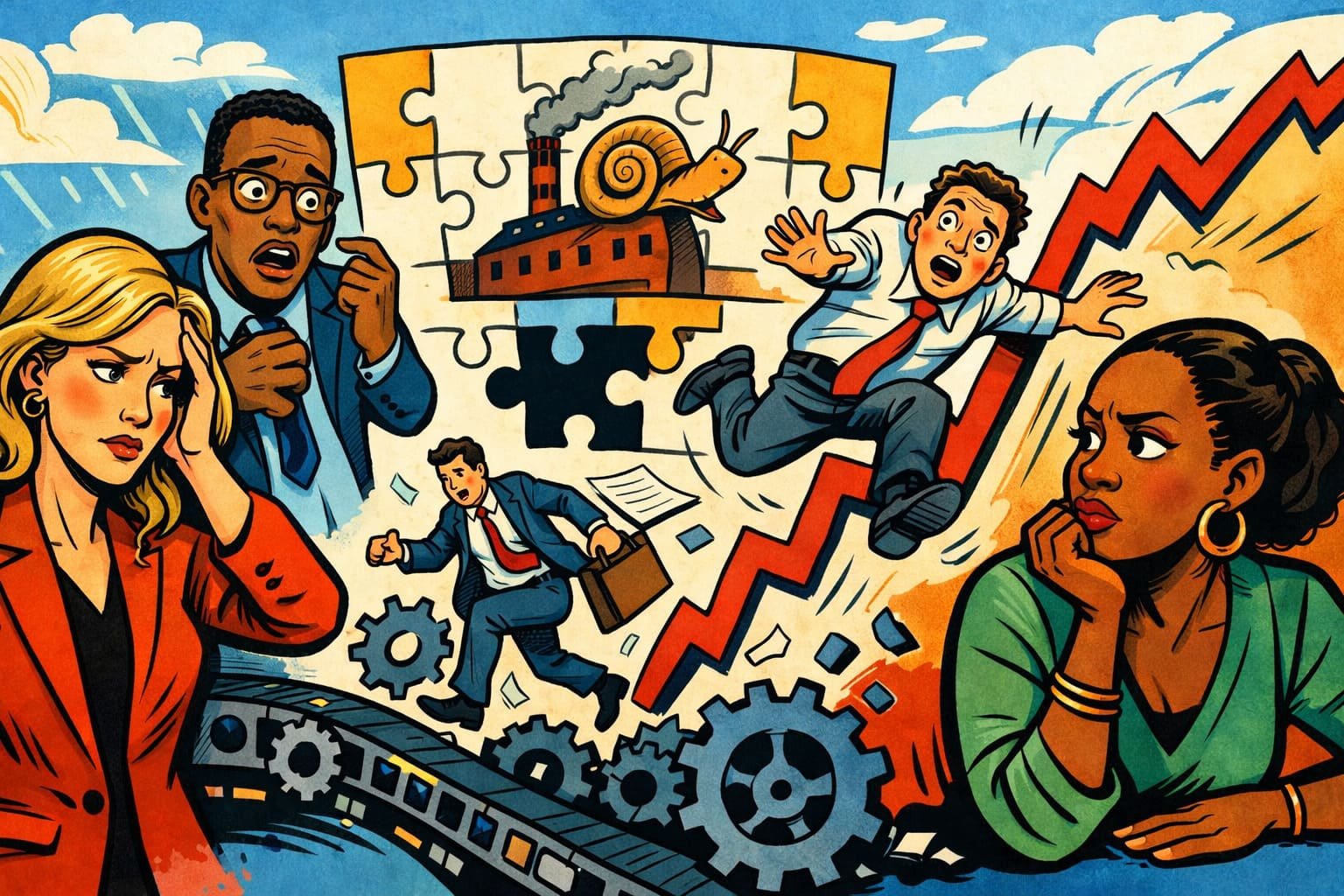
Rows of polished desks glow beneath immaculate office lights while dashboards pulse with cheerful shades of green. Meetings begin on time, inboxes overflow, and keyboards click with determined rhythm. Everything looks productive. Yet executives scanning quarterly reports often discover a stubborn contradiction hiding beneath the activity. Hours have multiplied, software has improved, and collaboration has accelerated, but meaningful output refuses to keep pace, leaving businesses wondering why busier workplaces increasingly struggle to produce proportionate economic value.
For decades, economists expected investment, innovation, and education to translate into steadily rising productivity. Reality has proved more complicated. New tools frequently require costly adjustment periods before measurable gains appear, while organizations wrestle with fragmented workflows, duplicated effort, and expanding administrative demands. Employees often spend valuable time coordinating work rather than completing it. Productivity therefore depends less on how many hours people contribute than on how effectively systems convert effort into lasting economic outcomes.
Major companies have confronted this challenge from different directions. Microsoft has highlighted how endless meetings, constant notifications, and fragmented attention quietly erode effectiveness despite sophisticated workplace technology. Toyota, by contrast, built its reputation through disciplined operational improvement, removing unnecessary steps before introducing additional complexity. Those contrasting examples reveal an uncomfortable lesson. Competitive advantage rarely comes from acquiring more tools alone. It emerges from eliminating friction that prevents talented people from focusing on work that genuinely creates value.
Victor managed operations for a growing manufacturing supplier that proudly invested in modern software across every department. Months later, production teams still worked late into the evening because employees now spent additional hours updating multiple systems describing identical tasks. One technician joked that he produced almost as many reports as finished products. Everyone laughed because the observation felt painfully accurate. Efficiency had expanded on paper while daily work became strangely heavier.
Financial statements eventually expose these hidden inefficiencies with remarkable honesty. Businesses experiencing stagnant productivity often encounter rising labor costs without matching improvements in revenue or profitability. Investors begin questioning capital allocation, while executives search for explanations that extend beyond workforce performance alone. Economists continue debating whether productivity growth has permanently slowed or merely paused during another period of technological transition. Either possibility carries profound implications for wages, inflation, living standards, and long-term economic expansion because sustained prosperity ultimately depends upon producing greater value from available resources.
Late evening settles across quiet offices where glowing monitors outnumber conversations, leaving only the faint hum of machines filling the space. Progress has never been measured by motion alone. Civilizations advanced because they learned how to transform ordinary effort into extraordinary results with greater precision and purpose. Businesses facing today’s productivity puzzle may discover that genuine breakthroughs arrive not after adding another layer of complexity, but after rediscovering the forgotten elegance of simplicity. That realization could become the most valuable investment of all.
