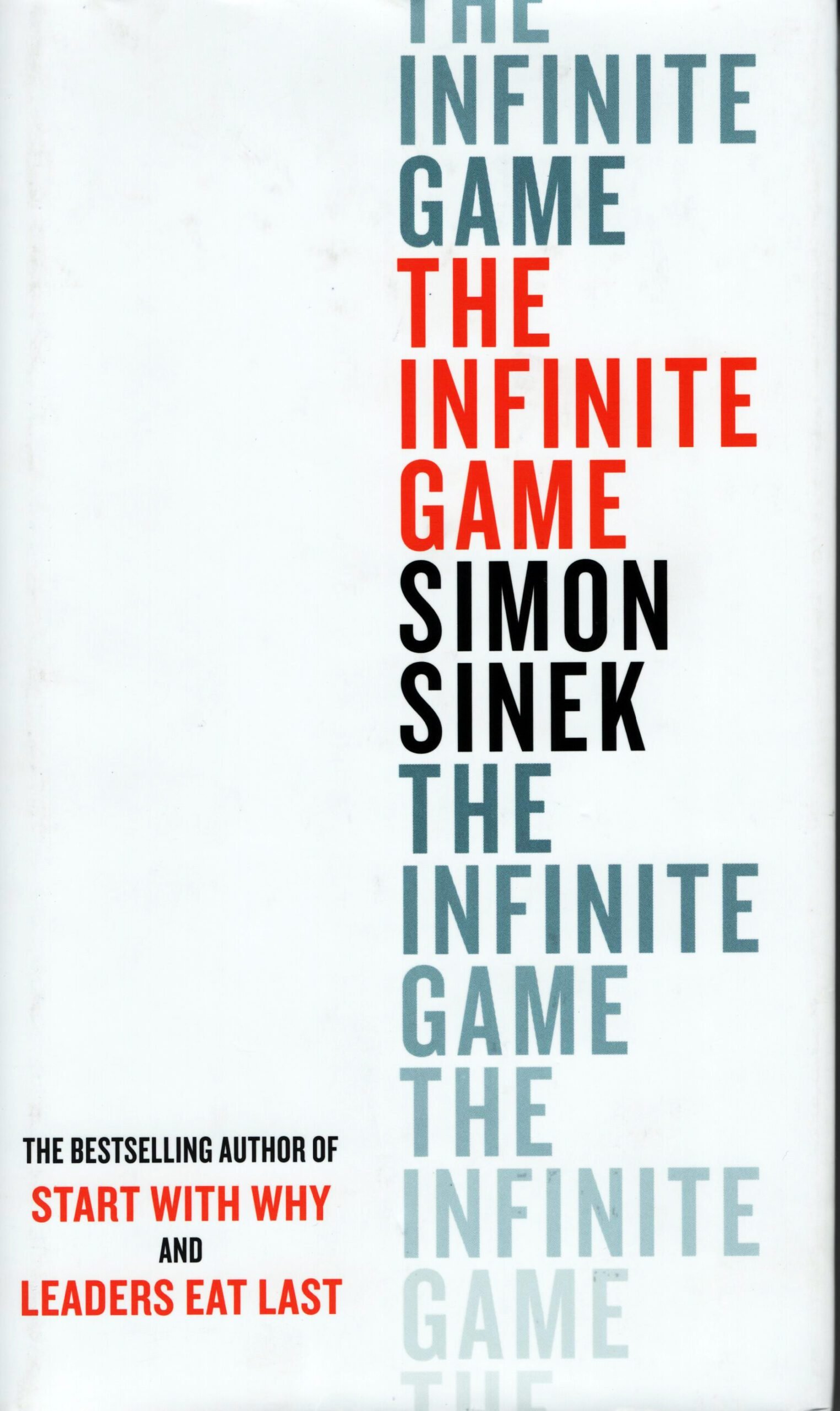
Rain hammered softly against the glass walls of an airport lounge while exhausted executives refreshed stock prices with the ritual intensity of gamblers checking horse races at dawn. Somewhere nearby, a founder rehearsed a keynote speech about innovation while quietly wondering whether success had made life larger or merely louder. In The Infinite Game, Simon Sinek steps directly into that psychological storm and asks a question most modern institutions spend enormous energy avoiding: what if the obsession with winning is precisely what destroys great organizations over time?
The book feels less like a conventional business manual and more like a controlled detonation beneath performance culture itself. Sinek argues that many leaders operate inside “finite games,” chasing short-term victories, quarterly dominance, public applause, and symbolic superiority. Yet the most enduring institutions think differently. They understand business, leadership, culture, and even civilization itself as infinite systems. There is no final scoreboard. No permanent champion. No lasting moment where history politely announces the game has been won forever. That shift sounds philosophical at first. Then it starts feeling uncomfortably personal. Entire careers collapse because people mistake temporary metrics for lasting meaning.
A shipping entrepreneur named Idris Varela once transformed a regional freight company into one of the fastest-growing logistics firms along the Mediterranean coast. Investors celebrated him relentlessly. Industry magazines praised his aggressive expansion strategy. Employees quietly burned out behind polished press releases and motivational town halls filled with rehearsed optimism. During one winter retreat in Lisbon, Idris admitted privately to a senior advisor that he no longer recognized the company culture he once loved building. Growth had become addictive. Competitors became enemies. Teams stopped experimenting because fear of losing momentum infected every meeting. Months later he abandoned a lucrative acquisition opportunity and rebuilt the company around sustainability, staff autonomy, and slower expansion. Rivals mocked the decision initially. Years later most of those rivals disappeared. Sinek’s core argument breathes inside stories like that. Survival often belongs to organizations willing to sacrifice ego for endurance.
The brilliance of the book sits inside its understanding of emotional atmosphere. Many leadership books discuss strategy while ignoring psychological weather entirely. The Infinite Game recognizes culture is not decorative. It is operational. Fear changes decision-making. Insecurity distorts ethics. Short-term pressure narrows imagination until organizations become emotionally incapable of long-range thinking. Sinek repeatedly returns to the idea of “just cause,” a purpose larger than immediate profit. Critics sometimes dismiss such language as corporate idealism. Yet the deeper point feels brutally practical. Human beings eventually exhaust themselves working solely for extraction. Teams need orientation, not merely compensation. Even elite athletes break mentally when competition loses emotional meaning beyond survival.
A creative director named Mireya Solberg once joined a celebrated streaming startup during its explosive rise. The office looked like a sci-fi utopia designed by exhausted billionaires trying to cosplay rebellion. Neon slogans covered concrete walls. Employees received luxury perks and endless productivity rituals disguised as empowerment. Yet every conversation revolved around growth metrics. Every failed experiment triggered subtle punishment. Mireya recalled hearing one engineer whisper in the bathroom that the company no longer felt like a mission. It felt like “a casino wearing sneakers.” That line lingers because it captures something modern culture rarely admits openly. Institutions obsessed with endless winning often become emotionally hollow long before they become financially unstable.
Sinek’s treatment of ethical leadership becomes especially sharp when discussing “ethical fading,” the process through which ambitious organizations slowly normalize compromise. The book quietly dismantles the fantasy that corruption begins dramatically. It usually begins with pressure. A manipulated report here. A hidden concern there. Public relations replaces introspection. Eventually people stop asking whether decisions are right and start asking whether consequences are manageable. The pattern echoes across politics, technology, finance, media, and entertainment. Watching certain companies implode over recent decades suddenly feels less surprising through Sinek’s framework. The issue was never intelligence alone. It was orientation. Organizations pointed entirely toward victory eventually lose the ability to distinguish conquest from self-destruction.
There is also something strangely tender beneath the book’s strategic language. Sinek writes like someone deeply aware that many ambitious people feel emotionally stranded inside modern work culture. Promotions arrive yet fulfillment remains delayed. Teams achieve targets while trust quietly erodes. Leaders project confidence while privately carrying exhaustion thick as wet concrete. The Infinite Game speaks directly into that contradiction. It suggests longevity belongs not to the loudest organization but to the most adaptive, emotionally resilient, and purpose-oriented one. That insight feels almost rebellious in a digital economy addicted to speed, virality, and domination theater.
A restaurateur named Hana Okafor once inherited a struggling hospitality group after her father’s sudden illness. Advisors urged immediate cost-cutting and aggressive expansion into luxury markets. Instead Hana spent months speaking quietly with cooks, cleaners, waiters, and reception staff across the company. One elderly chef confessed he stayed only because the restaurants once felt like family gatherings rather than transactional machines. Hana rebuilt the business around employee dignity, slower growth, and local partnerships. Profit rose gradually. Staff turnover collapsed. Guests returned repeatedly because the atmosphere carried warmth impossible to fake through branding alone. Hana later described leadership as “protecting the emotional architecture people live inside.” That sentence could sit comfortably beside Sinek’s central philosophy.
Near midnight, long after conference lights fade and motivational slogans disappear from glowing presentation screens, another exhausted executive still stares at a city skyline wondering why success feels strangely temporary once achieved. Somewhere else, a smaller company survives quietly because trust inside the room matters more than applause outside it. Coffee cools beside unfinished strategy documents. Elevators hum softly through corporate towers built to outlast the people inside them. That is where The Infinite Game leaves its mark. Not as a simplistic manifesto against ambition, but as a haunting reminder that civilizations, organizations, and human beings collapse the moment they confuse winning with meaning. The scoreboard eventually resets for everyone. The deeper question is whether the people left standing still remember why the game mattered in the first place.
Editorial Disclaimer: Whether a book is a work of fiction, a memoir, or inspired by real events, the ideas, actions, decisions, and behaviors discussed within are not intended to be encouraged, replicated, or endorsed in real-world situations. This review is published solely for educational, analytical, literary, and entertainment purposes, with the aim of examining the book’s themes, storytelling, characters, philosophies, and broader cultural or business insights. Any ethical or unethical viewpoints, practices, or conduct presented in the book do not necessarily reflect the views, values, or endorsements of ESYRITE.
