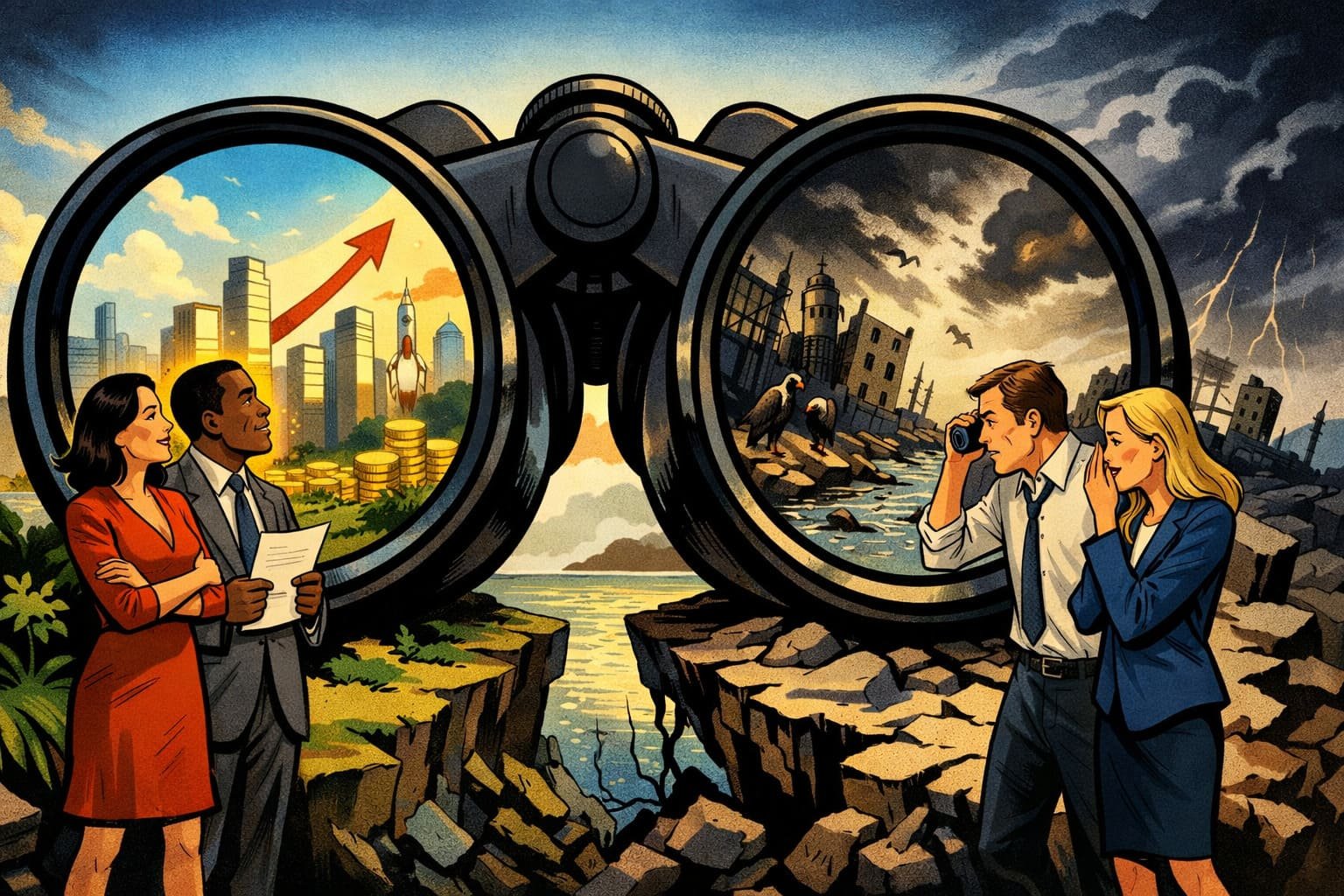
The room looked expensive enough to hide a bad idea for years. Glass walls, brushed steel, neat bottles of water arranged like stage props, and a screen glowing with the sort of polished slides that make weak thinking look respectable. A leadership team sat upright in designer calm, speaking in hopeful tones about growth, momentum, and opportunity. Then one question entered the room and spoiled the perfume. What if the business was not strong, only flattered?
That is the cruelty of business life. A company can look busy, admired, and well-branded while quietly rotting in a few crucial places. The website gleams. The team posts celebration photos. Customers still arrive. Revenue still flickers. Yet beneath the applause, something awkward waits in silence: a brittle culture, a weak margin, an overreliance on one big client, a product nobody would miss if a better option appeared on Tuesday morning. Most businesses do not collapse because the market is evil. They collapse because nobody wanted to say the obvious thing out loud.
This is why SWOT analysis still matters, even after years of being dismissed as classroom furniture. People mock it because it looks simple. Simplicity, in business, often gets mistaken for childishness. Yet a clean framework can be more dangerous than a sophisticated model because it leaves fewer places to hide. Strengths, weaknesses, opportunities, threats. That is not just a tidy acronym. That is a truth machine when used honestly.
The companies that ignore this kind of self-examination usually do so for emotional reasons, not intellectual ones. Strengths are easy to praise. Opportunities are fun to imagine. Weaknesses feel insulting, and threats feel like rain on the investor parade. So people soften the language, delay the meeting, or replace diagnosis with motivational theater. That is how businesses become museums to their own self-image.
This article goes straight at that problem. You are about to see why SWOT still works, why leaders misuse it, why self-awareness beats hype, and why the companies that thrive are often the ones willing to stare hardest at the parts that make them wince. A business does not become stronger by acting confident in public. It becomes stronger by telling itself the truth in private.
Quick Notes
1. SWOT is not old-fashioned because it is simple. It is timeless because most leaders still hate honest mirrors.
2. Strengths mean very little when a company keeps falling in love with them. Weaknesses are often the part of the business secretly writing the future.
3. Opportunities look glamorous, but threats usually deserve more respect. A business often dies from what it dismissed as background noise.
4. The value of SWOT is not in filling the boxes. The value is in naming the truth without perfume, excuses, or office theater.
5. The businesses that survive longest are rarely the most self-congratulatory. They are the ones willing to bruise their own ego before the market does it for them.
Strengths Can Make You Arrogant Before They Make You Rich
You are told to build on your strengths, and that is good advice until it becomes a religion. A company with a real advantage should absolutely lean into it. The problem begins when a strength turns into a bedtime story the business repeats to avoid new thinking. That is how once-useful assets become little shrines to past relevance.
BlackBerry is still one of the cleanest warnings in business memory. Its strengths were real, secure messaging, loyal enterprise users, hardware credibility, a strong foothold in executive culture. Those assets gave it genuine power. They also gave it false comfort. By the time the smartphone market changed shape, those same strengths had become blinders.
You see smaller versions of this every day. A company has great customer service, so it neglects product innovation. A founder has exceptional sales instincts, so systems stay messy because charm keeps patching the cracks. A family-owned brand has heritage, so it assumes customers will keep caring simply because the brand has been around longer than their favorite playlist. Strengths are useful, but they can also become sedatives.
A food manufacturer named Elias built a respected regional brand around trust and consistency. Buyers loved the reliable quality, and retailers praised the company’s reputation. That success became a trap. Younger consumers began shifting toward newer packaging, fresher formats, and brands that spoke their language with more energy. Elias kept saying, almost tenderly, “People know us.” They did know the brand. They just did not reach for it anymore. Familiarity had become a wall, not a moat.
That is why real SWOT work treats strengths with suspicion as well as pride. You do not just ask what you do well. You ask whether that strength still matters, whether competitors can copy it, whether customers still care, and whether the team is using it as a reason to avoid discomfort. A strength without scrutiny is just confidence with better lighting.
Weaknesses Whisper Before They Start Shouting
Weaknesses rarely enter the building like villains. They arrive looking manageable, even boring. A little staff turnover here. A messy reporting line there. One product delay, one bad hire, one customer segment doing too much of the lifting. None of it feels cinematic. That is exactly why it is dangerous.
You know this pattern because business failure often begins as administrative irritation. The founder keeps approving everything personally because trust is thin. The margins are tighter than people admit, but everyone says scale will fix it. The top salesperson is carrying the whole quarter on tired shoulders and passive aggression. The marketing team is measuring attention while finance is begging for profitability. Each weakness looks survivable alone. Together, they become a quiet landslide.
Kodak carried this problem with tragic elegance. It was not blind because it lacked technology. It was blind because its internal weakness was strategic courage. The company could see the future and still hesitate because protecting the old engine felt safer than disrupting itself. That is a textbook weakness, not technical ignorance, but emotional reluctance dressed as prudence.
Njeri ran a fast-growing home décor startup that looked glamorous online. Customers loved the style, influencers posted the products, and the brand carried that intoxicating digital sheen that makes founders feel they are starring in their own documentary. Underneath, the business depended on one operations manager who knew every supplier, every delay pattern, every hidden workaround. When that manager left after months of exhaustion, the whole machine began to cough. Orders slipped, customer complaints rose, and the beautiful brand suddenly sounded like a panic room. The weakness had been there all along, tapping the glass.
This is where SWOT becomes painful and useful. Weaknesses are not moral failings. They are structural truths. A mature business does not hide them out of embarrassment. It names them, prioritizes them, and either fixes them or redesigns around them. The market is brutally efficient at punishing what leaders are too polite to confront.
Opportunities Seduce, but Not All of Them Love You Back
Opportunities are the most flirtatious part of the framework. They sparkle. They flatter ambition. They sound excellent in planning retreats and investor updates. New markets, new products, partnerships, media attention, category expansion, all of it arrives with a shiny grin. The trouble is that opportunity can become a socially acceptable form of distraction.
You have probably watched this happen in real time. A solid company starts chasing adjacent markets before mastering its core. A founder sees a trend on social media and suddenly wants to pivot the whole business by Thursday. A profitable service firm starts dreaming of an app because the culture treats software like a holy upgrade. Opportunity, when misread, becomes the fastest route to strategic confusion.
Yahoo had opportunities most companies would trade a kidney to get. Search, media, email, advertising, partnerships, acquisitions, cultural relevance, brand recognition. Yet abundance became part of the problem. Too many open doors can make a leadership team wander like tourists in its own building. Opportunity without disciplined selection is just noise wearing luxury fabric.
A transport-tech founder named Leila faced a subtler version. Her platform had built a strong foothold serving independent delivery fleets. Then fresh interest came from e-commerce, healthcare, food distribution, and municipal logistics. The inbox felt like destiny. Her team wanted to grab everything. Leila forced a miserable month of prioritization, chose the two segments with the clearest fit, and let the rest go cold. It felt like rejecting popularity. It turned out to be the reason the company stayed coherent enough to scale.
That is the contrarian truth many leaders resist. Not every opportunity is a gift. Some are bait with better branding. SWOT only helps when you stop treating “opportunity” as a compliment and start testing it against fit, timing, capability, and cost. A beautiful possibility can still wreck a business if it pulls the company away from what actually works.
Threats Are Boring Until They Start Taking Names
Threats are where executive optimism often goes to do its finest pretending. People do not like lingering on what could harm them. It feels negative, defensive, even paranoid. So threats get watered down into vague phrases, market changes, new competitors, evolving customer behavior, regulatory shifts. Language becomes soft right where clarity should sharpen. That is how danger stays comfortably abstract until it turns personal.
Netflix was once treated as a curiosity by Blockbuster, which should now be studied as a cautionary tale and a comedy with terrible consequences. The threat was visible. Consumer behavior was shifting, digital distribution was not a passing phase, convenience was becoming a weapon. Still, the old model carried enough weight to make the threat feel negotiable. It was not.
Threats today move faster because the channels are faster. One creator can reshape taste. One startup can strip away an old advantage. One policy change can turn a profitable model into a legal headache. One category shift can make your beloved brand feel like a fax machine in the age of voice notes. That speed makes threat analysis less optional than ever.
A cosmetics company called Solmere discovered this with almost theatrical cruelty. The brand had strong repeat customers and a warm retail presence. Then a wave of digitally native rivals arrived with sharper storytelling, faster product cycles, and communities that behaved less like shoppers and more like fandoms. Solmere’s executives kept describing the newcomers as “niche noise.” Six months later, retailers were reallocating shelf space, younger customers were drifting, and the old confidence had curdled into emergency workshops. The threat was not sudden. The acknowledgment was.
A serious SWOT exercise forces you to stop using calming language for dangerous realities. Threats should be named like storms, not like meeting topics. Which competitor can undercut you. Which trend can age you. Which regulation can squeeze you. Which customer shift can make your current strength irrelevant. Businesses do not need to fear everything. They do need to stop speaking about obvious risk as if it were a passing mood.
The Real Power of SWOT Is Not Analysis, It Is Honesty
Plenty of teams fill out SWOT grids and change nothing. They treat the exercise like a professional ritual, the corporate equivalent of chopping herbs you never cook. The workshop happens. People nod. Sticky notes bloom across the wall like confetti. Then everyone returns to the same priorities, the same blind spots, the same polished lie that the company is basically fine. That is not strategy. That is decorative self-awareness.
The framework only becomes powerful when honesty outranks comfort. That means the founder has to hear things that bruise the ego. It means the senior team has to admit that a beloved initiative is weak, that a celebrated strength is fading, or that a threat once mocked is now sitting at the table. Good SWOT work is less like brainstorming and more like cross-examination.
Intel’s long history of hard strategic resets offers a useful reference point. The business has gone through shifts, stumbles, and pressure points, yet one lesson remains relevant: companies stay alive when they are willing to confront unpleasant truths before pride hardens around them. Reinvention always begins with an unsentimental read of current reality. You cannot pivot from a fantasy.
A founder named Mateo brought in his department heads for what they assumed would be another cheerful planning session. Instead, he opened with a question that landed like a dropped tray in a quiet restaurant: “If a ruthless buyer examined this company today, what would they call fragile?” The room changed. People stopped performing optimism. The operations lead admitted the reporting stack was unreliable. Sales confessed too much revenue came from relationships rather than process. Marketing acknowledged that awareness was being mistaken for loyalty. The meeting felt terrible. It was probably the best one they held all year.
That is why SWOT still deserves respect. It is not powerful because it is clever. It is powerful because it is blunt. In a culture where companies spend absurd energy curating their image, a framework that drags reality into the light is still worth more than the trendiest strategic jargon on the market.
The Truth Has Teeth
By the end of a long quarter, the office always reveals itself in strange ways. The air-conditioning hum turns accusatory, the carpet smells faintly tired, and the reflection in the dark window makes everyone look like a witness in a case they did not expect to testify in. That is usually when the truth becomes impossible to ignore. Not because it arrived suddenly, but because denial finally ran out of elegant clothing.
A business, seen clearly enough, is never just a machine for profit. It is a portrait of what its leaders are willing to face. Some companies prefer compliments and drift gently toward irrelevance with polished shoes and immaculate branding. Others choose a harsher gift. They let truth into the room early, even when it embarrasses them, even when it spoils the mood, even when it forces a painful change before the public notices anything is wrong.
That is the deeper lesson inside SWOT. Strengths show what can be sharpened. Weaknesses reveal what can wound from within. Opportunities tempt the ambitious. Threats stalk the complacent. The framework works because it maps the business the way life often maps character, through gifts, defects, openings, and danger. Strip away the acronym and it still reads like a human story.
The entrepreneur, from a distance, looks less like a hero and more like a person standing before a merciless mirror with no flattering angle left. That image matters because business failure is rarely just about markets. It is about self-deception, avoidance, vanity, and the old human habit of preferring pleasant stories over exact ones. A company can survive bad luck. It usually cannot survive a leadership team committed to fantasy.
So here is the question that matters when the room goes quiet and the mirror stops being kind: are you brave enough to learn what your business really is before the market tells you with a knife?