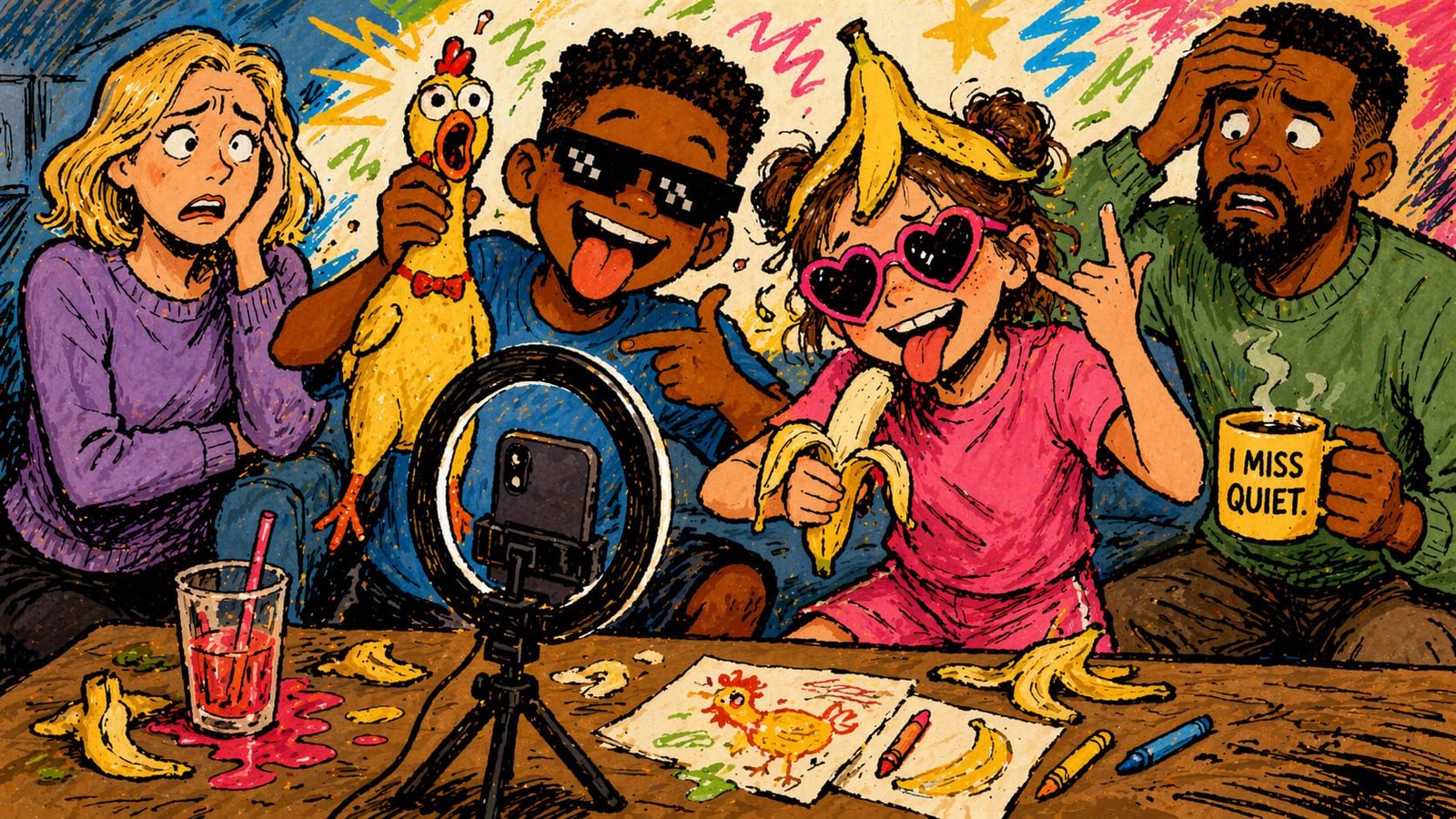
The feed scrolls too fast to question itself. A dancing chicken appears beside a looping banana, a fragment of a song repeats until it becomes rhythm rather than meaning, comments flood in with phrases that feel both absurd and strangely familiar. Nothing connects in a logical way, yet everything feels oddly coherent. It is noise that behaves like language.
What looks like nonsense at first glance begins to reveal a pattern. The internet, at its most chaotic, mirrors something older than technology. It echoes the way children play with words, sounds, and images before they learn to organize them into structure. Meaning is secondary. Expression comes first.
This is not a regression. It is a response. As digital spaces become more saturated with information, clarity begins to lose its advantage. Complexity overwhelms. Attention fragments. In that environment, absurdity becomes efficient. It cuts through noise not by explaining, but by surprising.
A content creator named Jules built a following by leaning into this chaos. Short clips that made little sense individually began to form a recognizable style. Followers described the content as “feeling right” even when they could not explain why. Jules once admitted that the goal was not to communicate clearly, but to trigger a reaction that felt immediate and instinctive.
The shift reflects a deeper tension between logic and emotion. Traditional communication relies on coherence, structure, progression. The chaotic style bypasses that entirely. It operates on rhythm, repetition, and visual impact. It feels closer to instinct than to analysis.
Pop culture has always flirted with absurdity, but the current form feels more pervasive. Memes evolve rapidly, often losing their original meaning within days. What remains is a kind of shared recognition, a sense that others understand the reference even if it cannot be fully articulated.
A teacher named Marco noticed this shift while observing his students. Their conversations often included fragments of online content that seemed disconnected from context. Yet within their group, the meaning was clear. He realized that communication had become more about participation than explanation.
There is also an element of relief in this chaos. In a world that demands constant clarity and performance, nonsense offers a kind of freedom. It allows expression without the pressure of precision. It creates space where being understood is less important than being felt.
Still, the pattern raises questions. When communication drifts away from meaning, what anchors it? When shared language becomes increasingly abstract, how do people maintain deeper understanding? The chaos feels playful, but it also hints at something more fragile.
Late at night, as the screen continues to refresh with images that blur into one another, a quiet awareness begins to surface. The content entertains, distracts, connects, yet it rarely settles into something lasting. It moves quickly, leaving only impressions behind.
And the question lingers, almost like an echo of the noise itself: if language becomes pure reaction, what happens to the part of us that needs to be understood?
