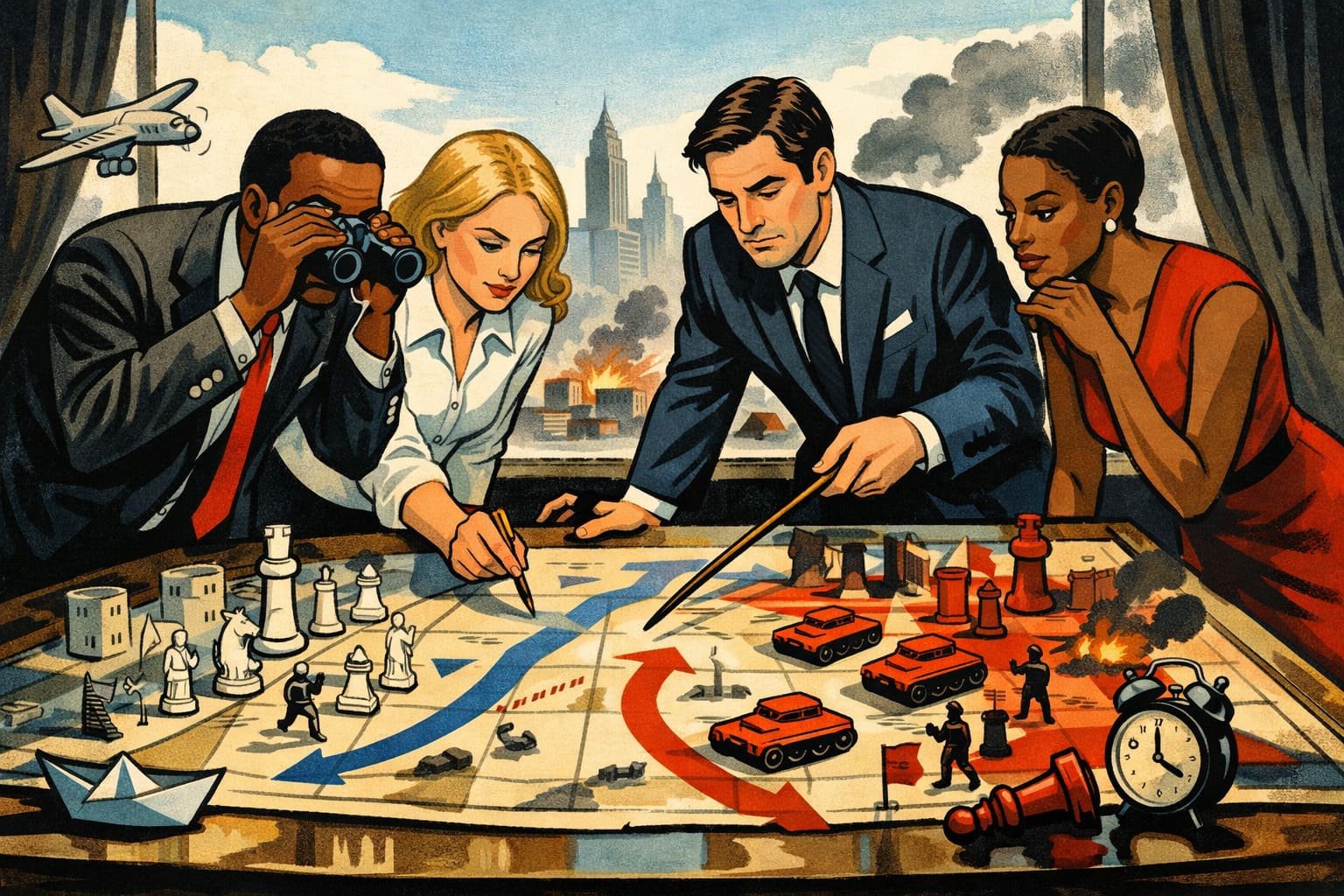
The screens were glowing before dawn, casting that pale electric light that makes every face look guilty. A leadership team sat around a polished table, ties loosened, coffee cooling, each person pretending the numbers on the screen were still a passing inconvenience. Outside, the city looked innocent enough, all glass and traffic and neat little routines. Inside, the room had the mood of a submarine taking on water. No alarms were ringing yet. That was the problem.
A business rarely dies at the moment of impact. It dies in the breath before impact, when people confuse motion with thought and urgency with intelligence. That is how companies stumble into self-inflicted chaos. A bad quarter arrives, a competitor launches something ugly and effective, a regulator clears its throat, a supply chain hiccup becomes a full-body shiver, and suddenly grown adults with expensive titles start making decisions like contestants in a game show. Strategy gets shoved aside. Panic grabs the wheel.
That pattern is older than modern commerce, and uglier because it keeps wearing new outfits. Nokia had scale and market presence, yet failed to respond with the clarity the smartphone age demanded. Blockbuster watched Netflix step onto the stage and kept acting like the curtains would close on the internet out of politeness. WeWork became a parade float for ambition without operational discipline, a reminder that charisma can intoxicate a market while strategy quietly leaves through the back door. The point is not that these organizations lacked smart people. The point is that intelligence without strategy becomes noise under pressure.
Every leader says planning matters, the way people say sleep matters right before checking email at midnight. The real test comes when conditions turn hostile. That is when strategy stops sounding like a tidy management word and starts looking like armor, navigation, memory, and nerve. In calm seasons, planning can seem slow. In rough seasons, it becomes the only thing standing between a company and a theatrical collapse.
This article goes after that truth without flinching. You are about to see why strategy is not paperwork, why reactive leadership is expensive, why panic multiplies dumb decisions, and why the most formidable companies look calm not because they feel safe, but because they planned before the room got hot. The winners in business are not always the fastest or loudest. More often, they are the ones who have already rehearsed the fire before the first spark.
Quick Notes
1. Strategy is not a deck, a retreat, or a slogan whispered over catered lunch. It is the hard choice you make before chaos gives you worse options.
2. Panic feels productive because it is loud. Planning feels boring because it is quiet. The market punishes the first and quietly rewards the second.
3. Strong leaders do not wait for certainty. They build scenarios, define priorities, and prepare for ugly weather while the sky still looks polite.
4. Companies crack when they confuse fast reactions with good judgment. Frenzy is not the same thing as momentum, even if the group chat says otherwise.
5. A real strategy lets you walk into a messy quarter with steady hands, cold eyes, and enough nerve to let other people exhaust themselves first.
Strategy Is Boring Until It Saves Your Skin
You live in a business culture that loves theatrics. Product launches get treated like movie premieres. Funding rounds become coronations. Founders start sounding like prophets after one strong year. Strategy, by contrast, often enters the room wearing plain shoes and carrying a spreadsheet. That is one reason people neglect it. It does not flatter the ego in public.
Yet strategy is what keeps drama from becoming destiny. It forces you to decide what matters before pressure scrambles your judgment. It asks uncomfortable questions while there is still time to answer them cleanly. Which customers matter most. Which markets are distractions. Which bets are worth starving other projects to feed. Without those decisions made early, every problem turns into a referendum on the whole company.
Amazon’s long history of disciplined expansion offers a clue here. For all the mythology around scale and ambition, the business repeatedly showed something simpler beneath the spectacle, patient prioritization. Distribution, infrastructure, customer obsession, cloud capability, logistics advantage, these were not improvised during a bad week. They were built through long-range thinking that looked excessive until the rest of the market caught up. Strategy often looks paranoid right before it looks brilliant.
A founder named Daria learned this while running an industrial supply company that served construction firms across three cities. Her competitors kept chasing every possible customer, grabbing flashy contracts that looked good on social media and bled cash in private. She chose a less glamorous path, narrower sectors, tighter service standards, and a brutal filter for clients who paid late or demanded chaos. When the market tightened, her rivals were sprinting through smoke, while her company kept moving with the dull confidence of a train on fixed rails. Her staff still hated the discipline meetings. They loved the payroll arriving on time.
The seductive lie in modern business is that spontaneity is genius. Sometimes it is. Most of the time, it is just unpreparedness wearing cologne. Strategy feels slow because it asks you to think in advance, and advance thinking is not glamorous in a culture drunk on improvisation. Still, when the floor starts shaking, the boring map becomes more valuable than the charismatic speech.
Panic Is a Bad CEO With Great PR
Panic has terrific branding. It arrives dressed as urgency, concern, decisiveness, action. It fills inboxes, lights up chat threads, produces emergency meetings, and makes everyone feel as though something serious is happening. That feeling can be intoxicating. It is also one of the fastest ways to destroy judgment.
You have probably seen this play out in ordinary office life. A sales dip appears, and suddenly prices are slashed without a long-term view. A rival introduces a new feature, and the product team is told to copy it by Friday. One angry customer post goes viral, and leadership begins rewriting the brand voice before lunch. These are not strategic moves. They are nervous twitches performed by people who cannot bear the emotional discomfort of waiting long enough to think.
The pandemic exposed this difference with ruthless clarity. Some companies froze, flailed, or made symbolic gestures that looked busy and solved nothing. Others adapted with remarkable steadiness because they returned to first principles, cash discipline, customer communication, operational flexibility, and scenario planning. The businesses that handled the shock best were not always the biggest. They were often the clearest.
Ravi, who managed a mid-sized hospitality group, faced that kind of test when bookings started disappearing like lights going out floor by floor. One executive wanted aggressive discounts. Another wanted layoffs by the weekend. A third wanted a cheerful rebrand, as if a new font could negotiate with reality. Ravi shut the room down, asked for a forty-eight-hour planning sprint, and built decisions around liquidity, customer trust, and phased recovery rather than fear. The room hated the pause. The pause saved the business.
Panic works like bad caffeine. It makes the pulse race, sharpens the voice, and tricks the body into thinking speed equals strength. In business, that illusion can be lethal. The loudest room is often the least intelligent room, especially when everyone is trying to prove they are taking the crisis seriously. Strategy is quieter because it knows volume is not competence.
The Best Plans Are Built Before Anyone Feels Afraid
The strange thing about planning is that it often feels hardest when business looks easiest. Growth is coming in, customers are happy, investors are smiling, and nobody wants to darken the mood by asking what could go wrong. That is exactly when serious leaders begin their real work. Calm is the cheapest time to think.
A good strategic plan does not predict one future. It prepares you for several. It identifies the pressure points that could snap first. It clarifies what you will protect, what you will cut, what you will delay, and what you will fight to keep alive. This is less like fortune telling and more like building exits in a crowded theater before anyone smells smoke.
Intel’s older playbook in moments of technological transition showed how this mindset can matter. The company did not survive repeated industry shifts by relying on good vibes and historical prestige. It survived by wrestling early with hard technical and market choices, sometimes painfully, sometimes imperfectly, but with the understanding that the future does not send a polite calendar invitation. Strategic planning in volatile sectors is not a luxury. It is a survival ritual.
Mara, who led a fast-rising home goods brand, kept one ritual her team mocked until they needed it. Every quarter, she ran a session called “What breaks first?” It sounded gloomy. It felt awkward. People rolled their eyes and checked their phones. Then freight costs jumped, a major influencer partnership collapsed, and a supplier delayed a flagship line. Because those exact problems had been gamed out earlier, the team moved with unnerving calm. Backup suppliers were already warm, messaging had already been drafted, and capital had been protected for exactly that kind of ugly surprise. What looked paranoid in spring felt prophetic by autumn.
Planning before fear arrives is one of the least theatrical forms of courage. It means you are willing to sound cautious in rooms addicted to optimism. It means you care more about resilience than applause. It means you are not building a business that survives only in perfect weather, which is useful, because perfect weather has a very poor attendance record.
Strategy Means Choosing, and Choosing Means Offending Someone
This is where many companies lose their nerve. Strategy sounds elegant until it requires subtraction. Then the room changes temperature. If you truly have a strategy, you are saying no to something attractive. You are declining a shiny market, postponing a pet project, ignoring a loud customer segment, or letting a fashionable trend pass by without chasing it. That restraint can feel almost rude in a culture that praises endless opportunity.
You cannot be strategically serious while trying to please every stakeholder every week. The minute you attempt that, strategy dissolves into negotiation theater. A plan becomes a collage of compromises, and the business starts drifting toward whatever is loudest, newest, or emotionally hardest to refuse. Clarity requires friction. Someone always feels left out.
Apple’s history under Steve Jobs still gets cited for good reason, not because it was perfect, but because it dramatized the force of ruthless selection. Product focus was not an aesthetic preference. It was a competitive weapon. Cutting distractions sharpened talent, capital, messaging, and customer understanding into something far more dangerous than a broad menu of confused offerings. You do not build legendary products by treating every idea like a sacred child.
Amina ran a growing education platform that had begun attracting everyone, parents, schools, tutors, nonprofits, corporate training units, even event organizers who wanted to piggyback on the brand. Her team was thrilled by the attention and wanted to build for all of it. She chose one lane, career mobility for early professionals, and killed or parked almost everything else. It felt brutal. One teammate accused her of thinking too small. A year later, the company owned a sharper identity, stronger economics, and a clearer message than several broader rivals who had stretched themselves into mush.
That is the hidden violence inside good strategy. It slices away the flattering options so the essential path can breathe. Many leaders want a strategy that feels expansive and kind. Markets rarely reward kindness in that form. They reward coherence. They reward the company that knows what it is not willing to be.
When Strategy Becomes Culture, Panic Loses Its Stage
A strategy document can sit in a folder and do nothing. A real strategy lives in how people behave when nobody has time for a meeting. It shapes what gets escalated, what gets ignored, how trade-offs are judged, how risk is discussed, and how a team speaks when pressure hits. That is when planning stops being an executive performance and becomes an organizational reflex.
Culture is often discussed with the sort of vague tenderness usually reserved for candles and playlists. In practice, culture is much harder and more revealing. It is the repeated pattern of decisions under stress. A company with strategic culture does not become fearless. It becomes legible to itself. People know what matters, what wins arguments, and what principles survive when the quarter gets ugly.
Toyota’s reputation for operational discipline, despite setbacks and painful lessons over the years, was built on that kind of embedded thinking. Systems, routines, learning loops, problem visibility, these are not glamorous words, but they create a business that does not need to invent maturity during a crisis. Mature behavior has already been rehearsed into the bones. That is why some companies look calm under pressure. Calm, in those cases, is not personality. It is process.
Jonas led a payments company where every setback used to trigger drama. Slack channels turned into digital stampedes. Product blamed marketing. Marketing blamed sales. Sales blamed the market, which was a creative choice. After a bruising year, he rebuilt the operating rhythm around a few hard strategic principles, customer trust first, margin discipline second, selective expansion third. Six months later, a fraud scare hit the business. The difference was immediate. Nobody performed panic. Teams worked the plan. The crisis was still painful, but it was no longer chaotic.
That is the final operational edge strategy gives you. It does not erase uncertainty. It stops uncertainty from turning your people into improvising strangers. Once the culture learns how to think, panic loses much of its glamour. The company may still sweat, but it no longer thrashes.
The Map Under the Skin
Past midnight, the war room always looks more honest. The polish has worn off, the air tastes faintly metallic, the screen light is cruel, and every face reveals the private math of responsibility. Somewhere in that stale hour, a leader learns the difference between pressure and collapse. Pressure asks what you prepared. Collapse exposes that you prepared nothing at all.
Across industries, the same private drama keeps unfolding. The companies that survive hard turns are not always the ones with the most money, the brightest talent, or the loudest public myth. They are the ones that built a map early enough for it to sink beneath the skin. When chaos comes, they do not need to invent themselves in public. They simply follow what was already decided in quieter rooms.
That is why strategy feels almost philosophical in the end. It is a way of refusing to let fear write your story for you. It is a declaration that your business will not be dragged around by every tremor, every rival headline, every nervous impulse in the executive bloodstream. In a culture obsessed with reaction, that kind of restraint looks almost rebellious.
The entrepreneur, seen from a distance, stops resembling a hero with a microphone and starts looking like something older and stranger, a keeper of direction in a world addicted to drift. Not grand. Not glamorous. Just steady in the moments when steadiness costs the most. That image lingers because it reaches past business and into character. A plan is not just a tool. It is a form of moral discipline under fluorescent light.
So before the next shock hits, before the next ugly headline, before the next meeting where everyone talks faster than they think, answer this without flinching: when the room heats up, will you have a strategy, or only adrenaline?