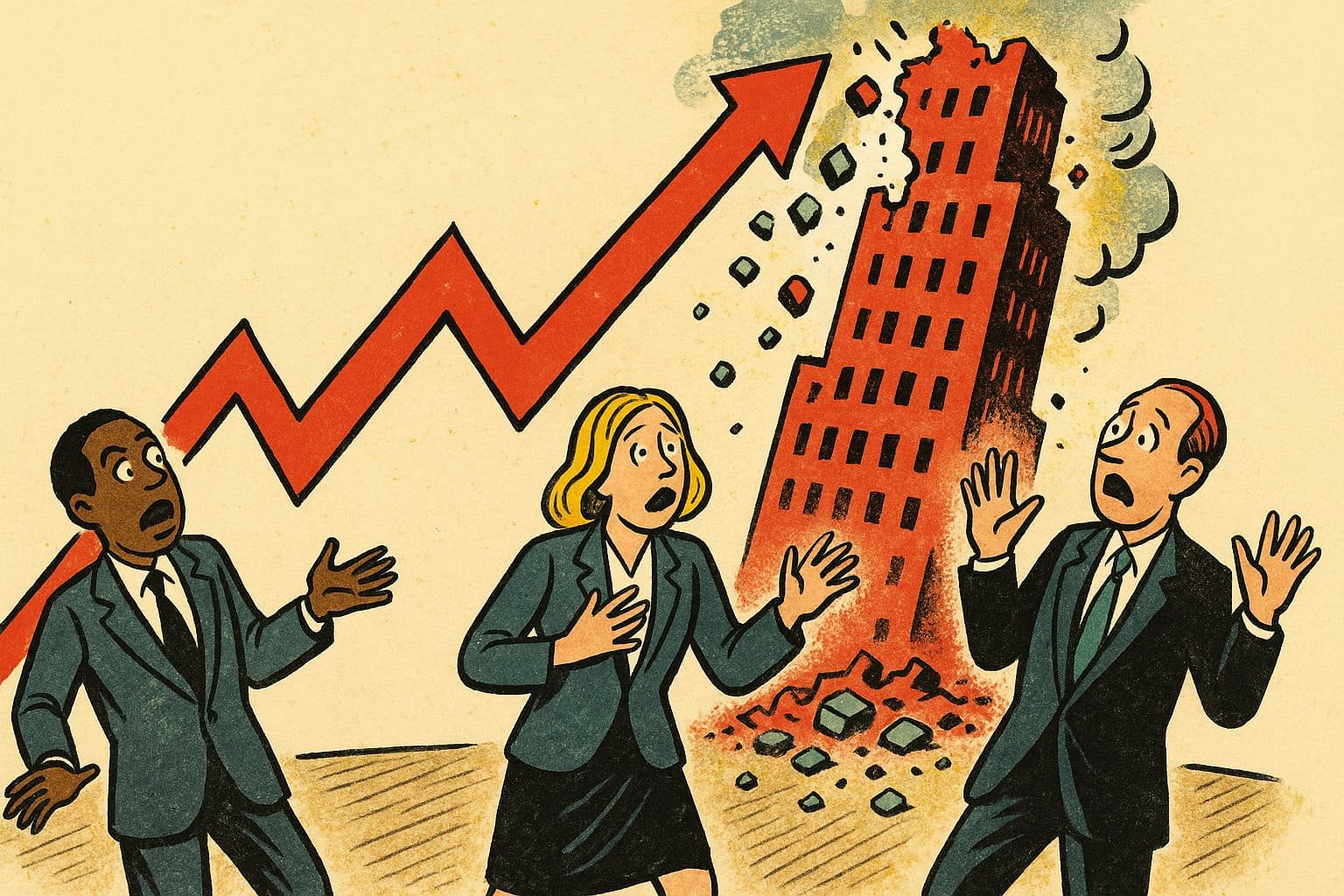
Spotlights blaze across a glass tower at midnight, where champagne spills over a deal just closed. Laughter echoes off marble floors, the air thick with bravado and the promise of endless profit. Somewhere on a conference table, a screen flashes the latest sales figures, each one a badge of pride for executives who measure worth in vertical lines and hockey-stick charts. Beneath their feet, janitors sweep away glittering confetti from last quarter’s celebration, already fading under the bright glare of the next big thing. No one notices the cracks in the walls—the quiet signs that all is not as solid as it seems.
At the city’s edge, an old bakery flickers under harsh fluorescent lights, the hum of machines steady and unhurried. Its owners recall the tech company that leased the corner office above them, scaling from zero to sixty in a single year before vanishing like a ghost. The bakery endures, slow and steady, its profits meager but dependable. The skyscraper next door is now half-empty, a silent monument to vanished ambition.
You can sense the tension everywhere. High-speed success stories race through social media feeds, boasting of overnight unicorns and viral apps, yet behind those stories lie cautionary tales no one wants to share. Every great boom is haunted by those left bankrupt or broken, their faith in speed shattered by reality’s slow hand.
Profit, when chased recklessly, becomes its own trap. The pursuit of rapid growth swallows up reason, blurs judgment, and lays waste to companies, families, and entire economies. Only the wise notice the warning signs in time—the subtle chill before the crash, the hollow ring behind the applause.
Tonight, a junior analyst sits alone in an office cubicle, staring at a spreadsheet that will soon cost her team their jobs. She whispers a lesson to herself, one handed down by the survivors of every bubble: “Easy come, easy go.” The city outside glitters with possibility, but every light hides a shadow.
Quick Notes
- Speed Is Seductive but Deadly: Fast profit stories excite, but behind every sprint is a graveyard of failures and regrets.
- Real Growth Needs Roots: Businesses that take time to build resilience are the only ones that weather storms.
- Pop Culture Loves the Meteor, Not the Ashes: The world obsesses over viral brands, rarely telling the story of what happens when hype collapses.
- Greed Eats Its Own: Pursuing rapid expansion can cannibalize a business’s values, culture, and long-term survival.
- True Winners Embrace Patience: Enduring organizations understand that lasting value is always slow-cooked, never microwaved.
The Velocity Trap—When Success Comes Too Fast
Rapid growth intoxicates the senses. Wall Street rewards meteoric charts with front-page headlines and analyst praise, but the underlying business is rarely ready for the pace. Founders often lose their bearings, swept up in demand they can’t sustain and choices they can’t control. The world saw this with “Zoomies,” an e-commerce darling that went from garage to IPO in a year, then imploded from logistics chaos and burned-out teams.
A product manager at Zoomies, Alex Tran, remembers the adrenaline rush of their big launch. “It felt like riding a rocket, until we realized nobody knew how to land,” he later confessed to friends. Overnight, backorders, lawsuits, and plummeting morale replaced celebration. Those still standing learned that fast money makes you feel invincible, right up until it turns you into a cautionary tale.
Investors feed the cycle, blinded by fear of missing out. When a company shows explosive gains, capital floods in, expectations soar, and the boardroom fills with pressure. Critical systems, compliance, and talent development get ignored for the next growth hack. The “move fast and break things” mantra becomes literal, with the thing that breaks often being the business itself.
Social media hypes the highs. Photos of new offices, international launches, and luxury perks flood Instagram, masking the reality of 18-hour days and nervous breakdowns. The employees not featured in glossy posts are often the ones cleaning up the wreckage months later, quietly looking for a new job.
The velocity trap is simple to fall into and nearly impossible to escape. Only those who recognize the warning signs—like declining quality, chaotic communication, and growing customer complaints—can steer clear of disaster.
The Bubble Mirage—How Hype Hijacks Judgment
Speculative bubbles are the business world’s cruelest magic trick. They promise infinite returns, inviting ordinary people to dream of luxury, only to vanish in a storm of panic selling. Each generation invents its own bubble—be it dot-com stocks, meme coins, or housing bonanzas—believing this time, speed and greed will pay.
Few forget the rise and fall of “GloboTech,” a startup that grew from obscurity to billion-dollar valuation by promising the world’s smartest home robot. Investors tripped over themselves to fund expansion, but the product barely worked outside staged demos. A software engineer, Priya, recalls sitting in late-night war rooms, praying for miracles while the company spent more on marketing than fixing flaws.
During the frenzy, caution gets mocked. Critics are dismissed as dinosaurs, while skeptics face open ridicule in boardrooms and media interviews. The herd stampedes toward the hottest trends, trampling nuance and history. Each rally feels like a revolution, until the floor falls out and everyone scrambles for the exit.
Pop culture feeds the cycle. Movies like “The Wolf of Wall Street” glamorize risky bets, while influencers post viral TikToks flaunting their “millionaire status” days after investing. Underneath the surface, despair simmers as regular folks lose savings, homes, and hope.
Hype blinds people to basic math and common sense. Rational analysis becomes boring, replaced by memes, moon emojis, and empty mantras. The lesson is timeless: bubbles burst, hype fades, and the only real winners are those who left the party before the music stopped.
The Culture Crash—When Greed Destroys Trust
Ruthless growth erodes company culture from within. When profit becomes the only metric, employees become expendable and integrity gets rebranded as “inefficiency.” The inside story at “QuickMint,” a fintech that rocketed to fame before imploding, is a masterclass in the dangers of toxic speed.
Sara, a customer service lead, tells how the company’s early days felt like a family. As revenue targets soared, the founders hired aggressively, slashed training, and demanded double the output from every worker. The mission became pure profit, and once-loyal staff started to quit in droves.
Misaligned incentives led to corner-cutting. Compliance rules got ignored, creative accounting slipped through audits, and vendors complained of missed payments. QuickMint’s legal troubles soon followed, erasing years of goodwill in a handful of headlines.
Customers always notice when trust collapses. Social media exposes every failing instantly, from data leaks to rude service. Once a company loses its reputation, winning it back is nearly impossible, no matter how much money is thrown at the problem.
Greed tricks founders into believing they are building an empire, when in reality they are lighting a fuse. Culture is not a marketing campaign—it is the nervous system that keeps a business alive, and once it burns out, the body cannot recover.
Lessons from the Ruins—Why Slow Endures
For every business that soared and crashed, a quieter story of resilience endures in the background. Slow growth firms may lack viral buzz, but they weather storms and outlast competitors. Their founders reject shortcuts, choosing methodical investment and community loyalty over unsustainable expansion.
Mariah, who runs a logistics startup in Ohio, refused to “scale at all costs” after watching her friends’ companies go bankrupt chasing hypergrowth. She focused on training, customer feedback, and responsible hiring. Years later, while bigger rivals flamed out, her small team became the go-to partner for local businesses.
Academic frameworks like “The Tortoise Principle” remind leaders that compounding returns, not spikes, drive wealth over time. Warren Buffett, often quoted but rarely followed, built his fortune brick by brick, letting opportunity and patience do the heavy lifting.
Slow growth does not mean no ambition. It means relentless focus on fundamentals: quality, ethics, talent, and adaptability. Companies like Patagonia and LEGO have thrived by expanding carefully, listening to stakeholders, and making bold moves only when ready.
Resilient organizations take pride in being boring. They skip hype cycles and treat each win as provisional, never permanent. The best ones balance confidence with humility, learning from failure instead of pretending it won’t happen to them.
The ruins of fast-money empires become a roadmap for those who listen. Every collapsed unicorn teaches the same lesson: slow is smooth, smooth is fast, and only the humble survive.
Pop Culture, FOMO, and the Psychology of Ruin
Why do so many fall for the trap, even when history repeats? The answer is as much psychological as it is financial. Fear of missing out (FOMO) drives people to reckless bets, while viral stories turn caution into an old-fashioned joke.
When “BitFlip” exploded on social media, its founder, Chris Lane, was hailed as a visionary. TikTok influencers chronicled his journey from dorm room to penthouse, sparking a stampede of copycats and imitators. The pressure to “keep up” became overwhelming, fueling a surge of risky investments across the market.
Behavioral economics teaches that humans are hardwired for herd thinking. Crowds amplify optimism in good times and panic in bad. The urge to be first, best, or richest drives smart people to gamble away fortunes, chasing someone else’s dream.
Pop culture amplifies every high and ignores every low. Movies, memes, and media create “celebrity CEOs,” who appear bulletproof until scandal erupts. In the aftermath, most people forget the warning signs and prepare for the next cycle.
Resisting the profit paradox is an act of rebellion. It means choosing logic over hype, values over virality, and sanity over the crowd. Only then can you avoid being the hero of someone else’s cautionary tale.
The Empty Throne—When Profit Destroys Its Kingdom
In a cavernous, dimly lit boardroom, empty chairs surround a polished table, the ghost of last year’s dreams lingering in the silence. The air is thick with the scent of expensive leather, but every seat is cold, left behind by leaders who chased fortune too fast. Shadows flicker across portraits of founders once celebrated as geniuses, now mere footnotes in cautionary case studies. On the marble windowsill, a single wilted rose from a forgotten grand opening gathers dust, its petals darkened by the weight of time.
A janitor mops quietly under flickering lights, humming a tune that once played at a launch party filled with laughter and champagne. The screens are dark, the ticker symbols erased, the world outside moving on while profits that once seemed eternal are now ghosts in spreadsheets. In the hallway, a faded mission statement echoes with irony, promising integrity and purpose to customers who have long since stopped believing.
An accountant reviews the final numbers, lips pressed into a tight line, the ledger revealing what headlines never show: growth without roots is just a bonfire waiting for the wind. The city skyline glimmers with new towers, but the lesson in this empty room lingers longer than applause.
You can chase the world’s definition of success, but if you let speed define you, ruin will always be waiting at the finish line.